This comprehensive article compares KYO and ADA, two prominent blockchain projects with distinct market positioning. KYO is an emerging liquidity technology platform launched in 2025, featuring cross-chain solver technology and white-label DEX solutions, while ADA represents an established blockchain infrastructure since 2017. The analysis examines historical price trends, current market status, tokenomics, institutional adoption, and technical ecosystems. With KYO currently priced at $0.02541 and ADA at $0.3002, the article evaluates investment strategies across different investor profiles, price projections through 2031, and associated risks. Whether you seek emerging technology exposure or established market presence, this guide helps determine which asset aligns better with your investment objectives in the current crypto market environment.
Introduction: KYO vs ADA Investment Comparison
In the cryptocurrency market, the comparison between KYO vs ADA remains a topic investors cannot avoid. Both show notable differences in market cap ranking, application scenarios, and price performance, representing distinct positioning within the crypto asset landscape.
KYO: Launched in 2025, this comprehensive liquidity technology platform has gained market attention through its cross-chain solver technology and white-label DEX solutions, backed by notable investors including Startale and Soneium Spark Fund.
ADA: Since its 2017 launch, Cardano has positioned itself as a layered blockchain platform designed to run financial applications, becoming one of the established cryptocurrencies with substantial global trading volume.
This article will examine the investment value comparison between KYO vs ADA across historical price trends, supply mechanisms, institutional adoption, technical ecosystem, and future outlook, attempting to address investors' most pressing question:
"Which presents a more compelling opportunity in the current market environment?"
I. Historical Price Comparison and Current Market Status
KYO and ADA Historical Price Trends
- 2025: KYO experienced significant price volatility following its launch, with the token reaching a notable level of $0.4552 in December 2025. The price movement was influenced by the platform's initial market entry and early trading activity.
- 2021: ADA witnessed substantial growth during the crypto market expansion, with the price reaching $3.09 in September 2021, driven by network upgrades and increased adoption of the Cardano ecosystem.
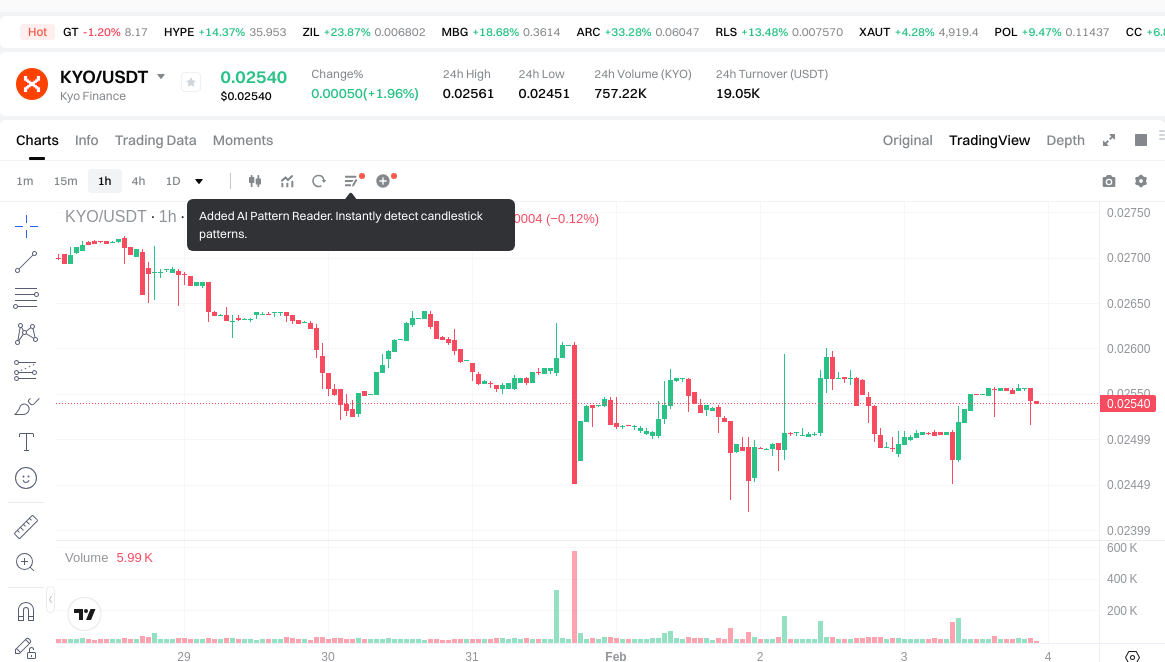
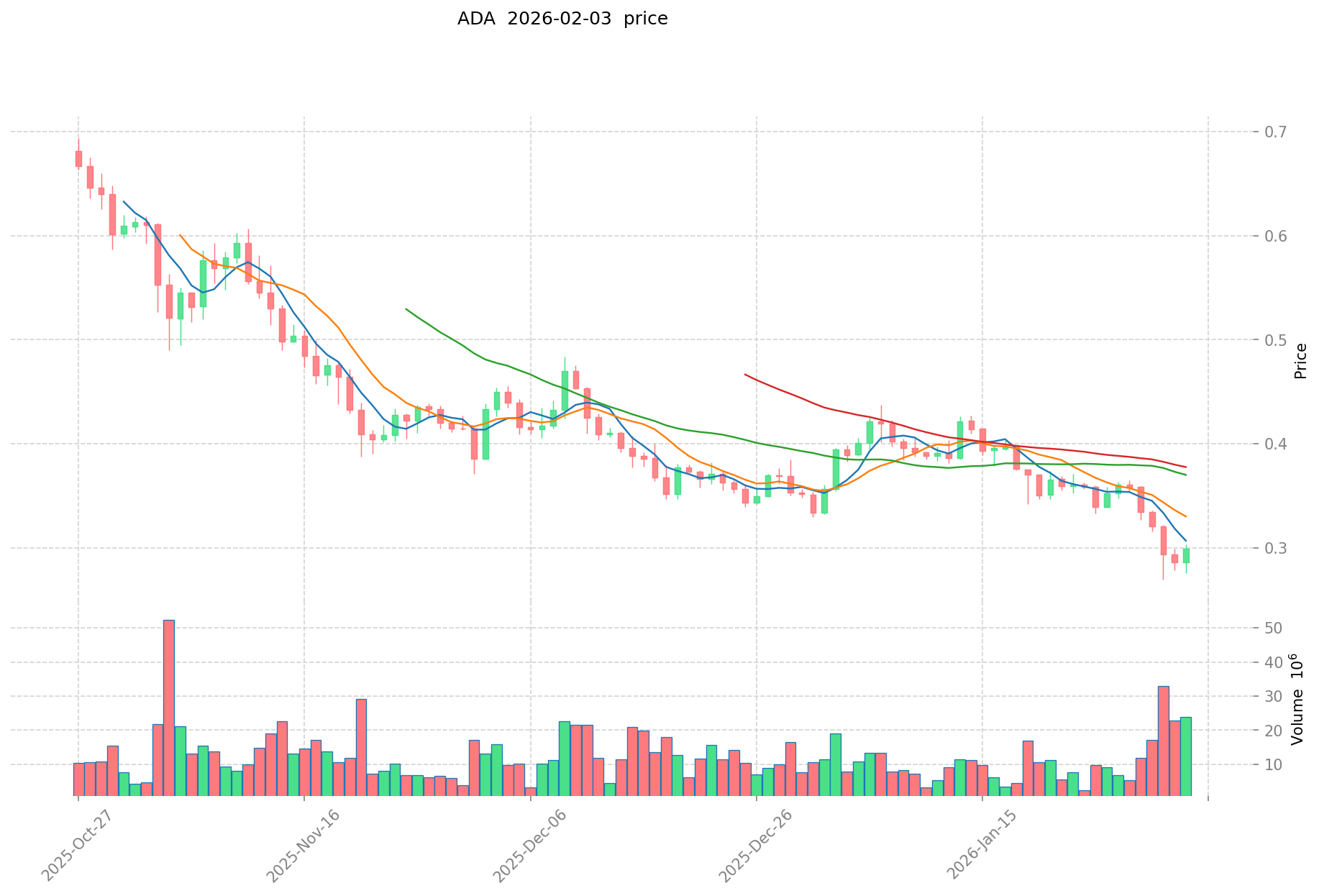
- Comparative Analysis: During recent market cycles, KYO declined from its peak of $0.4552 to a lower level of $0.0242, while ADA experienced a more prolonged correction from $3.09, reflecting broader market conditions and different project maturity stages.
Current Market Status (2026-02-03)
- KYO Current Price: $0.02541
- ADA Current Price: $0.3002
- 24-Hour Trading Volume: KYO recorded $19,071.54 compared to ADA's $3,432,669.96
- Market Sentiment Index (Fear & Greed Index): 17 (Extreme Fear)
View Real-Time Prices:
II. Core Factors Influencing KYO vs ADA Investment Value
Based on available reference materials, the provided context primarily discusses Kyo as an ABA therapy company specializing in autism treatment services rather than a crypto asset. The materials mention Kyo's focus on home and school-based therapy programs, particularly in the San Francisco Bay Area, along with references to unrelated entities such as a musician named Kyo and a character from The King of Fighters video game series.
Regarding ADA, the reference materials indicate it relates to innovative technology solutions operating in specialized markets with growing demand, though specific technical or economic details about its cryptocurrency characteristics were not provided in the context.
Supply Mechanism Comparison (Tokenomics)
The reference materials do not contain information about supply mechanisms, tokenomics models, fixed supply structures, deflationary mechanisms, or halving schedules for either KYO or ADA.
Institutional Adoption and Market Application
The available context does not provide data on institutional holdings, corporate adoption in cross-border payments or settlements, investment portfolio integration, or regulatory attitudes from different jurisdictions toward these assets.
Technical Development and Ecosystem Construction
The reference materials do not include information about technical upgrades, protocol developments, or ecosystem applications in DeFi, NFT, payments, or smart contract implementations for either asset.
Macroeconomic Factors and Market Cycles
The provided context does not contain analysis of performance during inflationary environments, responses to monetary policy changes, interest rate impacts, US dollar index correlations, or geopolitical factors affecting cross-border transaction demand for these assets.
III. 2026-2031 Price Prediction: KYO vs ADA
Short-term Forecast (2026)
- KYO: Conservative $0.0168 - $0.0254 | Optimistic $0.0254 - $0.0307
- ADA: Conservative $0.162 - $0.300 | Optimistic $0.300 - $0.423
Mid-term Forecast (2028-2029)
- KYO may enter a consolidation phase, with estimated price range of $0.0290 - $0.0398
- ADA may enter an expansion phase, with estimated price range of $0.254 - $0.630
- Key drivers: institutional capital inflows, ETF developments, ecosystem growth
Long-term Forecast (2030-2031)
- KYO: Baseline scenario $0.0286 - $0.0371 | Optimistic scenario $0.0427 - $0.0572
- ADA: Baseline scenario $0.368 - $0.542 | Optimistic scenario $0.636 - $0.910
View detailed price predictions for KYO and ADA
Disclaimer
KYO:
| Year |
Predicted High Price |
Predicted Average Price |
Predicted Low Price |
Price Change |
| 2026 |
0.030734 |
0.0254 |
0.016764 |
0 |
| 2027 |
0.03704844 |
0.028067 |
0.01712087 |
10 |
| 2028 |
0.0361390692 |
0.03255772 |
0.0289763708 |
28 |
| 2029 |
0.039844137736 |
0.0343483946 |
0.02919613541 |
35 |
| 2030 |
0.0482251460184 |
0.037096266168 |
0.03598337818296 |
45 |
| 2031 |
0.057165346164888 |
0.0426607060932 |
0.028582673082444 |
67 |
ADA:
| Year |
Predicted High Price |
Predicted Average Price |
Predicted Low Price |
Price Change |
| 2026 |
0.423 |
0.3 |
0.162 |
0 |
| 2027 |
0.531405 |
0.3615 |
0.29643 |
20 |
| 2028 |
0.459846075 |
0.4464525 |
0.263406975 |
48 |
| 2029 |
0.629877509625 |
0.4531492875 |
0.253763601 |
50 |
| 2030 |
0.731043088059375 |
0.5415133985625 |
0.3682291110225 |
80 |
| 2031 |
0.90987788793464 |
0.636278243310937 |
0.464483117616984 |
111 |
IV. Investment Strategy Comparison: KYO vs ADA
Long-term vs Short-term Investment Strategies
-
KYO: May appeal to investors with higher risk tolerance who are interested in emerging liquidity technology platforms and cross-chain solver innovations. The token's recent launch and early-stage development suggest potential for price discovery phases, though with considerable volatility.
-
ADA: May suit investors seeking exposure to established blockchain infrastructure with a longer operational history. The platform's focus on layered architecture and financial applications presents a different risk-return profile compared to newer market entrants.
Risk Management and Asset Allocation
-
Conservative Investors: A potential allocation approach could consider a heavier weighting toward more established assets with longer price history and broader market adoption, while limiting exposure to recently launched tokens.
-
Aggressive Investors: Those with higher risk appetite may consider diversified exposure across both emerging platforms and established networks, adjusting positions based on market conditions and project developments.
-
Hedging Tools: Market participants may consider stablecoin allocations for liquidity management, exploring derivative instruments where available, and maintaining diversified portfolio structures across different crypto asset categories.
V. Potential Risk Comparison
Market Risk
-
KYO: The token demonstrates notable price volatility patterns, with movement from $0.4552 to $0.0242 reflecting sensitivity to market conditions and early-stage trading dynamics. Lower 24-hour trading volume of $19,071.54 may indicate liquidity considerations for larger position management.
-
ADA: Price movements have shown correlation with broader crypto market cycles, with historical range from $3.09 to current levels. The substantially higher 24-hour trading volume of $3,432,669.96 reflects deeper market liquidity, though does not eliminate exposure to market-wide volatility.
Technical Risk
-
KYO: As a recently launched platform, considerations may include technology implementation maturity, cross-chain solver operational stability, and ecosystem development progression.
-
ADA: Technical considerations may involve protocol upgrade execution, network scalability implementation, and smart contract platform competition dynamics.
Regulatory Risk
Global regulatory developments may affect both assets differently based on their respective use cases, geographic presence, and institutional adoption levels. Market participants should monitor evolving compliance frameworks across jurisdictions where these assets are traded or utilized.
VI. Conclusion: Which Is the Better Buy?
📌 Investment Value Summary:
-
KYO Characteristics: Represents exposure to emerging liquidity technology infrastructure with cross-chain solver capabilities. Recent launch provides early-stage positioning, though accompanied by higher volatility and lower current trading volumes.
-
ADA Characteristics: Offers exposure to established blockchain infrastructure with longer operational history since 2017. Demonstrated market presence with substantial trading volumes and broader ecosystem development.
✅ Investment Considerations:
-
New Investors: May consider starting with assets that have longer price histories and deeper market liquidity, allowing for more reference points in market behavior analysis.
-
Experienced Investors: Could evaluate portfolio diversification across different project maturity stages and use cases, considering risk tolerance and investment timeframes in allocation decisions.
-
Institutional Participants: Assessment factors may include liquidity depth, regulatory clarity, operational infrastructure maturity, and alignment with institutional investment frameworks.
⚠️ Risk Notice: Cryptocurrency markets exhibit substantial volatility. This content does not constitute investment advice. Market participants should conduct independent research and consider their financial circumstances before making investment decisions.
VII. FAQ
Q1: What are the main differences between KYO and ADA in terms of market positioning?
KYO is an emerging liquidity technology platform launched in 2025 focusing on cross-chain solver technology and white-label DEX solutions, while ADA (Cardano) is an established blockchain platform launched in 2017 designed for running financial applications. The primary distinction lies in their maturity levels: KYO represents early-stage infrastructure with a current price of $0.02541 and 24-hour trading volume of $19,071.54, whereas ADA offers more established market presence with a current price of $0.3002 and substantially higher trading volume of $3,432,669.96, reflecting deeper liquidity and broader institutional adoption.
Q2: Which asset demonstrates higher price volatility?
KYO exhibits notably higher price volatility compared to ADA. Since its 2025 launch, KYO experienced significant price movement from a peak of $0.4552 in December 2025 to a low of $0.0242, representing substantial percentage fluctuations typical of newly launched tokens in early price discovery phases. ADA, while subject to crypto market cycles with historical movement from $3.09 in September 2021 to current levels, demonstrates more moderated volatility patterns associated with longer-established assets, though it remains exposed to broader market-wide price movements.
Q3: What are the projected price ranges for KYO and ADA through 2031?
Short-term (2026): KYO ranges from $0.0168-$0.0307, while ADA ranges from $0.162-$0.423. Mid-term (2028-2029): KYO may consolidate between $0.0290-$0.0398, whereas ADA could expand to $0.254-$0.630. Long-term (2030-2031): KYO baseline scenario projects $0.0286-$0.0371 (optimistic $0.0427-$0.0572), while ADA baseline scenario estimates $0.368-$0.542 (optimistic $0.636-$0.910). These projections factor in institutional capital flows, ecosystem development, and market cycle dynamics, though cryptocurrency price forecasts carry inherent uncertainty.
Q4: Which investment strategy suits different investor profiles for KYO vs ADA?
Conservative investors may consider heavier allocation toward ADA given its longer operational history, deeper liquidity, and established market presence, while limiting exposure to recently launched tokens like KYO. Aggressive investors with higher risk tolerance might explore diversified positions across both assets, with KYO offering early-stage exposure to liquidity technology platforms and ADA providing established blockchain infrastructure access. Portfolio allocation should reflect individual risk capacity, investment timeframes, and market condition assessments, with consideration for stablecoin reserves and position sizing appropriate to volatility levels.
Q5: What are the primary risk factors for investing in KYO versus ADA?
Market risks for KYO include higher price volatility from early-stage trading dynamics and lower liquidity with $19,071.54 daily volume potentially affecting larger position management. Technical risks involve technology implementation maturity and ecosystem development progression. ADA faces market risks from correlation with broader crypto cycles despite higher $3,432,669.96 trading volume, plus technical considerations around protocol upgrades and smart contract platform competition. Both assets face regulatory risks from evolving global compliance frameworks, though potentially affecting each differently based on use cases and institutional adoption levels.
Q6: How do trading volumes compare between KYO and ADA, and why does this matter?
The 24-hour trading volume comparison shows substantial disparity: KYO at $19,071.54 versus ADA at $3,432,669.96. This difference matters significantly for several reasons: higher trading volume typically indicates better liquidity for entering and exiting positions, tighter bid-ask spreads reducing transaction costs, lower slippage on larger orders, and generally more efficient price discovery mechanisms. The volume differential reflects ADA's established market presence and broader exchange listings compared to KYO's recent launch, presenting practical considerations for investors planning position sizes and execution strategies.
Q7: What factors should institutional investors prioritize when comparing KYO and ADA?
Institutional participants evaluating KYO versus ADA should prioritize liquidity depth for executing substantial positions without significant market impact, with ADA's higher trading volumes offering advantages. Regulatory clarity across operational jurisdictions affects compliance frameworks and reporting requirements. Operational infrastructure maturity influences custody solutions, trading venue availability, and integration with institutional systems. Additional considerations include historical price data availability for risk modeling, counterparty exposure in trading venues, and alignment with institutional investment mandates regarding asset maturity stages and volatility tolerance parameters.
Q8: What role does the current market sentiment play in KYO vs ADA investment decisions?
The current Fear & Greed Index reading of 17 (Extreme Fear) as of February 3, 2026, indicates significant market caution affecting both assets differently. During extreme fear periods, established assets like ADA may experience relatively more stable price floors due to stronger institutional support and broader holder bases, while newer tokens like KYO might face amplified volatility from reduced risk appetite. This environment typically favors dollar-cost averaging strategies over lump-sum investments, emphasizes importance of position sizing discipline, and suggests potential opportunity for longer-term investors willing to endure near-term volatility, though market timing remains challenging regardless of sentiment indicators.
* The information is not intended to be and does not constitute financial advice or any other recommendation of any sort offered or endorsed by Gate.