Heurist (HEU) is a decentralized AI-as-a-Service cloud platform launched in 2024 to democratize AI service accessibility and optimize distributed GPU resource utilization. Built on blockchain technology with an API-first serverless infrastructure, Heurist aggregates computing power from individual GPU owners and data centers, eliminating centralized control while ensuring transparency and security through cryptographic mechanisms. The platform serves developers, AI researchers, and resource providers seeking cost-efficient, censorship-resistant AI integration. As of February 2026, HEU token shows market capitalization of $1.48M with 47,505 holders across Base and zkSync Era networks, available on Gate.com and other exchanges. Despite recent price volatility reflecting market dynamics, Heurist addresses critical challenges in scaling decentralized GPU networks while advancing accessible AI infrastructure adoption through strategic ecosystem development and community engagement.
Heurist (HEU)'s Positioning and Significance
In 2024, Heurist's development team launched Heurist (HEU), aiming to address barriers to AI service accessibility, inefficient GPU resource utilization, and centralized control of AI infrastructure.
As a decentralized AI-as-a-Service cloud platform aggregating distributed computing resources, Heurist plays a key role in AI model deployment, serverless computing, and decentralized infrastructure.
As of 2026, Heurist has established itself as a decentralized AI infrastructure provider with an active development community.
This article will provide an in-depth analysis of its technical architecture, market performance, and future potential.
Origin and Development Journey
Background of Emergence
Heurist was created in 2024, aiming to solve limited access to AI services, inefficient use of distributed GPU resources, and lack of censorship-resistant AI infrastructure.
It emerged in the context of rapid growth in AI demand and blockchain technology maturation, with the goal of providing cost-efficient, censorship-free AI integration through serverless infrastructure to transform the current landscape.
Heurist's launch brought new possibilities to developers, AI researchers, and GPU resource owners.
Key Milestones
- December 2024: Token launched on Gate.com, expanding market accessibility.
- 2025: Platform development progressed, aggregating computing resources from individual GPU owners and data centers.
- 2026: Continued ecosystem development with API-first infrastructure enabling seamless AI service integration.
With the support of its development community and network participants, Heurist continues to optimize its technology, security, and real-world applications.
How Does Heurist Work?
No Central Control
Heurist operates on a decentralized network of computing nodes distributed globally, free from control by centralized entities.
These nodes collaborate to provide AI services, ensuring system transparency and attack resistance, granting users greater autonomy and enhancing network resilience.
Blockchain Foundation
Heurist leverages blockchain technology as a transparent, immutable foundation for its operations.
Transactions and service records are grouped into blocks, linked through cryptographic hashes to form a secure chain.
Anyone can verify records, establishing trust without intermediaries.
The platform's serverless architecture eliminates the need for developers to manage underlying GPU infrastructure.
Ensuring Fairness
Heurist utilizes a network coordination mechanism to validate service delivery and prevent fraudulent activities.
GPU resource providers maintain network security by contributing computing power and receive HEU token rewards.
Its innovation includes eliminating centralized bottlenecks and enabling cost-efficient AI service access.
Secure Transactions
Heurist employs cryptographic technology to protect transactions:
- Private keys (similar to secret passwords) are used to authorize operations
- Public keys (similar to account numbers) are used to verify ownership
This mechanism ensures asset security while transactions maintain transparency within the decentralized network.
The platform's API-first design provides developers with secure, accessible AI service integration.
Circulation Overview
As of February 2, 2026, HEU has a circulating supply of 196,088,747 tokens, with a total supply of 1,000,000,000 tokens and a maximum supply capped at 1,000,000,000 tokens. The circulating supply represents approximately 19.61% of the total supply. The token follows the ERC-20 standard and is deployed on multiple blockchain networks including Base and zkSync Era.
Price Fluctuations
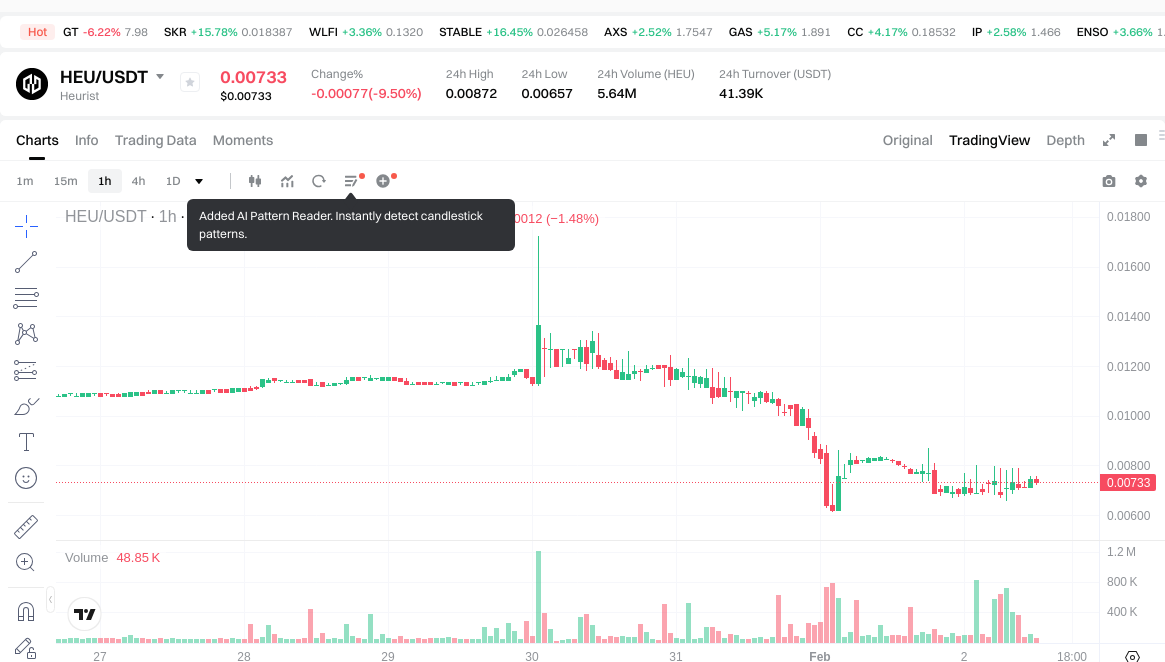
HEU reached a notable price level of $0.462 on December 28, 2024. The token experienced significant price movement during this period.
The lowest recorded price was $0.00613 on January 31, 2026, reflecting market volatility and shifts in trading sentiment. As of the latest update on February 2, 2026, HEU is trading at $0.00757, with a 24-hour trading range between $0.00657 and $0.00872.
Recent performance shows:
- 1-hour change: +3.23%
- 24-hour change: -6.54%
- 7-day change: -30.42%
- 30-day change: -32.35%
- 1-year change: -89.2%
These fluctuations reflect evolving market conditions, trading activity, and broader trends in the decentralized AI services sector.
Click to view current HEU market price
On-Chain Metrics
- Market Capitalization: $1,484,391.81
- 24-Hour Trading Volume: $41,360.02
- Fully Diluted Valuation: $7,570,000
- Holder Count: 47,505 addresses
- Listed Exchanges: Available on 4 exchanges
- Market Cap to FDV Ratio: 19.61%
Heurist Ecosystem Applications and Strategic Partners
Core Use Cases
Heurist's ecosystem supports multiple application scenarios:
- AI Services: The platform provides decentralized AI-as-a-Service, offering serverless AI infrastructure for developers without the need to manage underlying GPU resources.
- Compute Resource Aggregation: Heurist aggregates computing power from individual GPU owners and data centers, enabling cost-efficient and censorship-free AI integration through API-first infrastructure.
Strategic Collaborations
As Heurist continues to develop its decentralized AI cloud platform, strategic partnerships play a role in expanding its technical capabilities and market presence. These collaborations provide a foundation for Heurist's ecosystem growth and technological enhancement.
Challenges and Considerations
Heurist faces several challenges in its development:
- Technical Considerations: Scaling decentralized GPU networks and maintaining service quality across distributed resources
- Market Competition: Competition from other AI service providers and blockchain-based computing platforms
- Adoption Barriers: Encouraging developers to transition to decentralized AI infrastructure
These factors contribute to ongoing discussions within the community and drive continuous innovation in the platform.
Heurist's community demonstrates notable activity, with the token holding approximately 47,505 holders. The platform's focus on decentralized AI services has attracted interest from developers and GPU providers seeking alternatives to traditional cloud computing.
On X platform, sentiment regarding Heurist shows varied perspectives:
- Supporters highlight Heurist's decentralized approach to AI services and cost-effective infrastructure, viewing it as an innovative solution for AI development.
- Observers note price volatility and the early-stage nature of the platform, discussing the challenges of building decentralized AI infrastructure.
Recent trends reflect discussions around the platform's technical capabilities and market positioning.
Discussion Topics
X users engage with topics related to Heurist's decentralized GPU network, AI service accessibility, and tokenomics, exploring both the potential and challenges of decentralized AI infrastructure.
Additional Resources for Heurist
- Official Website: Visit Heurist Official Site for information on features, use cases, and latest developments.
- Whitepaper: The Heurist Whitepaper details the technical architecture, objectives, and vision for the decentralized AI cloud platform.
- X Platform: Heurist maintains an active presence on X through @heurist_ai, sharing updates on technical developments, community activities, and platform news.
Future Development Path
Heurist's development focuses on:
- Expanding the decentralized GPU network and improving AI service offerings
- Enhancing platform scalability and service reliability
- Growing the ecosystem of developers and AI applications
- Advancing the vision of accessible, censorship-free AI infrastructure
How to Participate in Heurist?
- Acquisition: HEU tokens are available on Gate.com and other supported exchanges
- Storage: Secure storage can be managed through compatible wallets supporting Base and zkSync Era networks
- Platform Usage: Developers can access Heurist's API infrastructure to integrate AI services into their applications
- Ecosystem Building: Visit the official documentation to explore development opportunities and contribute to the platform
Summary
Heurist represents an approach to AI services through decentralized infrastructure, offering serverless AI integration, cost efficiency, and censorship resistance. The platform aggregates GPU resources from individual owners and data centers, creating an alternative to traditional cloud AI services.
With an active community of approximately 47,505 holders and presence on Base and zkSync Era networks, Heurist demonstrates interest in decentralized AI solutions. The project addresses challenges including scaling distributed GPU networks, ensuring service quality, and driving developer adoption.
As the platform continues development, Heurist's API-first infrastructure and focus on accessible AI services position it within the evolving landscape of decentralized computing. Whether you are a developer seeking AI integration options or interested in decentralized infrastructure, Heurist offers a perspective worth exploring.
FAQ
What is HEU cryptocurrency and what does it do?
HEU is a cryptocurrency launched in 2024 on the Ethereum platform supporting Heurist AI, an artificial intelligence project. It has a total supply of 1 billion tokens designed to power AI-driven applications and services within the Heurist ecosystem.
How can I buy and store HEU tokens?
You can purchase HEU tokens on cryptocurrency exchanges or decentralized exchanges (DEX) using credit cards, bank transfers, or other payment methods. After purchase, store them securely in a Web3 wallet or hardware wallet for safekeeping.
What are the main risks and security considerations for HEU?
HEU's primary risks include proliferation concerns and theft vulnerability due to its high enrichment level. Security breaches could compromise nuclear material safety. Robust safeguards and secure storage are essential to mitigate these threats.
How does HEU differ from other cryptocurrencies?
HEU distinguishes itself through AI-as-a-Service integration and advanced nuclear fuel cycle technology applications. Launched in 2024, HEU offers innovative infrastructure solutions unlike traditional cryptocurrencies, focusing on practical enterprise adoption.
What is the current market price and trading volume of HEU?
HEU currently has a 24-hour trading volume of $123,967.60 and a market cap of $1.70 million. For real-time pricing, please check current market data on major cryptocurrency platforms.
* The information is not intended to be and does not constitute financial advice or any other recommendation of any sort offered or endorsed by Gate.