ParallelAI (PAI) is a decentralized AI computing platform launched in 2024 to address GPU bottlenecks and high computational costs in AI development. As an innovative blockchain-integrated infrastructure, PAI enables developers to access distributed GPU resources without centralized intermediaries, democratizing AI computation globally. The platform operates on blockchain technology, utilizing the $PAI token for transparent resource allocation and governance. With 10,724 token holders as of February 2026, ParallelAI demonstrates growing adoption. The ecosystem supports decentralized AI computation and blockchain integration through parallel processing optimization. While facing market volatility and competitive pressures, PAI's mission to provide cost-effective, transparent computational infrastructure positions it as a significant project at the intersection of AI and blockchain technology. This guide explores its architecture, market performance, ecosystem applications, and investment potential.
ParallelAI's Positioning and Significance
In 2024, the ParallelAI team launched ParallelAI (PAI), aiming to address GPU bottlenecks and high computational costs in AI development.
As an innovative decentralized AI computing platform, ParallelAI plays a key role in AI development and blockchain integration.
As of 2026, ParallelAI has established itself as a notable project bridging AI and blockchain ecosystems, with over 10,724 token holders and an active developer community.
This article will provide an in-depth analysis of its technical architecture, market performance, and future potential.
Origin and Development History
Birth Background
ParallelAI was created by its founding team in 2024, aiming to solve GPU resource scarcity and cost barriers that limit AI development scalability.
It emerged in the era of rapid AI advancement and blockchain adoption, with the goal of democratizing access to computational resources through decentralized infrastructure.
ParallelAI's launch brought new possibilities for AI developers and blockchain innovators worldwide.
Key Milestones
- September 2024: Token launch on Gate.com, establishing market presence in the AI-blockchain sector.
- December 2024: Price reached an all-time high of $1.518, reflecting strong initial market interest.
- Early 2025: Platform development progressed, focusing on parallel processing solutions for GPU optimization.
- 2026: Continued ecosystem expansion with transparent, cost-effective infrastructure for global developers.
With community and development team support, ParallelAI continues to refine its technology, security features, and real-world applications.
How ParallelAI Works?
Decentralized Infrastructure
ParallelAI operates on a decentralized network that connects distributed computational resources globally, removing dependence on centralized cloud providers.
This network enables developers to access GPU power without intermediaries, ensuring greater autonomy and improved resource efficiency.
Blockchain Foundation
ParallelAI utilizes blockchain technology as a transparent, immutable ledger for tracking computational resource allocation and token transactions.
Transactions are grouped into blocks and cryptographically linked to form a secure chain.
Anyone can verify records without intermediaries, establishing trust through transparency.
The platform integrates AI and blockchain ecosystems to unlock previously untapped global computational capacity.
Token Economics
ParallelAI employs the $PAI token as the core economic mechanism within its ecosystem.
Token holders participate in resource allocation and platform governance, facilitating transparent cost structures and efficient GPU utilization.
The platform's innovative approach includes parallel processing optimization that reduces computational overhead.
Secure Operations
ParallelAI uses cryptographic protocols to protect platform operations:
- Private keys secure user access and transaction authorization
- Public keys enable verification and transparent resource tracking
This mechanism ensures platform security while maintaining transparent operations.
As an ERC-20 token deployed on the Ethereum blockchain, ParallelAI benefits from Ethereum's established security infrastructure.
Circulation Overview
As of February 03, 2026, PAI has a circulating supply of 100,000,000 tokens, with a total supply of 100,000,000 tokens and a maximum supply capped at 100,000,000 tokens, indicating a fixed supply model.
The token operates under a fully circulated model where all tokens are currently in the market, representing a circulation ratio of 100%.
Price Fluctuations
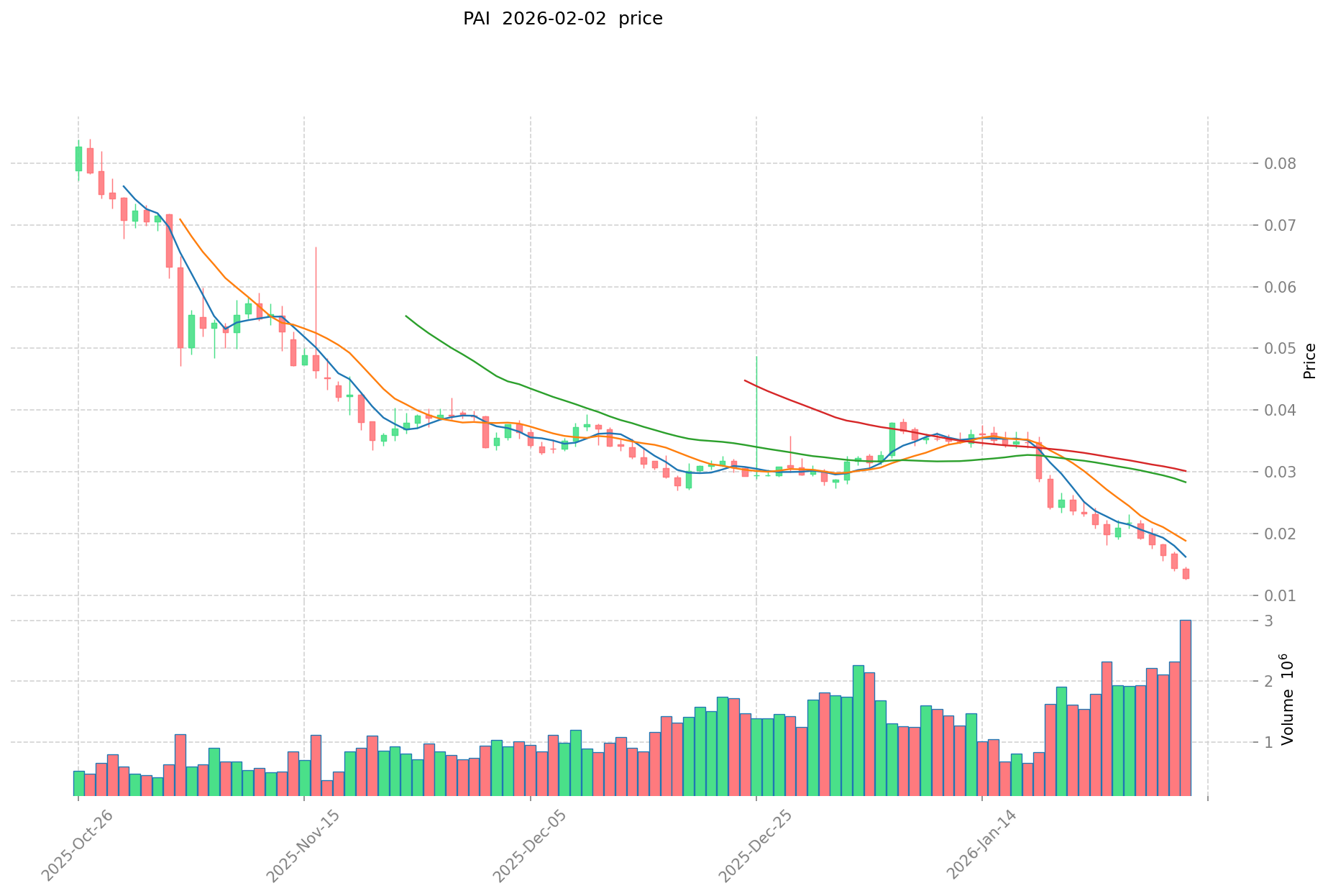
PAI reached a notable price level of $1.518 on December 12, 2024, driven by early market interest and initial trading activity following its launch.
The token recorded its lowest price of $0.01189 on February 02, 2026, reflecting broader market adjustments and reduced trading momentum.
These fluctuations demonstrate the impact of market sentiment, trading dynamics, and evolving adoption patterns on the token's valuation.
Click to view the current PAI market price
On-Chain Metrics
- Holder Count: 10,724 addresses (indicating growing user base and token distribution)
- 24-Hour Trading Volume: $35,307.48 (reflecting current market activity levels)
- Market Capitalization: $1,258,000 (representing the total value of circulating tokens)
ParallelAI Ecosystem Applications and Partners
Core Use Cases
ParallelAI's ecosystem supports multiple applications:
- Decentralized AI Computation: The platform provides GPU resources through a decentralized network, enabling cost-effective parallel processing solutions for AI developers.
- Blockchain Integration: By bridging AI and blockchain ecosystems, ParallelAI unlocks global computational resources previously untapped in traditional centralized systems.
Strategic Partnerships
While specific partnership details are not extensively documented in available materials, ParallelAI's decentralized approach positions it to collaborate with developers and projects seeking efficient GPU utilization solutions.
These potential collaborations could provide a foundation for ParallelAI's ecosystem expansion.
Controversies and Challenges
ParallelAI faces several challenges:
- Technical Hurdles: Optimizing GPU utilization across a decentralized network presents coordination and efficiency challenges
- Market Competition: The AI infrastructure space includes numerous projects competing for developer adoption
- Regulatory Uncertainty: As with many blockchain projects, evolving regulations around decentralized computing resources may impact operations
These issues have sparked discussions within the community and drive ParallelAI's ongoing innovation efforts.
ParallelAI's community shows growing interest, with 10,724 token holders as of February 2026.
On X platform, discussions around ParallelAI and its mission to democratize AI computation generate engagement among developers and blockchain enthusiasts.
Factors such as technological developments and platform updates fuel community enthusiasm.
Sentiment on X presents diverse perspectives:
- Supporters praise ParallelAI's decentralized approach and cost-optimization solutions, viewing it as a pathway to more accessible AI development.
- Critics focus on price volatility and early-stage development risks, noting the token's significant decline from higher levels.
Recent trends indicate mixed sentiment reflecting broader market conditions and the project's developmental stage.
Hot Topics
X users actively discuss ParallelAI's GPU optimization technology, tokenomics, and roadmap execution,
showcasing both its transformative potential and the challenges of establishing decentralized AI infrastructure.
- Official Website: Visit ParallelAI Official Site for features, use cases, and latest updates.
- Whitepaper: ParallelAI Documentation details the technical architecture, objectives, and vision.
- X Updates: On X platform, ParallelAI maintains an active presence at @ParallelAIx,
sharing updates on technical progress, community initiatives, and ecosystem development, generating engagement from the developer community.
ParallelAI Future Roadmap
- Development Focus: Advancing parallel processing solutions to further reduce GPU costs and enhance computation speed
- Ecosystem Goals: Expanding adoption among AI developers seeking scalable and efficient computational resources
- Long-term Vision: Establishing a transparent, democratized platform for AI innovation powered by blockchain technology
How to Participate in ParallelAI?
- Purchase Channels: Buy PAI on Gate.com and other supporting exchanges
- Storage Solutions: Securely store PAI using compatible ERC-20 wallets such as MetaMask or hardware wallets
- Community Engagement: Follow official channels to stay updated on platform developments and participate in ecosystem discussions
- Ecosystem Building: Explore developer documentation to understand how to leverage ParallelAI's infrastructure for AI applications
Summary
ParallelAI seeks to transform AI development through blockchain technology, offering decentralized GPU access, cost optimization, and transparent resource allocation.
Its innovative approach to addressing GPU bottlenecks and active development efforts position it as a noteworthy project in the intersection of AI and blockchain.
Despite facing market volatility and competitive pressures, ParallelAI's mission to democratize AI computation and clear technological focus give it potential relevance in the evolving landscape of decentralized technologies.
Whether you're a developer seeking computational resources or an investor exploring AI-blockchain convergence, ParallelAI represents an interesting project to monitor.
FAQ
What is Crypto PAI and what problem does it solve?
Crypto PAI is a utility token for ParallelAI ecosystem, enabling access to decentralized AI services and computational resources. It rewards users for contributing processing power to train AI models, solving the challenge of distributed AI model training and governance.
How does PAI token work and what are its use cases?
PAI tokens enable smart contract operations and peer-to-peer transactions within the Project Pai ecosystem. Token holders can participate in governance decisions and vote on network updates. Primary use cases include utility functions and decentralized governance participation.
What is the tokenomics of PAI - total supply, distribution, and vesting schedule?
PAI has a total supply of 100 billion tokens. Distribution is community-driven with no official vesting schedule. Current supply details remain undisclosed by the project team.
How can I buy and store PAI tokens securely?
Purchase PAI tokens through reputable cryptocurrency exchanges, then transfer them to a secure hardware wallet for long-term storage. Enable two-factor authentication and use strong passwords to protect your accounts.
What are the main risks and advantages of investing in PAI compared to other cryptocurrencies?
PAI offers potential for high returns through growing adoption and unique use cases in AI and data monetization. Main advantages include innovative technology differentiation and expanding ecosystem. Risks include market volatility, regulatory uncertainty, and liquidity variations typical of emerging cryptocurrencies.
Who are the team members and backers behind the PAI project?
The PAI project team includes Sébastien Aguinet, Hedi Ait-Moussa, Alizée Albertini, and Lydwine Alexandre. The project is backed by PAI Partners, a professional organization supporting the initiative.
What is the roadmap and future development plan for PAI?
PAI's roadmap, Vision 2025, focuses on building an equitable, inclusive, and locally led movement. The strategic plan guides development through 2025, emphasizing community-driven initiatives and sustainable growth across global markets.
* The information is not intended to be and does not constitute financial advice or any other recommendation of any sort offered or endorsed by Gate.