The core challenge of on-chain trusted computation is establishing "why the result can be trusted." While cryptographic proofs offer the highest degree of determinism, generating these proofs requires specialized hardware and hashrate, which naturally limits efficiency and increases costs. To balance determinism and performance, Brevis (BREV) introduces the coChain crypto-economic security model, leveraging Proof-of-Stake (PoS) staking and slashing mechanisms to provide an alternative, trustable source for challengeable optimistic results.
In this design, BREV serves as the payment, collateral, and governance asset. Its features, combined with the operational flow of coChain, form the foundation of Brevis’s crypto-economic security.
What Is the BREV Token?
BREV is the native utility and governance token of the Brevis network. It is more than just a transaction fee token—it is an economic instrument that directly links the quality of proof supply with network security.
Within the Brevis ecosystem, BREV connects three main participants: the requester of computation, the Prover who generates zero-knowledge proofs, and the validator responsible for maintaining coChain consensus. Requesters pay for proofs, while Provers and validators must lock BREV as collateral to guarantee fulfillment, with slashing applied for any breach, ensuring BREV’s circulation is tightly integrated with network activity.
What Are the Uses of BREV?
BREV serves three primary functions: payment, collateral, and governance. Together, these roles underpin Brevis’s proof supply economy, supporting the goal of "producing accurate computation and penalizing incorrect behavior."
| Function |
Role |
Description |
| Pay proving fees |
Requester |
Use BREV to pay for off-chain computation and proof generation |
| Prover staking collateral |
Prover |
Lock BREV as staking collateral to receive tasks; slashing applies for non-compliance |
| Protocol governance |
Holder |
Participate in governance decisions for critical protocol parameters |
These three utilities form a closed loop: requesters settle proving fees in BREV; Provers must stake BREV to accept tasks, converting their service commitment into an economically enforceable promise; holders help adjust protocol parameters, enabling the network to evolve securely.
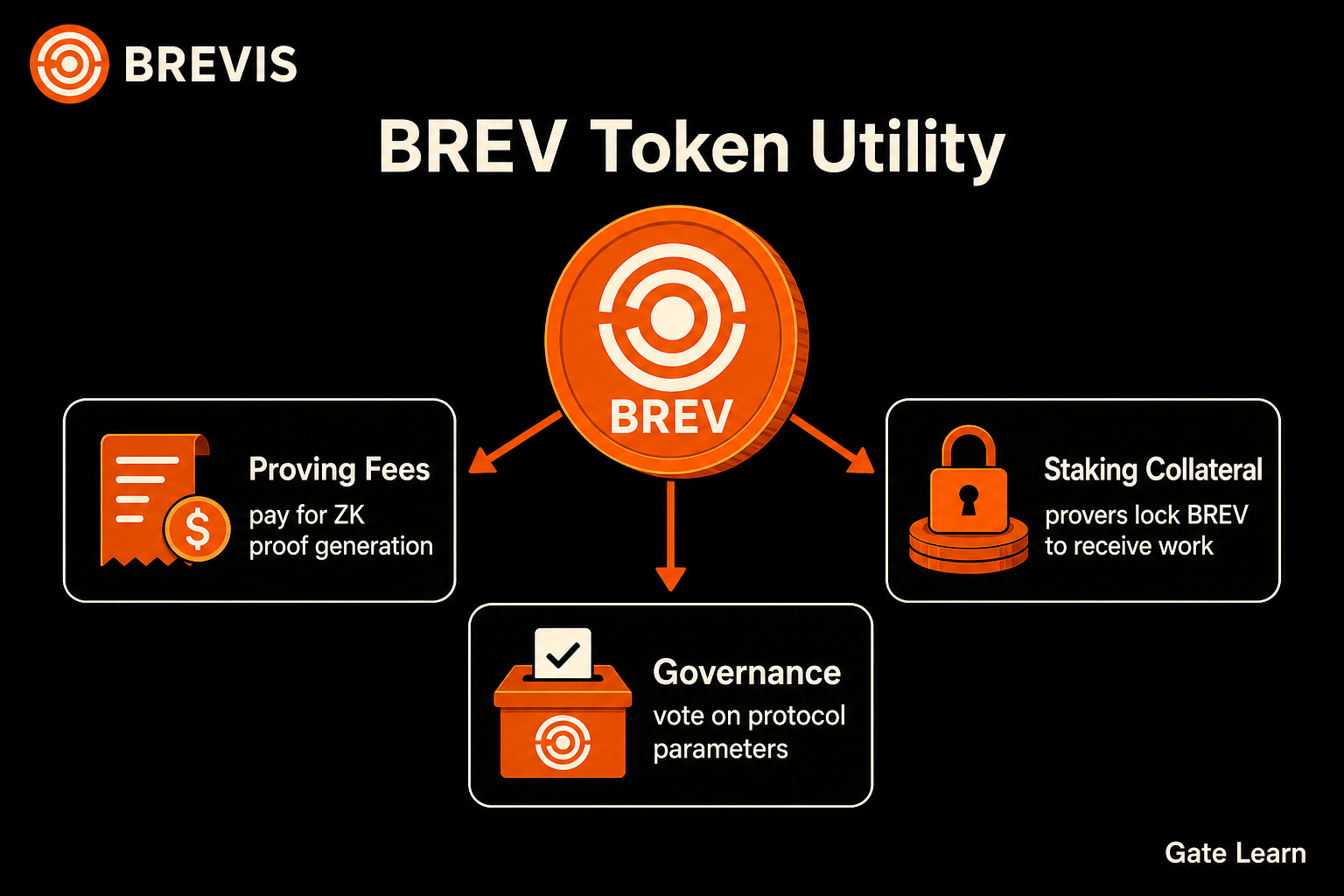
Figure 1. The three core utilities of the BREV token: paying proving fees, Prover staking collateral, and protocol governance.
What Is coChain and Why Is It Needed?
coChain is Brevis’s crypto-economic security model—a PoS blockchain with on-Ethereum staking and slashing, designed to provide a low-latency, cost-effective, and trust-minimized path for verifiable computation.
coChain was developed to address the limitations of the pure-ZK model. In a pure-ZK setup, every result must be accompanied by a zero-knowledge proof before it is delivered, which maximizes determinism but also incurs significant hardware, hashrate, and latency costs—especially for complex operations and real-time applications. The Pico zkVM general-purpose execution layer supports this proof generation process.
coChain resolves this challenge using an "optimistic proposal + challenge" approach: validator-submitted results are trusted by default, and zero-knowledge proofs are only required if a challenge arises. In most cases, this eliminates proof generation costs, while retaining a cryptographic fallback for error correction. This model, like the difference between Brevis and oracles, emphasizes on-chain verifiable computation rather than external data transmission, with coChain anchoring trust in staking and slashing.
How Does the coChain Crypto-Economic Security Model Work?
The coChain model operates through three key stages: proposal, challenge, and slashing. This process anchors the trustworthiness of results in slashable collateral, starting with off-chain computation and concluding with final adjudication on Ethereum.
- coChain validators generate coprocessor results using raw data from archive nodes—mirroring the logic of ZK data coprocessors that access and compute off-chain data—then reach consensus via PoS.
- Validators submit the result and aggregated quorum signatures as a proposal to the requesting chain, triggering two timers: an application-configurable challenge window and a system-level coChain slashing window.
- During the challenge window, any party can submit a zero-knowledge proof to dispute an erroneous proposal. If the challenge is valid, the validator’s stake is slashed on Ethereum; if no challenge occurs, the result is adopted by the dApp with no additional proof cost.
Brevis also plans to integrate EigenLayer, enabling developers to dynamically adjust security levels during the proposal stage—merging crypto-economic incentives with zero-knowledge proofs to offer flexible security and cost trade-offs for various use cases.
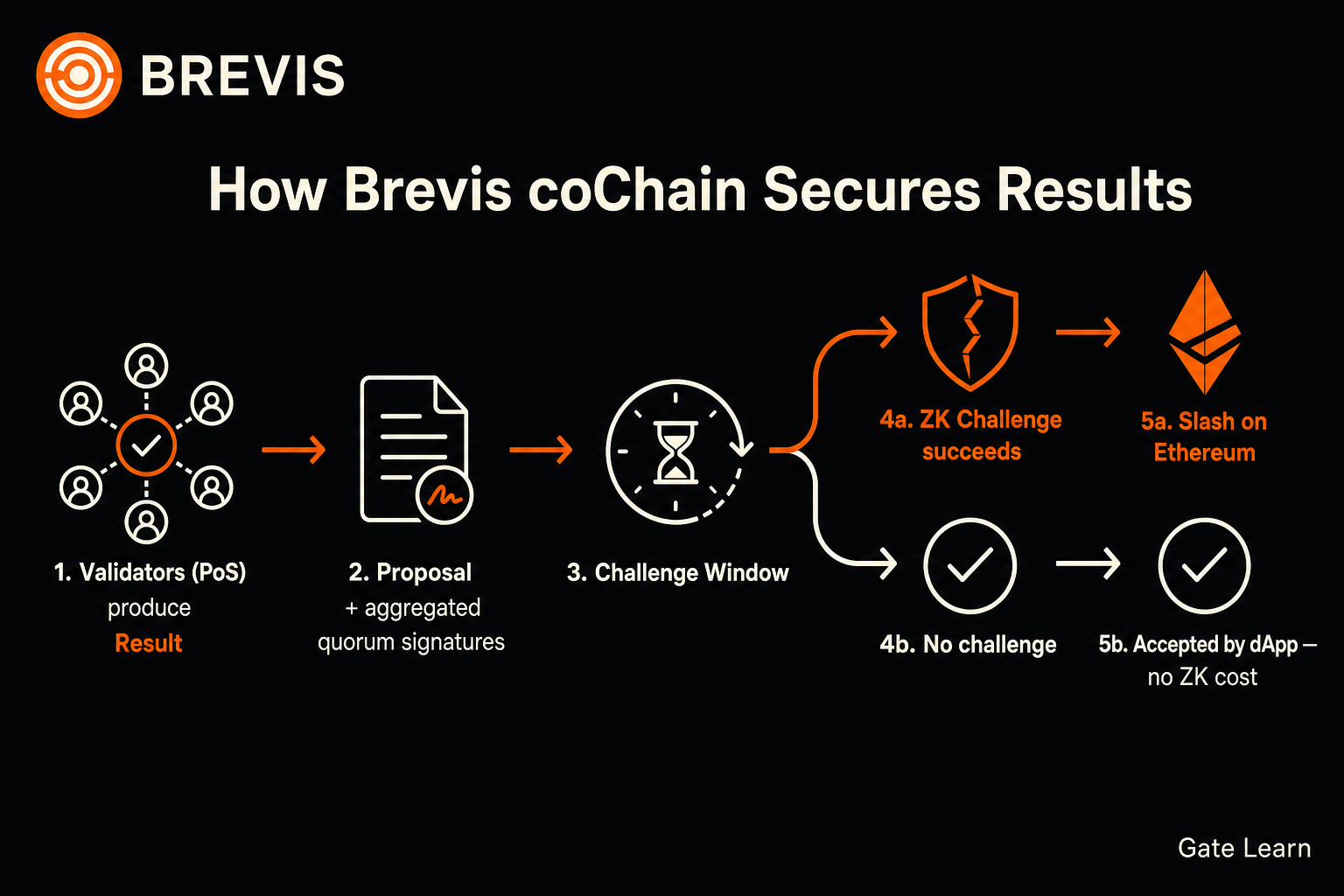
Figure 2. coChain crypto-economic security flow: PoS computation result → proposal (with aggregated quorum signatures) → challenge window → ZK challenge triggers slashing on Ethereum, or result is adopted by the dApp if unchallenged.
How Should You Choose Between pure-ZK and coChain (OP) Models?
The main distinction between pure-ZK and coChain is the trust mechanism: pure-ZK relies solely on cryptographic proofs, while coChain adds a layer of crypto-economic incentives through staking and slashing. These models are not mutually exclusive—they address different needs for determinism and cost.
| Dimension |
pure-ZK |
coChain (OP Model) |
| Trust Source |
Cryptographic proof |
Staking, slashing, and optional ZK challenge |
| Result Latency |
Wait for proof |
Usable after challenge window |
| Computation Cost |
Proof required every time |
No proof cost if unchallenged |
| Security Level |
Guaranteed by ZK proof |
Dynamically adjustable via EigenLayer |
| Use Cases |
Highest determinism |
Cost- and latency-sensitive scenarios |
In summary: pure-ZK offers simplicity and maximum determinism at the expense of higher costs and latency; coChain uses optimistic proposals to achieve lower latency and cost, with security dependent on the challenge process and staking scale. With the Brevis SDK, developers can write business logic once and deploy it across both models.
The BREV staking and slashing mechanism ensures Provers deliver proofs on time. To accept a task, Provers must first lock BREV as collateral, converting their commitment to timely delivery into a financially enforceable obligation.
This mechanism is implemented in ProverNet, Brevis’s decentralized ZK proof marketplace, which is live on mainnet and operates on a dedicated Brevis Chain rollup for auction coordination. Provers stake BREV to participate in auctions for proof tasks.
The key constraint is the deadline: if a Prover misses the deadline or fails to deliver a qualified proof, their staked BREV is slashed. This directly links proof supply reliability to real collateral, incentivizing Provers to only accept tasks they can complete on time, thus maintaining the proof market’s service quality.
What Are the Advantages, Risks, and Limitations of Holding or Using BREV?
BREV’s value is rooted in network utility: as the settlement, collateral, and governance asset for the proof economy, its demand is directly tied to actual usage of Brevis’s verifiable computation. According to the official Brevis blog (2025), the network has generated over 340 million proofs, covering more than 50 protocols across 8+ blockchains, with a robust operational foundation.
The main limitations are inherent to the mechanism design. coChain’s security depends on active challengers and sufficient validator staking; if challengers are absent or staking is too low, the error-correction capability of optimistic proposals is weakened. Critical parameters such as challenge window duration and slashing ratios are set by governance, and their appropriateness directly impacts security.
Risks include BREV’s reliance on adoption within the Brevis ecosystem and proof demand, ProverNet’s supply depending on Prover participation, and potential implementation flaws in smart contracts and SDK integrations. These are objective mechanism constraints and do not constitute investment advice or price forecasts.
Summary
BREV, the native utility and governance token of the Brevis network, links proof supply quality and network security through three core functions: paying proving fees, Prover staking collateral, and protocol governance. coChain, a PoS blockchain with Ethereum-side staking and slashing, offers an "optimistic proposal + challenge" path: erroneous proposals trigger slashing on Ethereum, while uncontested results avoid proof costs. Both models can be deployed as needed using the Brevis SDK, together forming a flexible security framework balancing determinism and efficiency.
FAQ
What are the use cases for the BREV token?
BREV, as the native utility and governance token of the Brevis network, has three main use cases: requesters use BREV to pay proving fees, Provers lock BREV as staking collateral to receive tasks and are subject to slashing for violations, and holders participate in protocol governance.
What is the difference between coChain and pure-ZK?
pure-ZK relies entirely on cryptographic proofs for trust, requiring a zero-knowledge proof for every result, which offers maximum determinism but comes with higher costs and latency. coChain adds a game-theoretic layer with staking and slashing, using optimistic proposals and a challenge mechanism to reduce costs and latency when unchallenged.
How does the coChain crypto-economic security model prevent validator misconduct?
coChain requires validators to stake on Ethereum and submit computation results as proposals to the requesting chain, initiating a challenge window. Anyone can submit a zero-knowledge proof to challenge a faulty proposal during this window; if the challenge is successful, the validator’s stake is slashed on Ethereum, effectively deterring malicious behavior.
When will a Prover’s staked BREV be slashed?
Provers stake BREV in ProverNet to win proof tasks. If a Prover misses the deadline or fails to deliver a qualified zero-knowledge proof on time, their staked BREV will be slashed, ensuring reliable delivery in the decentralized proof market.