As scalability and privacy compliance evolve in parallel, a single-chain architecture cannot simultaneously support high-throughput application deployment and on-chain identity verification. Manta Network addresses this with a dual-chain structure: Manta Pacific handles ZK applications and modular scaling within the Ethereum ecosystem, while Manta Atlantic manages privacy identity and credential layers within the Polkadot ecosystem, creating a complementary "application execution + identity compliance" framework.
From a blockchain perspective, Manta Network represents a modular ZK infrastructure. Universal Circuits lowers the barrier to ZK integration, MANTA unifies governance, gas, staking, and ecosystem incentives, and Restaking brings both MANTA and BTC into Pacific's fast finality framework. The ecosystem now hosts over 200 application projects.
What Is Manta Network? What Are Its Core Components?
Manta Network is a modular ZK application blockchain ecosystem that provides a scalable, low-cost on-chain environment for next-generation decentralized applications while maintaining zero-knowledge privacy and compliant identity capabilities. Manta Pacific serves as a modular L2 within the Ethereum ecosystem, and Manta Atlantic serves as a ZK L1 within the Polkadot ecosystem.
The ecosystem focuses on two directions: for developers, it offers an EVM-compatible deployment environment and Universal Circuits development libraries; for users and institutions, it provides zkSBT compliant credentials and zkAddress privacy addresses. The two chains are connected via the Celer bridge for MANTA cross-chain transfers, sharing a genesis total supply of 1 billion tokens. Core component comparison:
| Component |
Chain |
Core Function |
Typical Use Cases |
| Manta Pacific |
Ethereum L2 |
Modular execution, Celestia DA, zkEVM |
DeFi, on-chain gaming, social apps |
| Manta Atlantic |
Polkadot L1 |
On-chain compliant identity, zkSBT, zkAddress |
KYC credentials, privacy identity, staking governance |
| Universal Circuits |
Manta Pacific |
ZK-as-a-Service development library |
Compliant payments, identity verification, privacy shuffling |
| MANTA Token |
Shared across chains |
Governance, gas, staking, ecosystem incentives |
Network participation, credential purchases, delegated validation |
This structure separates application-layer scaling from identity-layer privacy, avoiding the need to compress heterogeneous requirements onto a single chain.
Why Does Manta Use a Dual-Chain Architecture?
Manta Network's technical path traces back to its Polkadot privacy parachain origins, with an early focus on zero-knowledge compliance and cross-chain interoperability. As modular architecture matured, the ecosystem expanded to two chains: Atlantic handles the identity and credential layer, while Pacific handles large-scale deployment of Ethereum-based ZK applications.
Core Differences Between Manta Pacific and Manta Atlantic can be compared across underlying ecosystem, gas token, and technical focus. Pacific gas is paid in ETH, while Atlantic network fees are paid in MANTA. The two chains lock and unlock MANTA via the Celer bridge, so cross-chain liquidity changes affect the total circulating supply.
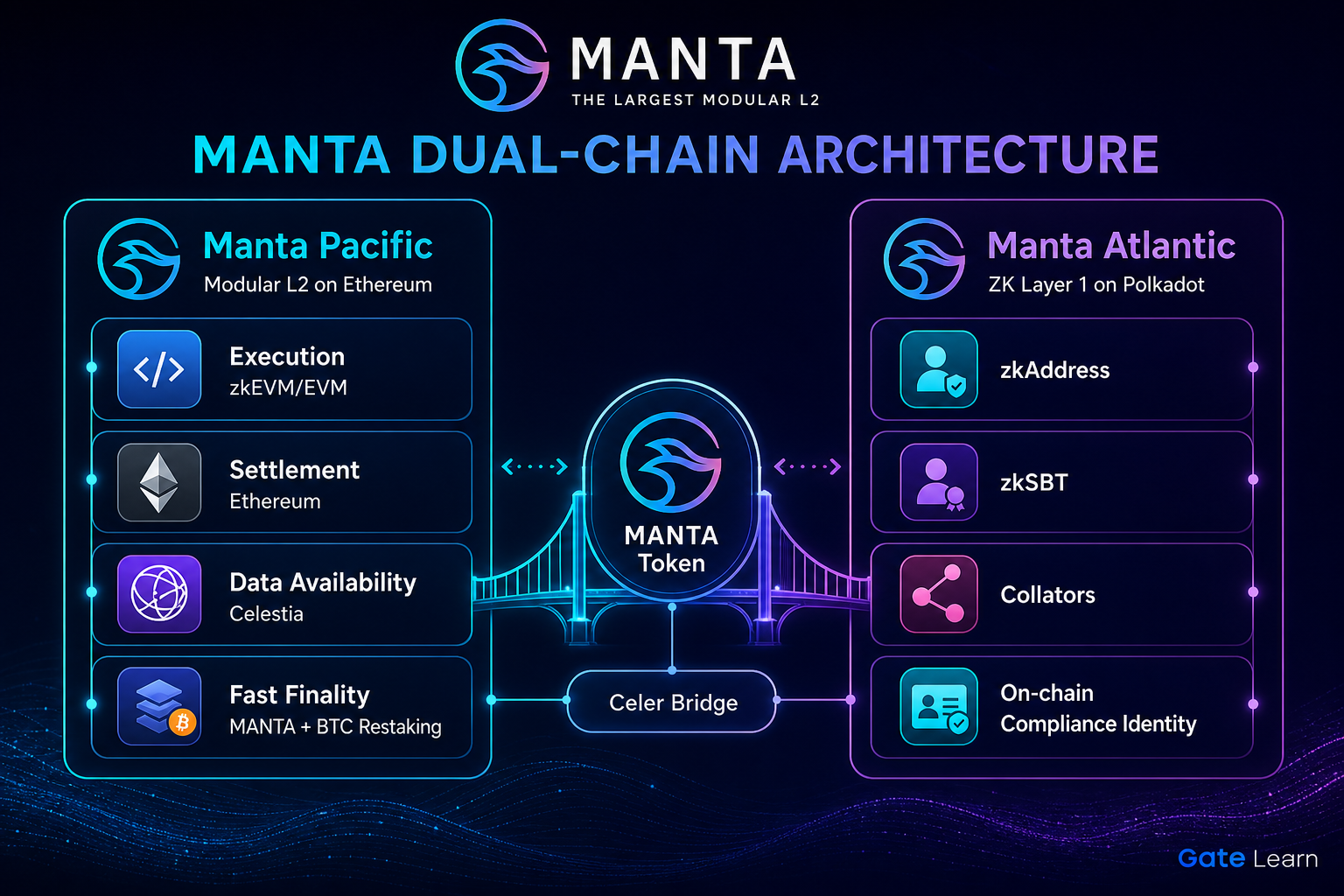 Figure 1. Manta Pacific (Ethereum L2) and Manta Atlantic (Polkadot ZK L1) connected via the MANTA token bridge.
The Full Process of Bridging to Manta Pacific breaks down the steps for users to participate in the Pacific ecosystem, from asset cross-chain and gas preparation to contract interaction. The ecosystem now includes over 200 applications spanning DeFi, on-chain gaming, social, and identity verification, creating a synergistic relationship between the Pacific application layer and the Atlantic identity layer.
How Does Manta Pacific Scale for ZK Applications?
Manta Pacific decouples transaction execution, settlement, and data availability (DA) using a modular architecture to overcome the cost and scalability limitations of monolithic L2s. Pacific uses Celestia as its DA layer, reducing data costs through Data Availability Sampling (DAS) and Namespaced Merkle Trees (NMT). The execution layer follows an EVM-compatible path, with the target architecture being a zkEVM Validium built on Polygon CDK.
Fast Finality uses a two-layer security framework: MANTA holders delegate node operators to verify state roots through Symbiotic Restaking, and BTC holders participate via the Babylon protocol. Results are aggregated by a decentralized relayer and posted to Ethereum, reducing finality time to within minutes. Pacific gas is paid in ETH, with sequencer revenue and DA savings channeled back into ecosystem development.
How Does Manta Atlantic Build On-Chain Compliant Identities?
Manta Atlantic, as a ZK Layer 1 in the Polkadot ecosystem, is positioned as a modular on-chain compliant identity infrastructure. It prioritizes building a ZK compliant credential layer that enables other projects to integrate interoperable identities without handling complex cryptography themselves. zkAddress and zkSBT Privacy Identity Mechanisms form Atlantic's core identity toolkit.
zkAddress uses UTXO-style privacy addresses that coexist with public accounts, offering reusability, auditability, and multi-NFT support. Users can selectively disclose specific credentials via Prove Key. zkSBTs, as non-transferable on-chain credentials, support KYC verification without exposing sensitive information. Atlantic's security is maintained by collators, with 72% of network fees allocated to ecosystem projects, 18% to the treasury, and 10% to collator rewards. Gas is denominated in MANTA.
How Can Developers Integrate Zero-Knowledge Functions at Low Cost?
Universal Circuits is Manta Pacific's ZK-as-a-Service development library, allowing Solidity developers to invoke zero-knowledge functions without deep ZK expertise. The Universal Circuits ZK application development mechanism covers the technical path of embedding ZK functions into dApps, from circuit calls and SDK integration to on-chain verification.
Universal Circuits 2.0 introduces ZK proof aggregation, reducing verification gas and increasing throughput. Core circuits include the Semaphore identity circuit and the on-chain game zkShuffle. Unlike specialized ZK languages like Cairo and Noir, Universal Circuits maintains EVM equivalence, allowing Ethereum contracts to be migrated to Pacific and enhanced with ZK features. zkSBTs also support compliant verification on the Pacific side, creating synergy between Pacific's application layer and Atlantic's identity layer in credential standards.
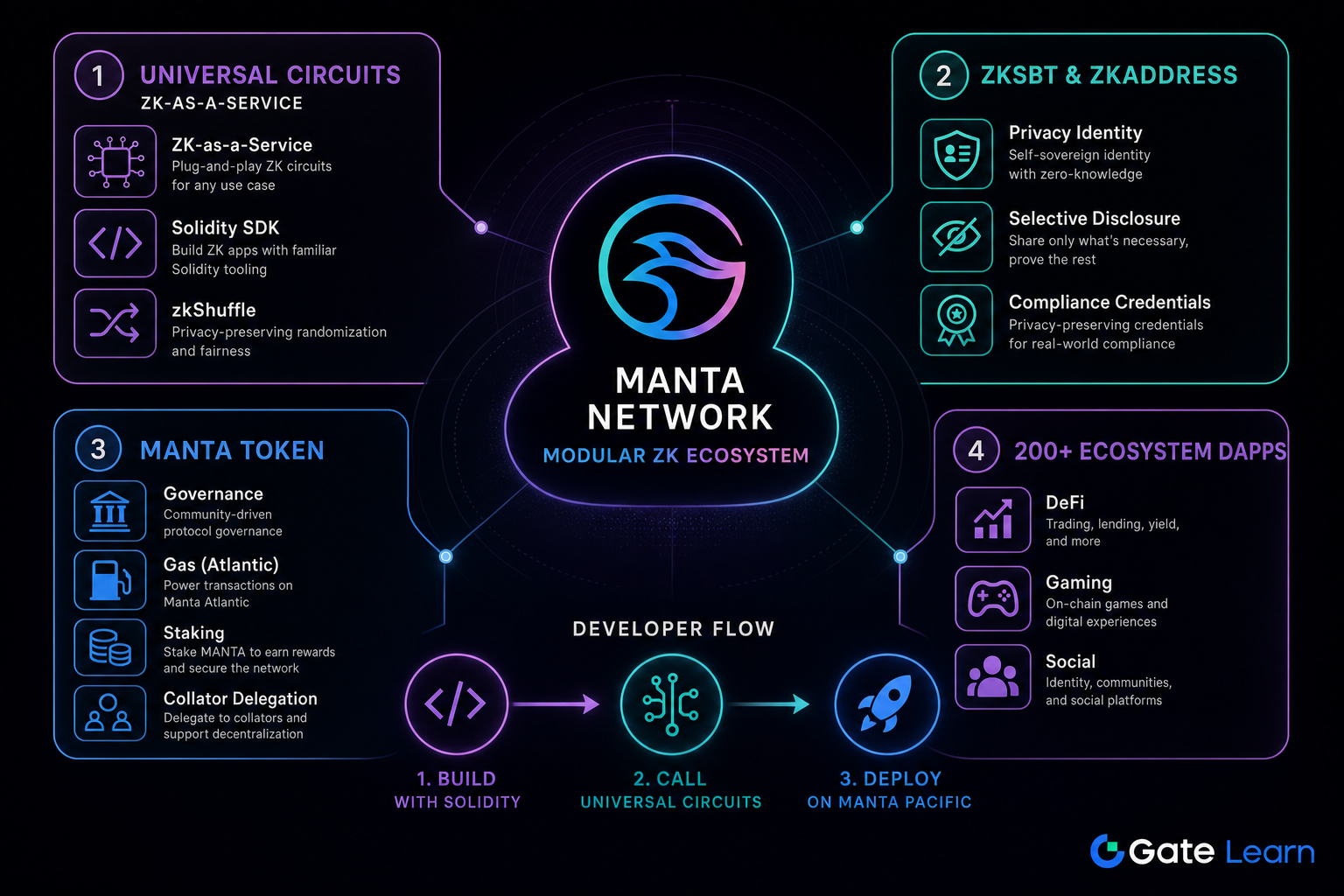 Figure 2. Manta Network ecosystem: Universal Circuits, zkSBT, zkAddress, MANTA token roles, and 200+ dApps.
What Can the MANTA Token Do? How to Participate in the Network?
MANTA serves as the native functional token across the dual-chain ecosystem, with a genesis total supply of 1 billion tokens and an annual inflation rate of 2% for validator rewards. MANTA tokenomics, from allocation structure and unlocking schedule to cross-chain circulation mechanisms, illustrate the token's long-term supply and incentive design.
| Functional Dimension |
Manta Pacific |
Manta Atlantic |
| Gas Payment |
Denominated in ETH |
Denominated in MANTA |
| Governance Voting |
Supported |
Supported |
| Staking/Delegation |
Symbiotic Restaking for fast finality |
Collator staking and delegation |
| Credential Purchases |
Ecosystem liquidity and collateral |
Medium for purchasing zkSBT, zkKYC |
| Value Accumulation |
Sequencer revenue and DA savings flow back to ecosystem |
72% of network fees allocated to ecosystem projects |
Cross-chain transfers work by locking and unlocking MANTA via the Celer bridge. The total unlocked tokens on both chains determine the circulating supply. BTC and MANTA Restaking participants can earn MANTA rewards for helping secure Pacific's fast finality.
What Are the Advantages and Risks of Adopting Manta Network?
The modular dual-chain architecture offers structural advantages in three dimensions: cost, development barrier, and identity compliance. Celestia DA reduces data costs, Universal Circuits lowers the ZK integration threshold, and zkAddress and zkSBT provide programmable compliant identity solutions.
Structural limitations include Pacific's dependence on Celestia, Polygon zkEVM, and Ethereum's settlement layer; Atlantic's interoperability is constrained by Polkadot's parachain architecture; and cross-chain MANTA relies on the Celer bridge's security and liquidity. Related risks include technical risks in ZK circuits and smart contracts, the possibility that slashing rules may not be fully activated in the evolving Restaking mechanism, the need to verify counterfeit MANTA contracts against publicly disclosed information, and risks from third-party protocols like Symbiotic and Babylon.
What Are the Most Commonly Confused Concepts About Manta?
Manta Network is not the same as the MANTA token; Manta Pacific is not the same as Manta Atlantic; Universal Circuits is not a complete ZK virtual machine but a ZK function library that can be embedded into Solidity contracts. zkSBTs are non-transferable—their core purpose is privacy verification, not trading or circulation. zkAddress enables selective disclosure for compliant identity, not coin mixing. On the Pacific side, gas is paid in ETH, while on the Atlantic side it's paid in MANTA—the mechanisms should not be mixed. Unverified MANTA contracts are not equivalent to the ecosystem's native token.
Summary
Manta Network uses the division of labor between Manta Pacific and Manta Atlantic to respectively handle Ethereum ZK application deployment and Polkadot on-chain compliant identity building. Celestia DA, zkEVM, and Universal Circuits form the Pacific tech stack, while zkAddress and zkSBT form the Atlantic identity layer. MANTA unifies governance, staking, gas, and ecosystem incentives. The core differences, bridging process, development mechanisms, tokenomics, and privacy identity mechanisms supplement the dual-chain ecosystem from five perspectives: architecture, operations, development, distribution, and credentials.
FAQ
What is Manta Network?
Manta Network is a modular blockchain ecosystem for zero-knowledge (ZK) applications, consisting of two chains: Manta Pacific (an Ethereum modular L2) and Manta Atlantic (a Polkadot ZK L1). Pacific focuses on ZK application deployment, Atlantic focuses on on-chain compliant identity, and MANTA is the native functional token shared across both chains.
What is the difference between Manta Pacific and Manta Atlantic?
Manta Pacific is deployed on Ethereum, uses Celestia DA and EVM/zkEVM, and gas is paid in ETH. Manta Atlantic is a Polkadot ZK L1 focused on zkAddress and zkSBT, with network fees paid in MANTA. The two chains are connected via the Celer bridge for MANTA cross-chain transfers.
How do Universal Circuits help developers integrate ZK functions?
Universal Circuits is Pacific's ZK-as-a-Service development library. Developers can call pre-built ZK circuits via SDKs within Solidity contracts, supporting use cases like compliant privacy payments, identity verification, and zkShuffle. Version 2.0 introduces proof aggregation to reduce verification costs.
What are the uses of the MANTA token?
MANTA is used on Atlantic for gas, governance, collator staking, and zkSBT purchases. On Pacific, it's used for governance, ecosystem incentives, Symbiotic Restaking for fast finality, and ecosystem liquidity. The genesis total supply is 1 billion tokens, with an annual inflation rate of 2%.
What are zkAddress and zkSBT respectively?
zkAddress is Atlantic's UTXO-style privacy address that supports selective credential disclosure via Prove Key. zkSBT is a non-transferable zero-knowledge soulbound token that enables decentralized KYC verification without exposing sensitive personal information.
How does Manta Pacific's Fast Finality work?
Pacific uses a two-layer verification scheme: MANTA holders delegate nodes to verify state roots through Symbiotic Restaking, and BTC holders participate through the Babylon protocol. Results are aggregated and posted to Ethereum, reducing finality time to within minutes.







