As asset types on Solana have evolved from early NFTs to vouchers, membership rights, brand assets, and on-chain intellectual property, project teams now require a more unified and maintainable foundation for asset issuance.
From a digital asset engineering perspective, Metaplex shifts the focus from simply “creating assets” to “building asset systems,” integrating standards, protocols, and governance into a cohesive framework.
Metaplex is not a single application, but rather middleware for asset issuance, designed for developers and project teams. It bridges Solana’s on-chain account model, metadata standards, minting processes, and management capabilities, enabling teams to deliver asset products with consistent specifications.
Within the infrastructure stack, Metaplex typically occupies the “asset logic layer.” The base layer consists of Solana’s account and execution environment, while the upper layer includes wallets, markets, and applications. Through its universal program interface, Metaplex minimizes redundant development and eliminates the need for teams to build asset contracts from the ground up.
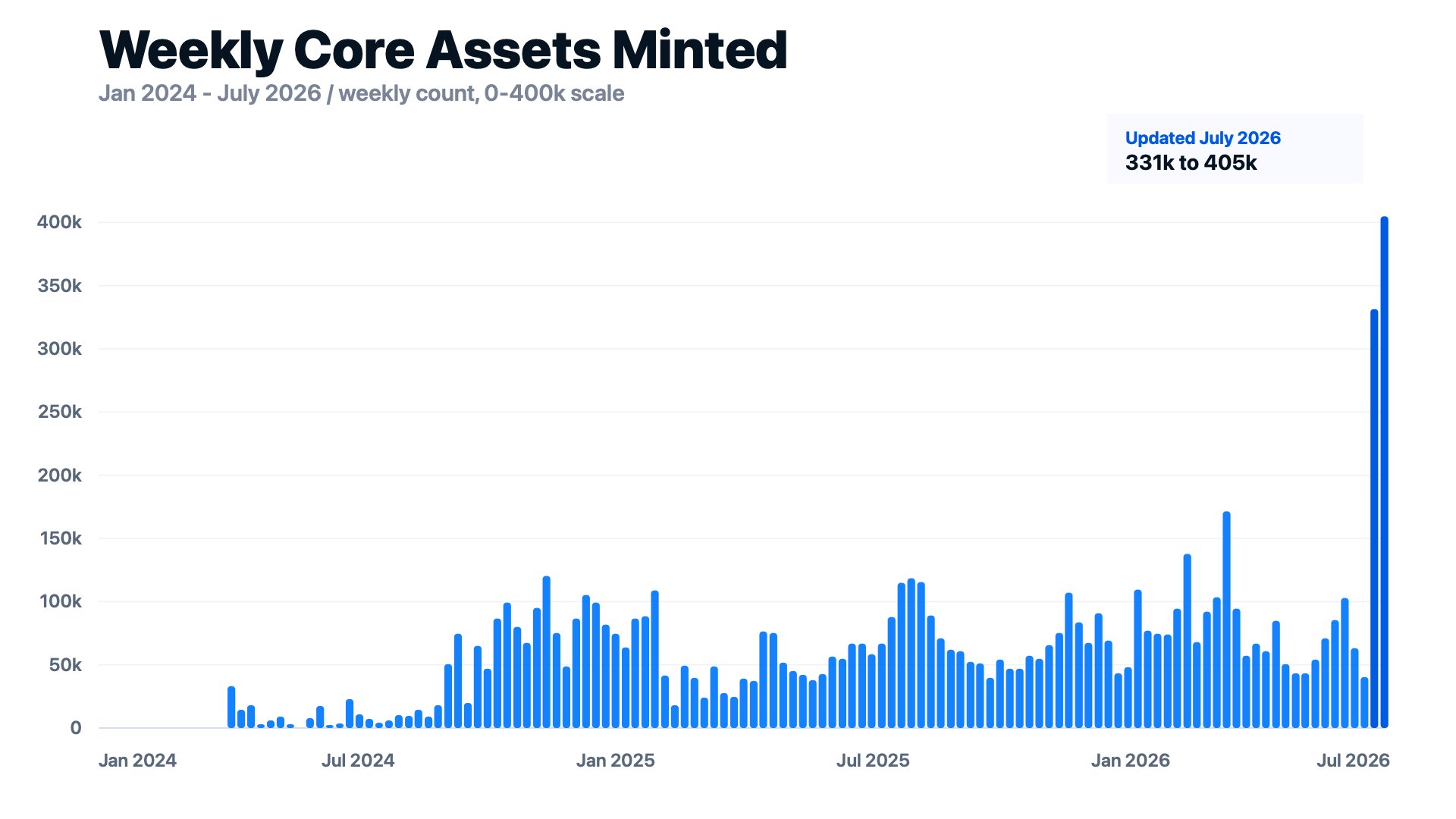 Metaplex Core data, source: NFToly
Metaplex is made up of various modules that work together to cover the entire lifecycle: “defining assets, issuing assets, managing assets, and extending assets.” The combination of components varies by scenario, but the design goal remains consistent—enabling uniformity while preserving extensibility.
| Component |
Main Function |
Common Use Cases |
| Token Metadata Program |
Defines on-chain asset metadata structure and indexing |
NFT, collectibles, brand asset registration |
| Candy Machine |
Batch minting and issuance control |
Large-scale series launches, public or whitelist minting |
| Metaplex Core |
Lightweight framework for next-generation asset models |
Multi-type digital assets, programmable asset logic |
| Developer Tools & SDKs |
Streamline integration, testing, and deployment |
App development, issuance scripts, automation |
These components collaborate around a unified issuance logic. Project teams can define asset structures, set issuance strategies, and layer in permissions and extension logic as needed.
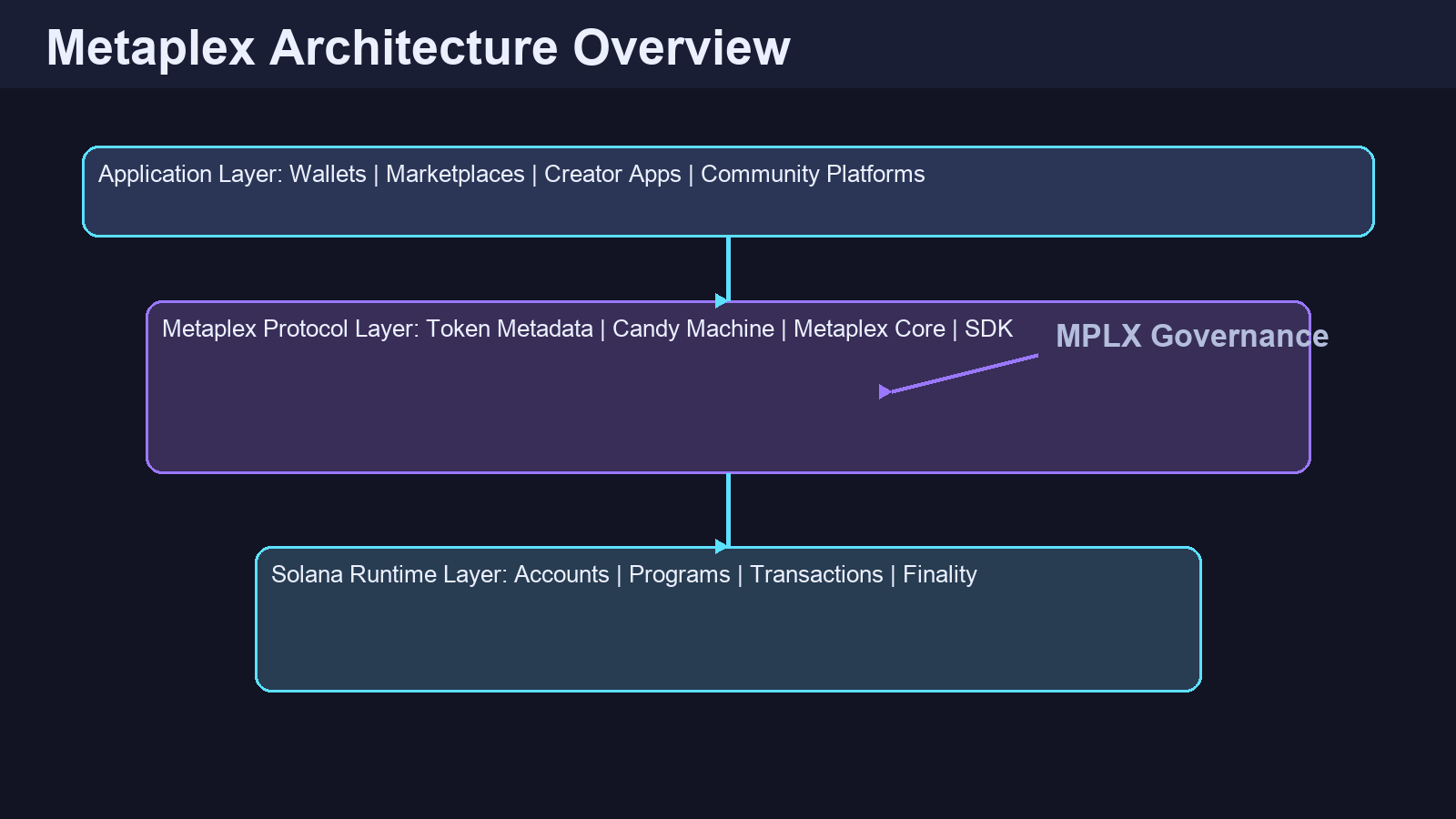
Metaplex’s layered architecture in the Solana ecosystem, illustrating the interaction between application, protocol, and runtime layers.
Unlike the early “single NFT minting script plus metadata hosting” approach, Metaplex Core emphasizes integrated modeling of asset logic. The main difference, as detailed in Metaplex Core vs. traditional NFT creation, is that Core abstracts asset capabilities into composable units, reducing the complexity of stitching together disparate programs.
Traditional methods typically follow a “mint first, then add external logic” process, resulting in fragmented permission management, transfer rules, and extension functions. The Core approach favors “defining asset behavior first, then entering the issuance process,” which simplifies future maintenance.
For developers, this shift is more than a change in syntax—it’s a change in engineering methodology. Traditional models focus on rapid deployment, while the Core model prioritizes scalable architecture, making it easier to maintain consistent rules and manage versions over time.
Metaplex’s value lies in mapping technical and business steps onto a single workflow. When planning an asset issuance, teams must address asset definition, permission settings, minting schedules, and user entry points in parallel. This workflow, as outlined in How to launch an asset project with Metaplex, can be broken down into repeatable engineering templates.
| Stage |
Technical Focus |
Output |
| Asset Design |
Define metadata, supply model, permissions, and lifecycle rules |
Auditable asset specification |
| Issuance Preparation |
Configure minting parameters, whitelist, and access policies |
Executable issuance configuration |
| Minting & Launch |
Connect frontend and wallet, execute batch or phased minting |
Initial asset distribution completed |
| Post-Issuance Ops |
Manage asset status, extend features, integrate with ecosystem |
Ongoing operations and secondary applications |
This process is not limited to a single asset type—collectibles, community vouchers, and brand digital rights can all leverage this framework.
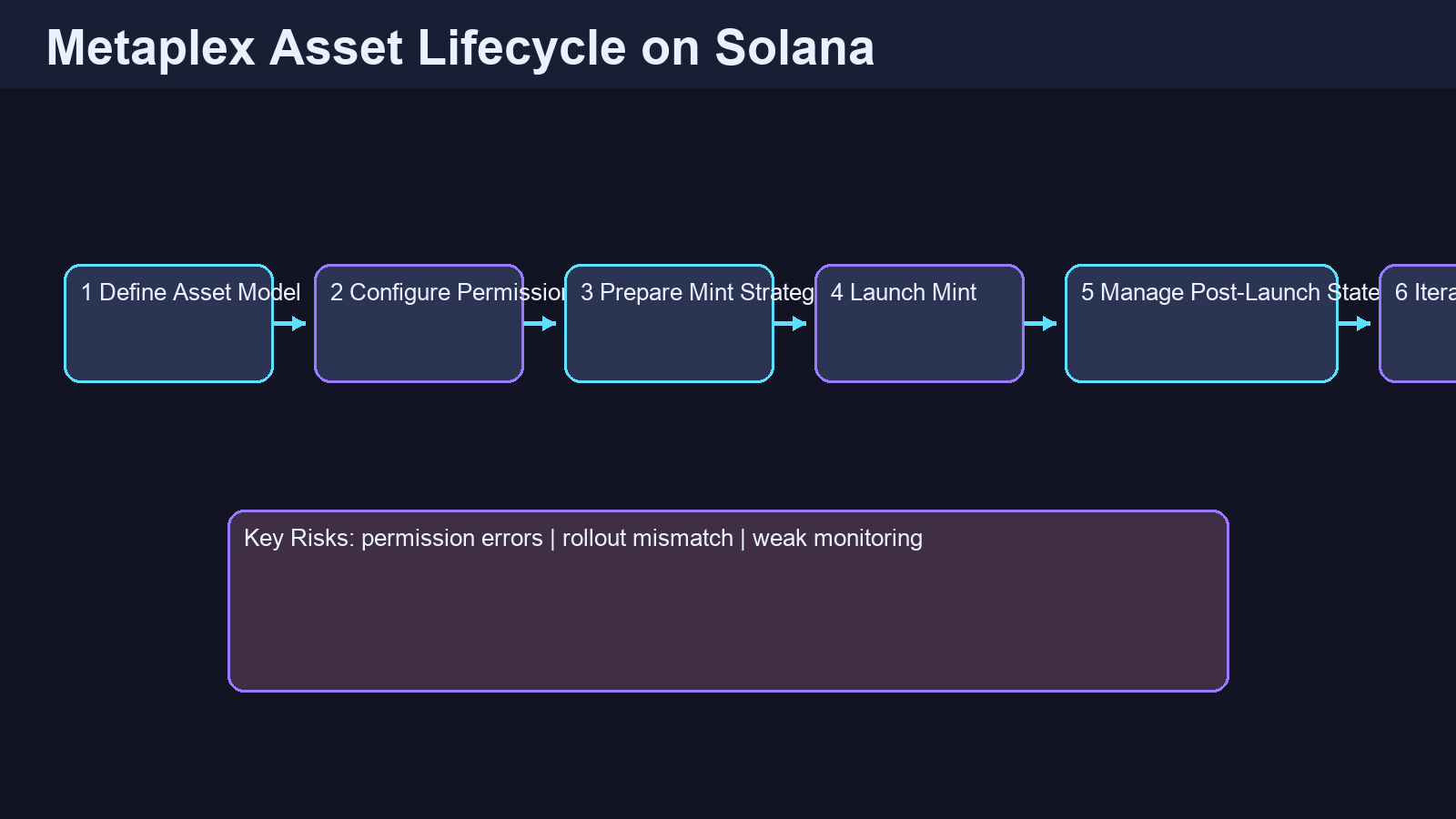
Metaplex asset project lifecycle, from modeling and issuance to governance iteration.
What Is the Role of the MPLX Token in Ecosystem Governance and Parameter Coordination?
MPLX primarily serves governance functions within the Metaplex ecosystem, rather than substituting for the business value of assets themselves. It’s focused on protocol parameter discussions, upgrade coordination, and incentivizing governance participation.
In infrastructure projects, governance tokens determine “who can participate in rule-making” and “how rules evolve.” This structure allows Metaplex to maintain protocol continuity while incorporating a broad range of community and ecosystem feedback.
It’s important to distinguish that Metaplex is the infrastructure for asset issuance, while MPLX is a tool for governance collaboration. The value of specific assets is still defined by each project’s rules. This separation helps avoid conflating governance rights with asset utility.
Solana’s ecosystem offers multiple asset issuance solutions. Teams must balance flexibility, complexity, development cost, and maintainability. The core of the Metaplex vs. other Solana frameworks discussion is not which is absolutely superior, but which best fits the intended use case.
When comparing frameworks, focus on lifecycle management needs, issuance scale and configuration complexity, long-term maintenance, and ecosystem compatibility. For rapid validation of a single event, lightweight solutions may suffice. For building a long-term asset product line, Metaplex’s standardization is a clear advantage.
Metaplex’s main advantage is ecosystem-wide consistency. Unified standards reduce integration costs across wallets and applications, and make it easier for users to identify asset origin and structure. Its modular design accelerates product iteration, enabling rapid expansion within an established framework.
Risks stem from both engineering and operations. On the engineering side, risks include permission misconfigurations, scripting errors, and poor version control. Operational risks include poorly designed issuance schedules, inadequate user expectation management, and unclear asset rule communication. These risks are not unique to Metaplex but are magnified during large-scale issuance.
Limitations arise from learning and governance costs. Compared to one-off minting tools, Metaplex requires teams to master more modules and interfaces. For short-term, small-scale projects, this comprehensive framework may introduce unnecessary complexity.
A robust approach is to “validate on a small scale, then expand gradually”: first test the asset model and issuance logic in a controlled environment, then extend the framework to broader business scenarios.
Summary
Metaplex delivers foundational infrastructure for digital asset issuance on Solana, integrating standards, protocols, tools, and governance into a system designed for sustainable evolution. Its core value is not in one-time minting efficiency, but in enabling projects to build verifiable, maintainable, and scalable asset engineering systems. By focusing on Core, issuance processes, and framework comparisons, ecosystem participants can better determine when to use Metaplex, how to design asset lifecycles, and how to manage implementation complexity.
FAQ
Is Metaplex Only for NFT Projects?
Metaplex was originally recognized for NFT issuance, but its capabilities now extend to broader digital asset creation and management. Any project requiring on-chain verifiable asset definitions, issuance workflows, and ongoing operations can leverage Metaplex as infrastructure. Different asset types can be realized with different module combinations.
What Is the Biggest Change in Metaplex Core Compared to Traditional NFT Minting?
Core’s key innovation is to model asset behavior upfront, rather than patching in scattered logic after minting. This ensures greater consistency in permissions, extensibility, and lifecycle management. For long-term projects, this integrated structure is generally more maintainable and adaptable.
What Preparations Are Needed to Launch an Asset Project with Metaplex?
Teams should first define the asset model, metadata structure, and permission boundaries, then configure issuance parameters and front-end integration. On the technical side, prepare the Solana development environment, testing processes, and deployment scripts. On the operational side, plan issuance schedules and user access to ensure on-chain rules align with the product experience.
Is MPLX Primarily for Asset Payment or Governance?
MPLX is primarily a governance token, not a general-purpose payment asset. It’s used for community participation in protocol evolution, parameter discussions, and governance decisions. The specific features and value of business assets are still determined by each project’s rules.
How Should Teams Choose Between Metaplex and Other Solana Issuance Frameworks?
Selection should be based on the project’s goals and team capabilities, not just feature comparisons. For long-term asset operations, standardization, and scalability, Metaplex is usually preferable. For simple, short-term needs, lightweight solutions may be more efficient, with the option to migrate to a more comprehensive framework as requirements grow.