In the current wave of rapid AI development, issues such as computing power centralization, data monopolies, and restricted model access are becoming increasingly prominent. Major technology companies control large volumes of AI models and computing resources, which often forces developers and users to rely on closed platforms when using AI services. Decentralized AI networks have therefore emerged as an important direction within the Web3 ecosystem. Their goal is to make AI capabilities more open, composable, and verifiable through open protocols and distributed infrastructure.
From the perspective of blockchain and digital asset development, the convergence of AI and Web3 is creating a new technological paradigm. Through on-chain settlement, token incentives, and open computing networks, artificial intelligence capabilities can be tokenized and integrated into decentralized economic systems. Venice was created within this broader trend. By combining AI model networks, privacy preserving computation mechanisms, and on-chain incentive systems, it aims to build an open market for AI computing.
Venice and the Architecture of Decentralized AI
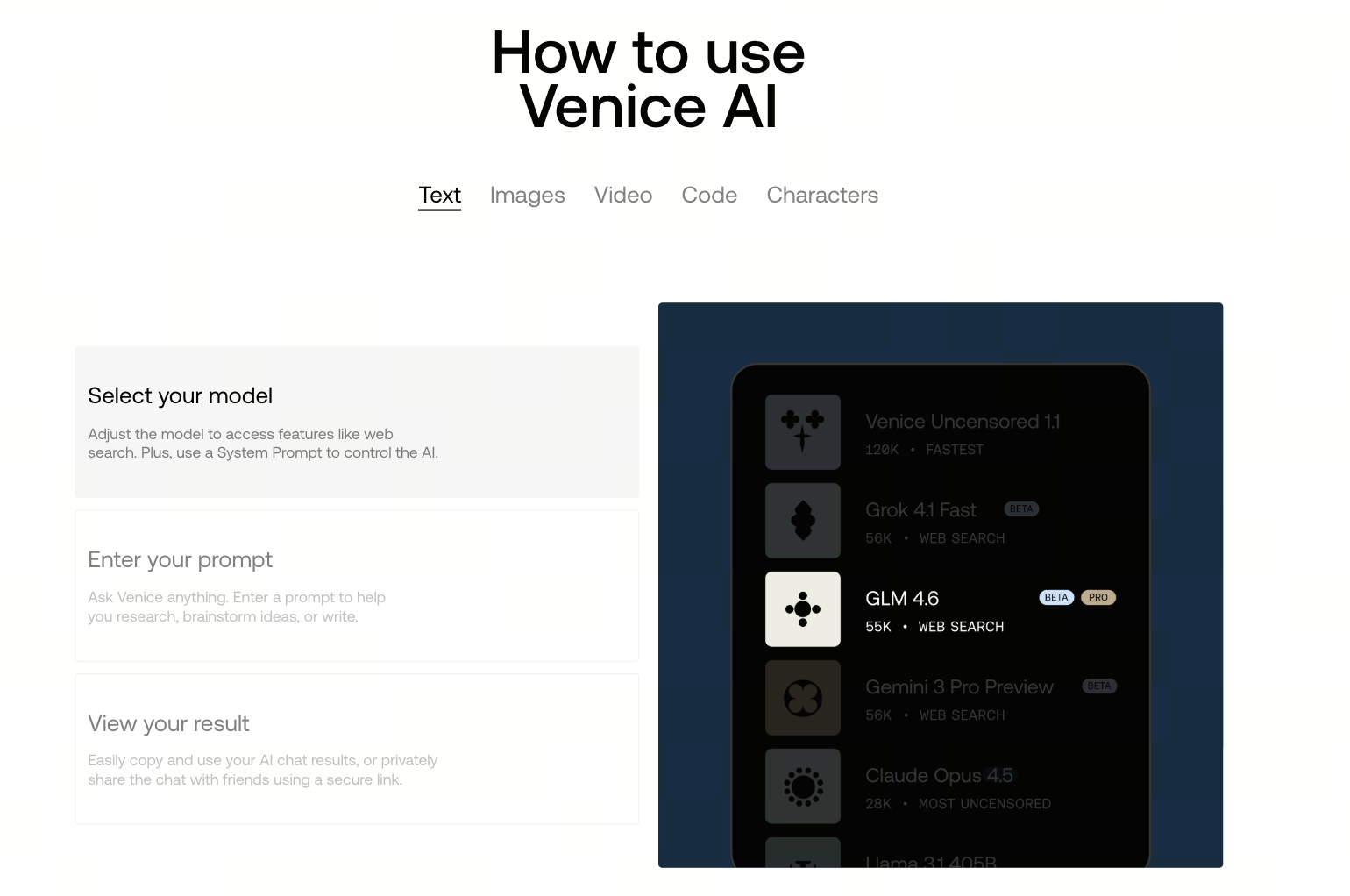 Image source: Venice official website
The core objective of Venice is to establish a decentralized AI service layer, allowing artificial intelligence capabilities to be accessed and shared across an open network in the same way blockchain infrastructure is used.
In traditional AI ecosystems, models typically run on centralized servers. Users must access these models through APIs or subscription based services. This approach presents several challenges.
-
Data privacy risks. User inputs are usually uploaded to centralized servers for processing, which means users do not fully control their own data.
-
Platform dependency. When AI models are controlled by a small number of companies, developers and application ecosystems become subject to platform rules and commercial strategies.
Venice addresses these issues by deploying AI inference nodes across a decentralized network. In this model, model computation can occur on distributed infrastructure. The architecture generally includes several key layers.
-
AI inference node network. Distributed nodes run AI models and provide inference capabilities.
-
Privacy computing and data isolation mechanisms. These ensure that user input data is not permanently stored or misused.
-
Blockchain settlement layer. This layer records usage activity, handles payments, and distributes rewards to network participants.
Through this structure, AI services no longer rely on a single cloud provider. Instead, computing resources and model access are shared through an open network.
The operational logic of the Venice platform can be understood as a combination of an AI model network and a blockchain settlement layer.
Within this system, the process of calling an AI model typically follows several steps.
Step 1: User Request Generation
A user or application submits an AI request through the Venice interface. This could include tasks such as text generation, data analysis, or automated workflows.
Step 2: Task Distribution
The network protocol assigns the task to available AI inference nodes, which may be operated by different participants across the network.
Step 3: Model Execution
The selected node runs the AI model locally to perform the computation and returns the result.
Step 4: on-chain Settlement
Service fees are settled through blockchain transactions and distributed to node operators according to protocol rules.
This model provides several important advantages.
-
Openness. Any developer can deploy AI services on the Venice network.
-
Verifiability. Blockchain records ensure that AI usage activity is transparent and traceable.
-
Resource sharing. Computing power and model resources can circulate freely across the network.
In essence, Venice functions as a decentralized marketplace for AI computing.
How Venice Uses AI to Improve Protocol Security and Efficiency
Security and efficiency are two major challenges in decentralized networks. Venice applies AI technology across several layers to enhance platform performance.
Intelligent Anomaly Detection
AI models can analyze network activity in real time to detect:
Machine learning models can identify potential threats and automatically trigger protective measures.
Automated Resource Scheduling
AI systems can optimize the allocation of computing resources by:
-
Dynamically assigning compute nodes based on demand
-
Adjusting model inference priorities
-
Optimizing network bandwidth usage
These mechanisms significantly improve inference efficiency across the network.
Data Privacy Protection
Venice’s privacy architecture often combines several techniques.
AI models process only the data required for each task, reducing the risk of privacy exposure.
As a result, AI is not only a core service function within Venice but also an important component of the platform’s governance and security systems.
Venice’s Application Path in Decentralized Finance (DeFi)
The integration of AI and decentralized finance is becoming an important direction in Web3 development. Venice’s AI infrastructure can support several DeFi use cases.
Intelligent Trading Strategies
AI can analyze market data and generate trading strategies, including:
DeFi protocols can run these AI models through the Venice network.
Risk Monitoring and Liquidation Management
In lending protocols, AI systems can monitor collateral risk in real time by:
-
Detecting liquidation risk
-
Predicting market volatility
-
Automatically triggering risk alerts
This helps improve the stability of DeFi protocols.
Automated Asset Management
AI agents can act on behalf of users to perform asset management tasks such as:
-
Automatically rebalancing investment portfolios
-
Executing yield aggregation strategies
-
Scanning DeFi markets for opportunities
In this model, AI becomes not just a tool but an active participant in the on-chain economy.
Technical Differences Between Venice and Other AI Protocols
Several AI-related protocols have already emerged in the Web3 ecosystem, including:
-
AI computing networks
-
AI data marketplaces
-
AI agent platforms
Venice differs from many of these projects in several key ways.
Privacy First Architecture
Many AI platforms still rely on centralized model services. Venice places stronger emphasis on privacy protection and user control over data.
Decentralized Computing Network
Venice is closer in design to a distributed AI inference network rather than a single AI service provider.
Web3 Native Design
From the beginning, Venice was designed to integrate directly with blockchain-based economic systems. Examples include:
This architecture makes it easier for the platform to integrate with the broader Web3 application ecosystem.
| Comparison Dimension | Venice | Centralized AI Platforms | Web3 AI Compute Networks | AI Agent Protocols |
| --- | --- | --- | --- | --- |
| Architecture Model | Decentralized AI inference network combined with privacy computing | Cloud server based centralized architecture | Distributed computing power networks | AI agent task execution networks |
| Data Privacy | Emphasizes privacy first design, with user data processed locally whenever possible | Data usually needs to be uploaded to the platform’s servers | Depends on the protocol, some support privacy computing | Data is shared between agents and applications |
| AI Model Execution | AI inference models run on distributed nodes | Models are deployed and managed centrally by the platform | Nodes provide computing power to run models | Agents call external models to perform tasks |
| Settlement Mechanism | On chain settlement combined with token incentives | Subscription based or API usage billing | On chain settlement for computing resource usage | Service fees settled for agent execution |
| Ecosystem Goal | Build an open decentralized AI service network | Provide commercial AI API services | Provide computing resources for AI training and inference | Build an automated AI agent economy |
| Developer Openness | Open protocol that can integrate with Web3 applications | Limited by platform rules and policies | Open computing resource marketplace | Developers can create and deploy agents |
| Integration With Web3 | Native Web3 architecture | Limited integration with Web3 | Focus on decentralized computing markets | Focus on automated AI driven economies |
| Typical Use Cases | Privacy focused AI services, DeFi analytics, AI tools | Text generation, image generation, AI SaaS | AI model training and inference computing | Automated trading, DAO agents, task automation |
Venice is therefore positioned as a privacy first decentralized AI service network rather than simply an AI computing marketplace or an AI agent protocol. Its goal is to build an AI infrastructure layer within the Web3 ecosystem that is callable, composable, and economically settled.
The Evolution of Deep Integration Between AI and Blockchain
The integration of AI and blockchain technology is still in an early stage, but several important trends are already emerging.
The AI Agent Economy
In future Web3 ecosystems, AI agents may become independent participants capable of:
Decentralized Computing Networks
As demand for AI computing continues to grow, distributed computing markets may become an important layer of infrastructure.
Networks similar to Venice could allow computing resources to be shared globally.
Tokenization of AI Models
In the future, AI models themselves may become tokenized assets. Examples include:
This approach integrates artificial intelligence directly into the digital asset economy.
Conclusion
Venice represents an exploration into decentralized AI infrastructure. By combining distributed computing networks, privacy preserving mechanisms, and blockchain settlement systems, the platform attempts to move beyond the traditional model in which AI services depend on centralized cloud providers.
From a technical perspective, the core value of Venice lies in building an open AI computing network where model execution, computing resources, and data processing can operate within a decentralized environment. At the same time, AI technologies are used to enhance protocol security, optimize resource allocation, and expand Web3 application scenarios such as DeFi.
As AI and blockchain technologies continue to converge, the digital economy may evolve toward more complex and intelligent network structures. In this process, decentralized AI platforms like Venice could become an important infrastructure layer connecting artificial intelligence capabilities with the broader Web3 economic system.