


Q1. Basic Logic of Live Copy Trading
A: 1. Copy Trading Logic
1.1. Copy trading is based on the trader’s position adjustment amount. The copy trade amount (rounded down) = copy ratio ✖️ adjustment amount. If the amount is less than the contract’s minimum copy amount, no copy trade will occur.
1.2. The system then calculates the maximum tradable amount for the follower based on their available funds and the set contract leverage. If the copy trade amount ≤ the follower’s tradable amount, the copy trade is executed successfully; otherwise, it fails.
1.3. Without considering copy ratios, leverage systems, or single order constraints, the follower will replicate the trader’s position changes until their copy funds are depleted. When the trader reduces their position in the corresponding contract, the follower’s available funds will be updated accordingly.
1.4. For copy trading margin, the follower’s spot account funds are transferred into a virtual sub-account dedicated to copy trading. This sub-account only follows the trader’s copy trades. After copy trading ends, the sub-account is settled, and the remaining funds—after deducting profit sharing and trading fees—are returned to the spot account.
A: 2. Example of Copy Trading Logic
Ignoring trading fees and funding rates:
A trader has a total of 1,000 USDT and uses 100 USDT to buy contract A with 100x leverage, creating a position worth 100 × 100 = 10,000 USDT.
A follower has 100 USDT in copy trading funds, sets a copy ratio of 0.1, and uses 20x leverage. In theory, the follower’s position for this trade would be 10,000 × 0.1 = 1,000 USDT. The required margin for the follower would be 1,000 / 20 = 50 USDT, leaving 100 - 50 = 50 USDT of available funds.
Next, the trader uses 200 USDT to buy contract B with 100x leverage, creating a position worth 200 × 100 = 20,000 USDT.
At this point, the follower has 50 USDT left, and with 20x leverage, can build a maximum position of 1,000 USDT. If the follower wants to copy the trader’s purchase of contract B, they can only open a 1,000 USDT position, using up all available copy funds.
When the prices of both A and B rise by 10% and the trader closes both positions:
Trader’s profit: (11,000 - 10,000) + (22,000 - 20,000) = 3,000 USDT
Follower’s profit: (1,100 - 1,000) + (1,100 - 1,000) = 200 USDT
A: 3. Potential Issues with This Copy Trading Logic
Followers may notice their profits differ from the trader’s. This can occur if the follower uses a different principal, leverage, or sets a unique copy ratio. Followers should carefully configure their copy trading parameters and consider following traders with similar capital. For more on issues with copy trading logic, see Q2.
Q2. Why Might the Trader’s and Follower’s Returns Differ?
A: 1. Differences in Principal
If the follower’s funds are insufficient, they may not be able to copy all of the trader’s actions. Currently, followers replicate the trader’s position changes until their copy funds run out. If earlier trades have used up all of the follower’s funds, they cannot continue to copy subsequent trades.
A: 2. Existing Positions and Cost Differences
If the trader already has a position in a contract before the follower starts copying, and later increases that position, the follower’s entry cost will differ from the trader’s, resulting in different profits when closing.
A: 3. Custom Leverage Settings
If the follower sets a specific leverage in their copy trading parameters, this can also cause differences in profits after closing compared to the trader.
A: 4. Leverage Limits
Followers and traders may have different leverage limits. For risk control, the maximum leverage for followers is currently 20x, while some traders may use up to 100x. This discrepancy can lead to different returns.
A: 5. Copy Ratio Settings
The copy ratio determines how much of the trader’s position change the follower will replicate. For example, if the copy ratio is set to 10x and the trader adds 10 contracts, the follower will add 10 × 10 = 100 contracts. The copy ratio can be set from 0.01 to 100. It’s recommended to set the copy ratio in proportion to the follower’s and trader’s capital. For instance, if the trader’s equity is 1,000 USDT and the follower’s is 100 USDT, set the copy ratio to 0.1 (100/1,000). If the follower has 5,000 USDT, set the ratio to 5 (5,000/1,000).
Q3. How Can Followers Avoid Profit Discrepancies?
A: 1. Use Similar Capital
Followers are advised to select or use investment capital similar to the trader’s.
A: 2. Set Copy Ratio Proportionally
It’s recommended to set the copy ratio in line with the ratio of the follower’s funds to the trader’s funds.
Q4. What Order Types Are Supported for Followers?
A: Only limit orders are currently supported. If the order is not filled, it fails.
Q5. If a Follower’s Order Isn’t Filled, How Long Is It Valid?
A: Only limit orders are supported. If the order isn’t filled, it fails. There is no order validity period.
Q6. How Is the Copy Ratio Determined?
A: Users can set the copy ratio themselves or calculate it based on the proportion of available balance.
Q7. Can Followers Manually Stop Copy Trading?
A: Copy trading can only be stopped manually. However, once you choose to stop, it ends the entire copy trading relationship—not just a single order.
Q8. Can Followers Copy the Trader’s Stop-Loss Orders?
A: Stop-loss orders are not copied. Followers need to set their own take-profit and stop-loss levels.
Q9. How Is the Copy Trading Profit Displayed on the Follower Page Calculated? Why Doesn’t It Match the Sum of Individual Trade Profits?
A: Copy trading profit = historical profit – current position’s trading fees – profit sharing.
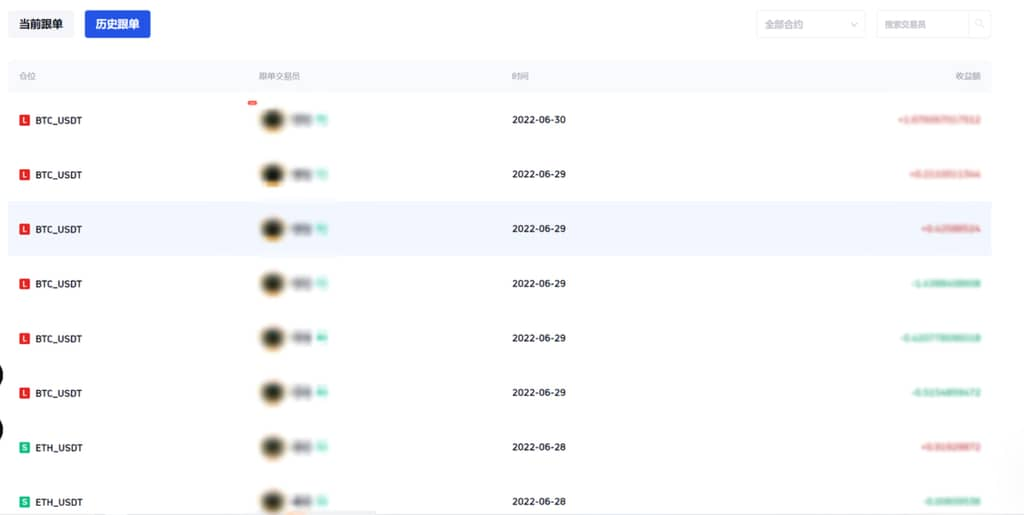
A: Historical profit is the sum of each copy trade’s profit shown in the image above.
Note: Unrealized P&L shown on the copy trading page is not included in copy trading profit.

Q10. Why Didn’t My Custom Leverage Setting Take Effect?
A: 1. Copy Trading Leverage Is Restricted by Risk Limits
If your custom leverage (e.g., 20x) didn’t take effect, it’s because the trader’s trade triggered the exchange’s risk limit mechanism. According to copy trading rules, the actual leverage used by the follower will not exceed the trader’s maximum available leverage for that trade.
A: 2. Explanation of the Risk Limit Mechanism
The exchange automatically assigns a risk limit tier based on the trader’s position value. The larger the position, the higher the risk limit tier, and the lower the maximum allowable leverage (for example, it may drop from 20x to 3x). If the trader’s maximum available leverage is only 3x due to a large position, your leverage will be automatically adjusted to 3x, even if you set it higher.
Related links:
Q11. What Is Maximum Entry Slippage? How Do I Set It?
A: 1. What Is Maximum Entry Slippage?
Maximum entry slippage refers to the maximum price deviation allowed when a follower copies a trader’s entry. The system will only execute the copy trade if the actual fill price does not exceed the slippage range you set compared to the trader’s entry price.
A: 2. Why Set Maximum Entry Slippage?
Due to copy trading latency, the follower’s actual fill price may differ from the trader’s entry price. Setting a maximum entry slippage allows you to control the maximum acceptable price deviation, helping ensure your entry price closely matches the trader’s.
A: 3. How to Set Maximum Entry Slippage
In the quick copy pop-up or copy trading parameter edit page, find the "Maximum Entry Slippage" option:
- Default: Use the system-recommended slippage setting.
- Custom: Manually input or drag the slider to set slippage, ranging from 0.1% to 3.0%.
A: 4. Notes
The smaller the slippage setting, the closer your entry price will be to the trader’s, but the higher the risk of copy trade failure if the price moves beyond the limit. The larger the slippage, the higher the success rate, but the greater the possible price deviation from the trader’s entry. Set this according to your personal preference.
Q12. Explanation of Contract Copy Trading Settlement Pop-up Fields
A: 1. Margin Balance (Project Level): Project wallet balance + unrealized P&L
A: 2. Total P&L: Margin balance – net copy trading amount
A: 3. Net Copy Trading Amount: Initial investment + total additional investment – total withdrawn principal
A: 4. Estimated Profit Share: Settled profit share + pending profit share
A: 5. Estimated Receivable (Project Level): Margin balance (project level) – remaining estimated profit share
A: 6. Remaining Estimated Profit Share: Unrealized P&L on unsettled positions × current profit share ratio
Q13. Will Trial Funds Be Reclaimed After Stopping Copy Trading?
A: Trial funds will be reclaimed after you stop copy trading.
Q14. Where Will Profits from Copy Trading with Trial Funds Be Transferred?
A: Any profits earned while using trial funds will be automatically transferred to your spot account after the trial funds expire or are voided.
Gate reserves the final right of interpretation for this product.
Disclaimer
The content provided herein is for reference and educational purposes only and does not constitute any financial, investment, trading, or legal advice, nor does it constitute an offer or solicitation to buy or sell any digital assets. Gate makes no express or implied representations or warranties regarding the accuracy, completeness, or timeliness of the information contained herein. Product features, interfaces, rules, and fee structures may be updated or adjusted at any time. Please refer to the latest announcements and the actual information displayed on the Gate platform for the most accurate details.
Digital asset investments involve significant risk, and prices may fluctuate substantially. You may lose the entire amount of your investment. Please make decisions cautiously based on your own financial situation and risk tolerance after fully understanding the associated risks. If necessary, you are advised to consult an independent professional financial or legal advisor.
For more information about potential risks, please refer to Gate's Risk Disclosure and User Agreement.
