As the AI industry enters a "hashrate infrastructure race," the market is increasingly recognizing a deeper structural reality: what truly dictates the pace of AI productivity release is not chip designers, but semiconductor manufacturing equipment makers.
When DRAM, HBM, NAND, and advanced logic processes all enter expansion cycles simultaneously, equipment companies are often the first to benefit. Every wafer capacity expansion must begin with equipment investment.
Wonik IPS is one of the key players in South Korea's equipment chain during this cycle.
The AI Semiconductor CapEx Cycle Is Entering the "Second Half of Expansion"
According to the latest broker research and industry data, global semiconductor capital expenditure (CapEx) is entering a classic "multi-driver cycle."
On one side, improving DRAM supply-demand dynamics are prompting Samsung Electronics and SK hynix to restart expansion plans. On the other, AI-driven demand for HBM (high-bandwidth memory) continues to surge, pushing up demand for advanced process equipment.
Korean brokerages expect this CapEx cycle to extend through 2027, with equipment demand remaining elevated and driving significant profit growth for Wonik IPS over the next two years. Under this structure, equipment companies typically exhibit a "orders lead, profits lag" pattern.
Wonik IPS's Core Business: Linking DRAM, NAND, and Advanced Process Equipment Chains
Wonik IPS focuses on semiconductor front-end manufacturing equipment, especially CVD (chemical vapor deposition) and ALD (atomic layer deposition) machines.
These tools don't design chips—they handle the critical thin-film deposition steps in wafer manufacturing, which have a decisive impact on chip yield and performance.
Within the industry chain, Wonik IPS is embedded in the expansion ecosystems of Samsung Electronics and SK hynix, making it a textbook "equipment-first beneficiary."
Market data shows its equipment is widely deployed for:
- DRAM production line upgrades
- HBM process expansion
- NAND Flash process improvements
- Auxiliary steps in advanced logic processes
This structure ties its performance closely to Korean memory chip capital expenditure.
Why the Stock Price Has Been Surging: Order Confirmation and Estimate Upgrades Converge
Wonik IPS's recent stock price surge isn't driven by a single factor but by the convergence of multiple cycle variables.
- Stronger order confirmation: As Samsung's Pyeongtaek plant and SK hynix's M15X factory push forward with expansions, equipment delivery is entering the realization phase. Analysts project revenue growth of around 45% this year, with operating profit nearly tripling, driven mainly by the recovery in DRAM and NAND investment.
- Upward market revisions: Multiple brokerages have raised target prices to historical highs, reflecting the market's early pricing of 2027 earnings. Equipment investment now extends beyond DRAM into NAND upgrades and advanced process modifications, strengthening order sustainability.
- Capital flow shifts: As Korea's semiconductor cycle restarts, foreign capital is returning to equipment stocks, amplifying volatility in small- and mid-cap names.
Korea's Equipment Chain: The First to React in the AI Cycle
Compared to chip companies, equipment makers have a clear "leading indicator" nature.
Why?
- Chip expansion must order equipment first.
- Equipment orders signal future capacity expectations.
- CapEx cycles typically precede profit cycles.
Therefore, as AI and memory cycles resonate, Korea's equipment chain often becomes the first sector to rise. Wonik IPS, Jusung Engineering, and SEMES form the core of Korea's equipment industry.
Among them, Wonik IPS is more directly tied to the memory equipment chain, making it a direct beneficiary of the DRAM/HBM cycle.
How Gate's Korea Stock Trading Opens Access to Korean Semiconductor Equipment Investment
With the launch of Korea stock trading on Gate, KOSDAQ equipment chain assets are now part of a unified trading system.
Key changes in this mechanism:
- Use USDT for pricing and settlement.
- Manage US, Hong Kong, and Korea stocks in one place.
- Lower cross-border investment barriers.
- Improve portfolio asset allocation efficiency.
For investors, this means Korean equipment stocks are no longer just regional assets—they become part of a global tech cycle allocation.
Trading Path and Structure for Investing in Wonik IPS on Gate
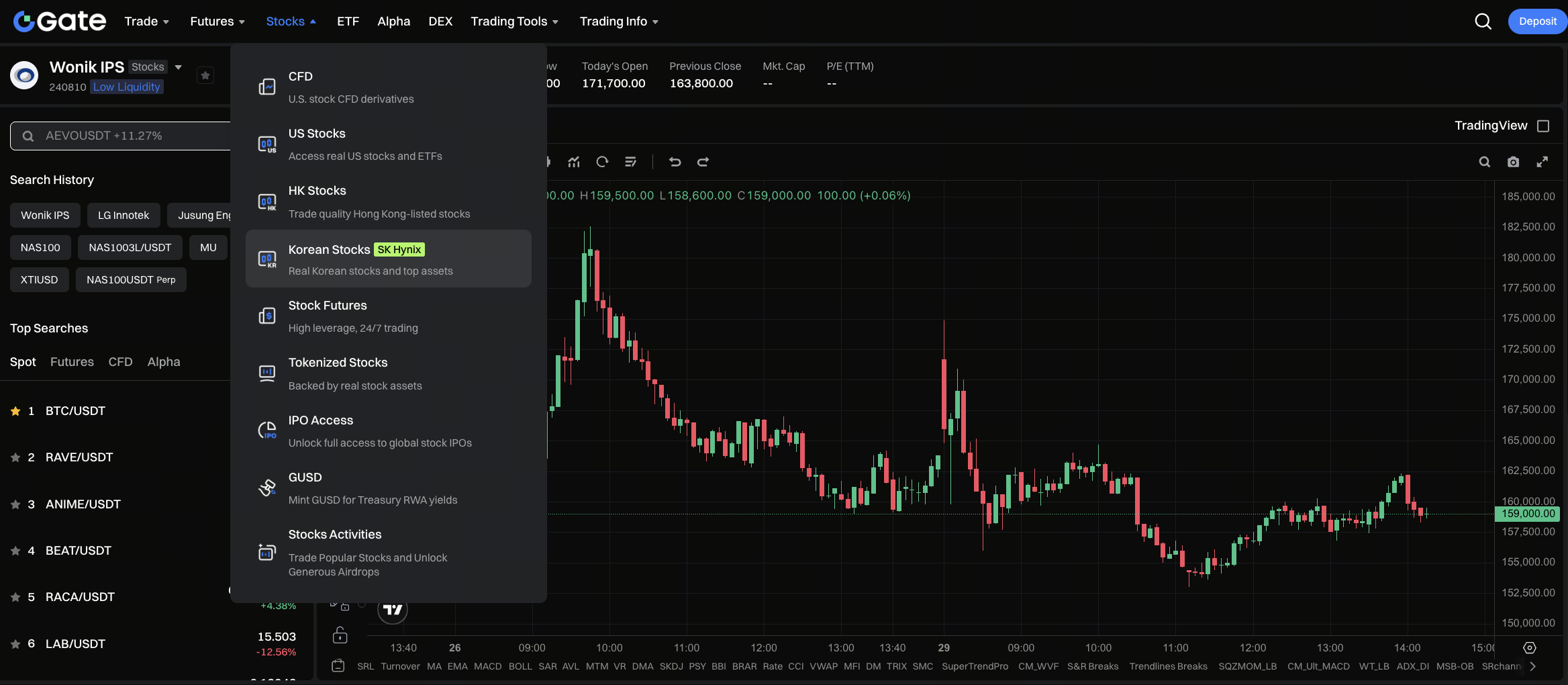
First, complete registration and identity verification on Gate. Then transfer USDT into your stock account as trading capital.
Go to Gate Korea Stock Trading, search for Wonik IPS or code 240810, and enter the trading interface.
After execution, your holdings are automatically included in the unified asset system, managed alongside US semiconductor stocks and Hong Kong tech assets.
The essence of this structure: cross-market investing shifts from an "account opening process" to an "asset allocation decision."
Financial Growth and Valuation Expansion: The Classic Equipment Stock Double Play
Wonik IPS is currently in a classic "Davis Double Play" situation: earnings are growing rapidly as orders are realized, and the market is already pricing in the next two years of the equipment cycle.
The company's P/E ratio has entered the 40–70x range, reflecting the market's partial pricing of growth expectations. This is common in the semiconductor equipment industry, where "orders drive earnings" and "expectations drive valuation."
Risk Structure: Equipment Cycles, Customer Concentration, and Technology Iteration Risks
Despite the clear trend, Wonik IPS remains a high-volatility asset.
Key risks:
- Equipment cycle fluctuations: If DRAM or NAND investment slows, orders can drop quickly.
- High customer concentration: Heavy reliance on Samsung and SK hynix.
- Technology iteration risks: New process changes could alter equipment demand.
Additionally, small- and mid-cap equipment stocks have lower liquidity, which amplifies price swings.
Conclusion: The True Beneficiaries Behind AI Chips
The investment logic of the AI industry is undergoing a structural shift. While the market focuses on GPUs and model companies, the equipment makers that truly determine the speed of capacity release are becoming the new cycle's core. Wonik IPS represents the most fundamental yet critical layer of the AI semiconductor supply chain: the source of manufacturing capability.
By bringing Korea's equipment chain into a unified trading system, Gate is re-integrating these deep-industry assets into the global capital perspective.
FAQs
-
Q1: What does Wonik IPS do?
It's a semiconductor equipment company, mainly providing deposition tools like CVD and ALD.
-
Q2: Why is it affected by AI?
AI drives expansion of DRAM, HBM, and NAND, which in turn boosts equipment demand.
-
Q3: Who are its main customers?
Primarily Samsung Electronics and SK hynix.
-
Q4: Do I need a Korean broker to trade it on Gate?
No, you can trade directly through your unified account.
-
Q5: Is it a growth stock or a cyclical stock?
It's a hybrid: strongly cyclical with growth-driven characteristics.