As the DeFi market continues to evolve, capital efficiency has become a key focus for liquidity protocols. Magma Finance supports both ALMM and CLMM models, offering choices for liquidity providers with varying needs and establishing itself as a representative dual-liquidity architecture within the Sui ecosystem.
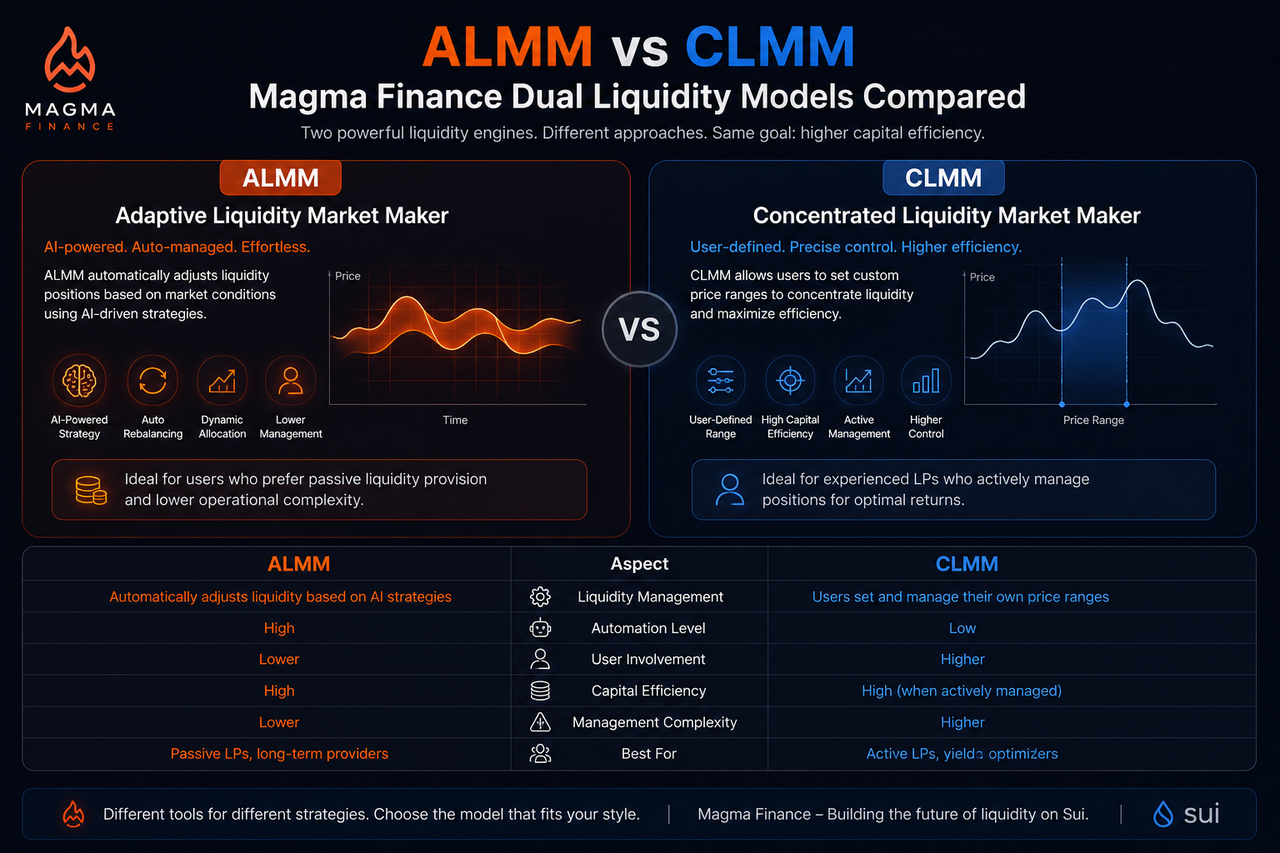
What Is ALMM?
ALMM (Adaptive Liquidity Market Maker) is an adaptive liquidity market-making mechanism introduced by Magma Finance. Its core objective is to reduce liquidity management complexity while maintaining high capital efficiency.
ALMM dynamically adjusts liquidity distribution in response to market conditions. After users supply assets, the protocol automatically handles a portion of the liquidity configuration, keeping capital consistently positioned near more active trading zones. Compared to traditional liquidity models, ALMM emphasizes automation and intelligent management.
This mechanism is designed to minimize the need for frequent position rebalancing, enabling a broader range of users to participate in high-efficiency liquidity markets.
What Is CLMM?
CLMM (Concentrated Liquidity Market Maker) is one of the most widely adopted liquidity models in the DeFi space.
CLMM allows liquidity providers to independently choose the price range for capital deployment. By concentrating liquidity within a specific price band, the same amount of capital supports more trading activity, resulting in significantly higher capital efficiency than traditional AMMs.
However, CLMM's advantages rely on active management. When the market price moves outside the selected range, liquidity providers must readjust their positions; otherwise, their funds cease to participate in trading.
Why Are the Two Models Often Compared?
ALMM and CLMM share highly similar goals—both aim to address the capital underutilization problem of traditional AMMs—so they are frequently discussed together.
On the surface, both models improve capital efficiency and enhance liquidity depth. Yet in practice, they impose entirely different requirements on users. CLMM prioritizes user-driven control, while ALMM favors protocol-driven automation.
Thus, understanding the differences between the two models matters more than simply comparing yield levels.
How Do Liquidity Management Approaches Differ?
Liquidity management is the most fundamental distinction between ALMM and CLMM.
With CLMM, users determine the liquidity deployment range themselves and adjust the price range as the market changes. Users enjoy high freedom but bear greater management responsibility.
ALMM, by contrast, employs automated management. The protocol dynamically optimizes liquidity configuration based on market conditions, keeping capital as close to active trading ranges as possible. Users maintain high capital utilization without frequent position adjustments.
In essence, CLMM entrusts management to users, whereas ALMM delegates a portion of management duties to the protocol.
Are There Differences in Capital Efficiency?
Capital efficiency is a critical metric for evaluating liquidity models.
CLMM significantly boosts capital utilization by concentrating liquidity. For experienced liquidity providers, a well-configured price range can generate higher fee income.
ALMM also targets improved capital efficiency but achieves it through automation. Its dynamic adjustment mechanism continuously optimizes fund positions, reducing idle liquidity.
Both models therefore offer high capital efficiency, but they achieve it via different routes.
How Does User Experience Vary?
User experience marks one of the clearest contrasts between the two models.
CLMM suits users familiar with market dynamics. Liquidity providers must monitor price movements, adjust ranges, and manage positions—leading to relatively high operational complexity.
ALMM functions more like an automated financial management tool. After depositing funds, most liquidity management is handled by the protocol. For participants without professional market-making experience, ALMM significantly lowers the barrier to entry.
This difference means the two models serve distinct user segments.
What Are the Differences in Risk Structure?
Neither ALMM nor CLMM can fully eliminate impermanent loss, so both carry market risk.
CLMM's risk primarily stems from user decisions. An improperly set price range may prevent liquidity from effectively supporting trading, thereby affecting yield.
ALMM relies on automated strategies. While this reduces human error, the strategy itself can be impacted by market conditions. During extreme market events, automatic rebalancing may not always perform optimally.
Thus, the two models face different sources of risk, but both must contend with market volatility.
Which Users Are ALMM and CLMM Suitable For?
User type often determines the more suitable liquidity model.
For users who prefer active position management and possess strong market analysis skills, CLMM offers greater control and strategic flexibility. They can tailor liquidity distribution to their own judgment and craft personalized market-making strategies.
For users seeking to reduce operational complexity and minimize frequent management demands, ALMM is more appealing. Automated liquidity configuration allows them to access high-capital-efficiency markets without constant market monitoring.
Neither model is inherently superior; they cater to different participation needs.
ALMM vs CLMM Comparison Table
| Dimension |
ALMM |
CLMM |
| Full Name |
Adaptive Liquidity Market Maker |
Concentrated Liquidity Market Maker |
| Liquidity Configuration |
Automatic adjustment |
User-set |
| Rebalancing Method |
Protocol-executed |
User-executed |
| User Participation |
Low |
High |
| Automation Level |
High |
Low |
| Capital Efficiency |
High |
High |
| Management Complexity |
Low |
High |
| Target Users |
Ordinary users and passive LPs |
Advanced LPs and professional market makers |
Summary
ALMM and CLMM are both important liquidity models for boosting capital efficiency, but they take different approaches. CLMM achieves high-efficiency liquidity configuration through active user management, while ALMM reduces operational complexity through automated strategies and dynamic adjustment mechanisms.
Within the Magma Finance ecosystem, the two models together form the liquidity infrastructure. CLMM provides professional users with greater control, and ALMM enables more ordinary users to participate in high-efficiency liquidity markets.
FAQs
What is the biggest difference between ALMM and CLMM?
The biggest difference lies in liquidity management. CLMM requires users to actively set and adjust price ranges, whereas ALMM automatically adjusts liquidity configuration based on market conditions.
Is ALMM's capital efficiency higher than CLMM's?
Both models offer high capital efficiency. CLMM's efficiency depends on user management skills, while ALMM continuously optimizes liquidity positions through automation. The approaches differ.
Why does Magma Finance offer both ALMM and CLMM?
Different users have different needs. CLMM suits advanced users who want active position management; ALMM suits ordinary liquidity providers who prefer lower operational complexity.
Do both ALMM and CLMM incur impermanent loss?
Yes. Impermanent loss is a common risk in liquidity provision. Neither ALMM nor CLMM can completely avoid the impact of market price fluctuations.
Is ALMM or CLMM better for beginners?
For users without active market-making experience, ALMM is generally easier to start with. Automated management reduces rebalancing needs, while CLMM is better suited for advanced users familiar with market dynamics.