This model makes American Tower an important infrastructure provider in the digital economy. As global mobile data traffic grows, 5G network construction accelerates, and cloud computing and IoT applications expand, telecom infrastructure continues to become more important. Compared with business models that depend on end-user consumption, infrastructure leasing usually offers greater stability and a longer revenue cycle.
American Tower’s assets mainly include communication towers, rooftop sites, distributed antenna systems, and certain digital infrastructure resources. Unlike traditional real estate investment trusts that hold office buildings, shopping centers, or residential properties, American Tower owns infrastructure assets that support the operation of wireless communication networks.
AMT is the ticker symbol for American Tower Corporation, which is listed and traded on the New York Stock Exchange (NYSE). Headquartered in Massachusetts, the company is one of the world’s largest independent communication tower operators and operates as a real estate investment trust (REIT).
After years of expansion, American Tower has built operating networks across North America, Europe, Latin America, Africa, Asia, and other regions. Because its business spans many countries and regions, the company has a highly diversified geographic revenue base, making it one of the most representative companies in the global telecom infrastructure industry.
American Tower’s Revenue Sources
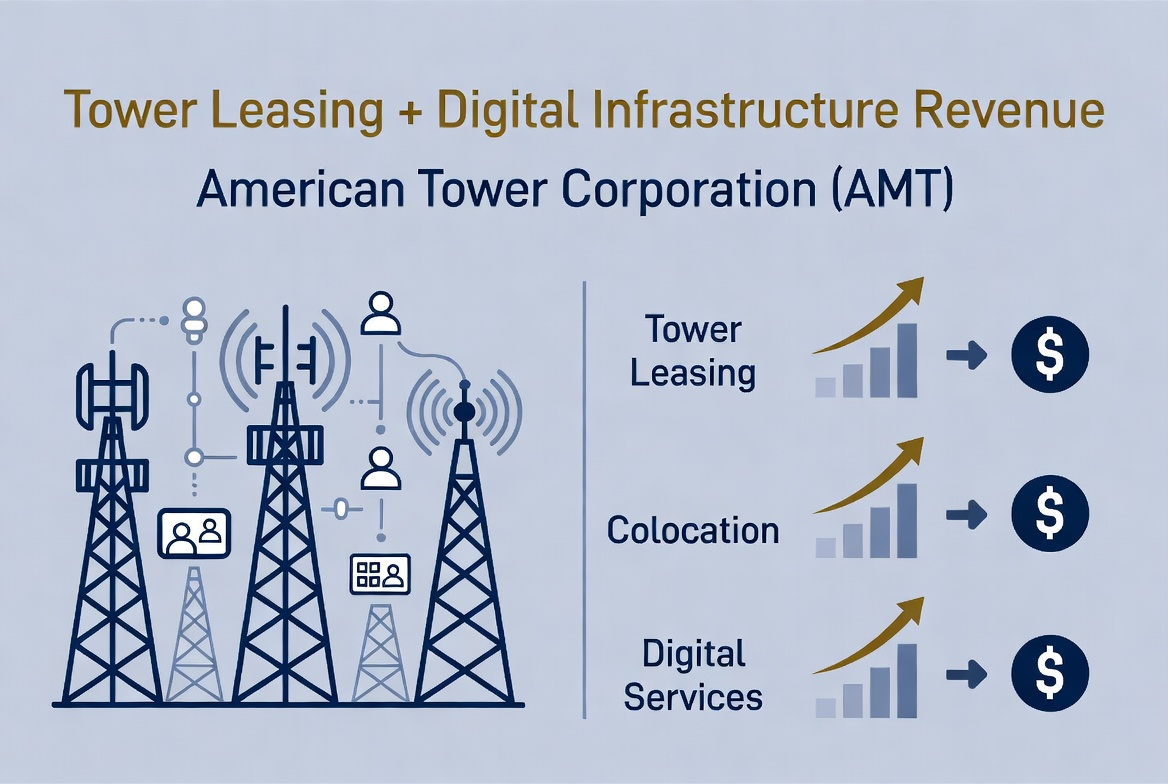
American Tower’s revenue mainly comes from communication tower leasing, along with some revenue related to digital infrastructure and data centers. The core feature of its business model is the ability to generate long term, stable cash flow through shared infrastructure.
Telecom operators need to deploy wireless equipment across different regions to ensure network coverage and data transmission capacity. To avoid repeatedly building new towers, most operators choose to lease existing infrastructure resources. American Tower earns rental income by providing site space, power access, and supporting facilities.
From a revenue structure perspective, tower leasing remains American Tower’s most important source of revenue. At the same time, the company has also been exploring digital infrastructure and edge computing related businesses in recent years, seeking new growth opportunities beyond traditional communication networks.
| Revenue Source |
Main Content |
| Tower leasing revenue |
Telecom operators lease sites |
| Network infrastructure services |
Supporting equipment and operational support |
| Digital infrastructure revenue |
Data centers and edge computing |
| Other leasing revenue |
Specialized communication facility leasing |
This revenue model allows American Tower to continue benefiting from the growth of global wireless communication demand.
How Communication Tower Leasing Generates Revenue
Communication tower leasing is American Tower’s core profit model. After building or acquiring communication towers, the company leases tower space to wireless operators for the installation of antennas and network equipment.
For operators, building towers independently requires significant capital investment and involves complex processes such as land acquisition, regulatory approvals, and ongoing maintenance. As a result, leasing existing infrastructure is usually more cost efficient. American Tower meets this demand by providing operators with mature site resources.
Once operators sign lease agreements, they pay rent regularly according to the contract. Because communication networks are long term operating assets, lease terms are usually relatively long, allowing the tower business to generate recurring revenue.
Compared with companies that sell products on a one time basis, American Tower’s revenue is closer to an infrastructure leasing model. As long as communication networks continue to operate, demand for site leasing will usually remain over the long term. This is the foundation of the stability of its business model.
Why the Multi-Tenant Model Improves Profitability
One of the most distinctive operating models in the communication tower industry is the Multi-Tenant Model. This model is also an important source of American Tower’s profitability.
Once a tower has been built, its fixed costs are largely set. If it serves only one operator, asset utilization is relatively limited. In practice, however, the same tower can often host equipment from multiple operators at the same time, creating several sources of revenue.
For American Tower, when a second or third operator joins the same site, the additional operating cost is usually far lower than the additional rental income. This means the marginal profit of a single asset can continue to rise as the number of tenants increases.
This shared infrastructure model not only improves tower utilization, but also reduces construction costs across the entire telecom industry. As a result, the multi-tenant structure has become one of the core business principles of the global communication tower industry.
How the Data Center Business Expands the Revenue Structure
As the digital economy develops, the boundaries of telecom infrastructure continue to expand. In recent years, American Tower has begun investing in data centers and digital infrastructure businesses, hoping to build new growth engines beyond its traditional tower business.
Data centers provide data storage, computing, and network connectivity functions, making them important infrastructure for cloud computing and internet services. As enterprise digital transformation accelerates, more data needs to be processed closer to users, which is also driving the development of the edge computing market.
American Tower has an extensive communication site network, giving it a natural advantage in developing edge infrastructure. By combining communication resources with data processing capabilities, the company can build new business connections between wireless communications and digital services.
Although the data center business is still smaller than the traditional tower business, its strategic importance is steadily increasing. In the future, digital infrastructure revenue may become an important supplement to American Tower’s overall revenue structure.
Why Long Term Contracts Strengthen Cash Flow Stability
One important reason American Tower can maintain strong operating stability is its long term contract model. Unlike many cyclical industries, telecom infrastructure usually requires continuous long term operation, so lease terms are generally lengthy.
After operators deploy wireless equipment, relocating sites often requires replanning network coverage and taking on additional costs. Therefore, once deployment is complete, operators usually do not change tower service providers frequently. This gives American Tower strong customer retention.
Long term contracts also improve revenue predictability. The company can assess future cash flow more accurately based on existing lease agreements, supporting asset investment and business expansion plans.
For infrastructure companies, stable cash flow is often more important than short term high growth. For this reason, long term contracts have become an important pillar of American Tower’s business model and one of the reasons the market views it as an infrastructure-style asset.
Conclusion
American Tower’s business model is built on telecom infrastructure leasing. Its core revenue sources include tower leasing, multi-tenant operations, and a gradually expanding digital infrastructure business. By sharing site resources, the company helps telecom operators reduce construction costs while earning long term, stable rental income. As 5G network construction, mobile data traffic growth, and the digital economy continue to develop, telecom infrastructure is becoming increasingly important, while long term contracts and the multi-tenant model further strengthen American Tower’s cash flow stability and profitability.
FAQs
How Does American Tower Mainly Make Money?
American Tower mainly earns rental income by leasing tower and wireless site space to telecom operators. This is the company’s core revenue source.
What Is the Multi-Tenant Model?
The multi-tenant model means that one communication tower serves multiple operators at the same time. Because the cost of adding new tenants is relatively low, it can significantly improve asset profitability.
Why Is American Tower Considered a REIT?
American Tower operates under a real estate investment trust (REIT) structure. Its main assets are telecom infrastructure, and it generates revenue through leasing.
What Does the Data Center Business Mean for AMT?
Data center and digital infrastructure businesses help expand revenue sources and allow American Tower to participate in edge computing and digital economy related markets.
Why Are Long Term Contracts Important?
Long term contracts improve revenue predictability, strengthen cash flow stability, and reduce operating risks related to customer churn.
How Does 5G Development Affect American Tower?
5G networks require denser infrastructure deployment, which may drive demand for communication sites and increase demand for communication tower leasing.