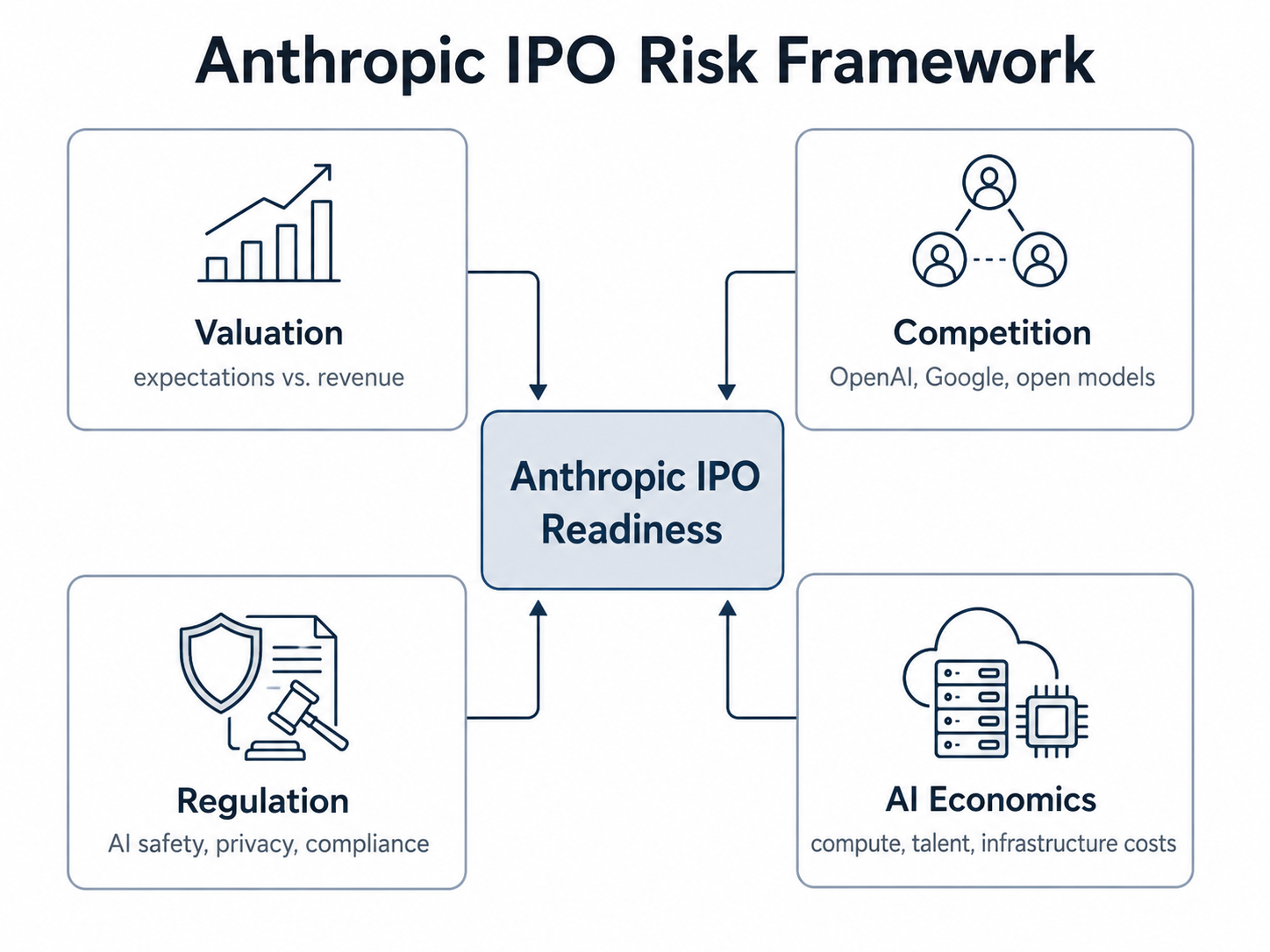
Anthropic IPO risks are mainly related to valuation pressure, competition from major AI companies, regulatory uncertainty, and the financial challenges of building advanced artificial intelligence systems. A potential Anthropic IPO would require Anthropic to show that Claude AI can support sustainable business growth while competing with OpenAI, Google DeepMind, Meta AI, and rapidly improving open-source AI models.
Anthropic has become one of the most closely watched AI companies through its Claude AI model family and AI safety-focused research approach. Understanding Anthropic’s technology position, business model, and valuation expectations provides important context when evaluating possible IPO risks.
Anthropic’s business model depends on enterprise AI adoption, API usage, cloud infrastructure partnerships, and continued development of advanced AI systems. The company’s ability to convert AI capabilities into predictable revenue will be a key factor in public-market evaluation.
For a broader understanding of Anthropic’s commercial structure, Anthropic’s Claude AI business model, IPO valuation considerations, and market positioning provide important background when evaluating the company’s future growth challenges.
TL;DR
-
Anthropic IPO risks include valuation uncertainty, competition, regulatory requirements, and high AI infrastructure costs.
-
Anthropic competes with OpenAI, Google DeepMind, Meta AI, and open-source AI developers.
-
Advanced AI models require significant spending on computing resources, research talent, and model safety systems.
-
Public investors may evaluate Anthropic based on revenue growth, profitability potential, and competitive differentiation.
-
AI regulation could affect Anthropic’s product development, enterprise adoption, and operational costs.
What Are the Main Anthropic IPO Risks?
The main Anthropic IPO risks come from the difficulty of turning frontier AI technology into a sustainable public-company business.
Unlike traditional software companies, AI companies require continuous investment in:
| Area |
IPO Risk Impact |
| Computing infrastructure |
Higher costs for training and running advanced AI models |
| Research capability |
Continued need for specialized AI researchers and engineers |
| Product development |
Constant improvement required to remain competitive |
| Safety systems |
Additional testing and governance requirements |
A public company must demonstrate not only technological capability but also financial discipline.
The central question for Anthropic is whether Claude’s technical performance can translate into durable commercial demand.
Anthropic Valuation Risk: Can AI Expectations Match Financial Reality?
Anthropic valuation risk is one of the most important IPO challenges because AI companies have attracted significant private-market investment based on future growth expectations.
Anthropic has received major strategic investment and infrastructure support from technology companies including Amazon and Google.
These relationships provide access to cloud infrastructure and technology resources, but they also highlight the expensive nature of frontier AI development.
A potential IPO would require public investors to evaluate several questions:
| Valuation Factor |
Key Question |
| Revenue growth |
Can Anthropic convert Claude adoption into recurring revenue? |
| Cost structure |
Can Anthropic manage AI infrastructure expenses? |
| Market position |
Can Anthropic maintain differentiation against competitors? |
| Long-term margins |
Can AI services become economically sustainable? |
One major risk is that private-market expectations may exceed public-market tolerance.
Public investors typically evaluate companies through measurable financial indicators rather than technology potential alone.
Competition Risk: Anthropic vs OpenAI, Google DeepMind and Open-Source AI
Anthropic competition risk is significant because the AI market contains several companies with different strategic advantages.
| Company |
AI Platform |
Competitive Strength |
| Anthropic |
Claude |
Enterprise AI focus and safety research |
| OpenAI |
GPT models |
Consumer adoption and developer ecosystem |
| Google DeepMind |
Gemini |
Search, cloud, and research infrastructure |
| Meta AI |
Llama |
Open-source model ecosystem |
| Open-source developers |
Various models |
Customization and lower-cost deployment |
Anthropic’s challenge is that AI competition is not determined only by model quality.
Companies compete through:
For Anthropic, maintaining market differentiation will require more than releasing capable AI models. Anthropic must show that enterprises continue choosing Claude for specific business needs.
Anthropic Business Model Risk: Revenue Growth Versus AI Costs
Anthropic business model risk comes from the economic challenge of operating advanced AI services.
Anthropic generates business value through areas such as:
-
Claude enterprise applications;
-
API access for developers;
-
AI-powered workflows;
-
organizational adoption of AI assistants.
However, AI businesses face significant operating expenses.
A simplified AI business model calculation is:
AI service revenue - computing costs - research expenses - operational costs = sustainable business potential
Major cost areas include:
| Cost Area |
Business Challenge |
| AI computing |
Advanced models require substantial processing resources |
| Research teams |
Frontier AI development requires specialized talent |
| Model evaluation |
Safety and reliability testing add operational complexity |
| Infrastructure |
Scaling AI services requires significant investment |
A successful Anthropic IPO would likely depend on whether revenue growth can outpace increasing AI development costs.
Readers evaluating Anthropic’s commercial structure can better understand these dynamics by examining how Anthropic generates revenue through Claude API services, enterprise adoption, and AI business operations.
Regulatory Risk: How AI Rules Could Affect Anthropic
Anthropic regulatory risk comes from increasing government attention toward artificial intelligence safety, transparency, privacy, and security.
The European Union AI Act, which entered into force in 2024, introduced comprehensive AI governance requirements that may influence how advanced AI systems are developed and deployed.
Potential regulatory impacts include:
| Regulatory Area |
Possible Effect |
| AI transparency |
Additional documentation requirements |
| Safety evaluation |
More testing before deployment |
| Data governance |
Greater scrutiny of training practices |
| Enterprise usage |
Additional compliance considerations |
Although Anthropic has emphasized AI safety research, regulatory requirements could still increase operational complexity.
AI companies may need to balance innovation speed with compliance responsibilities.
IPO Timing Risk: Market Conditions Matter
Anthropic IPO timing risk depends on broader market conditions.
Factors that may influence IPO outcomes include:
| Market Factor |
Potential Impact |
| AI investment sentiment |
Changes investor expectations |
| Technology valuations |
Influences public-market pricing |
| Economic conditions |
Affects demand for growth companies |
| Competitive announcements |
Changes market perception |
A strong technology company can still face challenges if market conditions are unfavorable.
Anthropic IPO Risks Compared With Other AI Companies
| Risk Category |
Anthropic |
OpenAI |
Google DeepMind |
| Valuation pressure |
High due to AI growth expectations |
High due to AI market attention |
Lower due to Google’s broader business |
| Competition |
Competes with multiple AI ecosystems |
Faces broad AI competition |
Benefits from Google distribution |
| Infrastructure costs |
Significant |
Significant |
Supported by Google infrastructure |
| Regulation |
High due to frontier AI models |
High due to global deployment |
High due to platform scale |
| Business model transition |
Requires scalable AI revenue |
Requires sustainable monetization |
Integrated with existing products |
The comparison shows that Anthropic faces many challenges shared by frontier AI companies. However, as an independent AI company, Anthropic may face stronger pressure to prove financial sustainability.
How to Evaluate Anthropic IPO Risks
A practical framework for evaluating Anthropic IPO risks includes five areas:
| Evaluation Area |
Question |
| Technology |
Can Anthropic maintain AI competitiveness? |
| Revenue |
Is enterprise demand creating predictable income? |
| Costs |
Can infrastructure expenses be controlled? |
| Competition |
Does Claude maintain meaningful differentiation? |
| Regulation |
Can Anthropic adapt to AI governance requirements? |
Understanding these factors helps separate AI industry enthusiasm from measurable business fundamentals.
Readers researching Anthropic before a possible IPO should focus on company structure, market positioning, and business fundamentals rather than relying only on valuation expectations.
Summary
Anthropic IPO risks include valuation uncertainty, competition from major AI companies, regulatory requirements, and the high cost of developing advanced AI systems.
Anthropic’s Claude models have positioned the company as an important AI industry participant, but a future IPO would require Anthropic to demonstrate sustainable revenue growth, operational efficiency, and long-term differentiation.
The biggest challenge is transforming frontier AI research into a scalable business model capable of meeting public-market expectations.
FAQs
What are the biggest Anthropic IPO risks?
The biggest Anthropic IPO risks are valuation uncertainty, competition from companies such as OpenAI and Google DeepMind, regulatory changes, and the cost of operating advanced AI systems.
Will Anthropic launch an IPO?
Anthropic has not announced a confirmed IPO date. Any future public listing would depend on company strategy, financial readiness, and market conditions.
How does Anthropic make money?
Anthropic generates business value through Claude AI products, API access, enterprise applications, and partnerships supporting AI deployment.
How is Anthropic different from OpenAI?
Anthropic focuses on Claude AI models and AI safety research, while OpenAI focuses on GPT models, consumer products, and developer ecosystem growth.
Why are AI IPOs risky?
AI IPOs can face challenges because companies often require significant infrastructure investment before achieving predictable profitability.