Anthropic is not simply a smaller OpenAI, and Google DeepMind is not just another AI lab. Each company occupies a different position in the foundation model market. OpenAI leads as an independent AI platform, Google DeepMind benefits from Google's integrated ecosystem, and Anthropic specializes in enterprise AI, coding agents and safety-oriented model development.
TL;DR
-
OpenAI has the strongest standalone AI platform, combining ChatGPT, APIs, enterprise workspaces and Codex under one widely recognized brand.
-
Google DeepMind has the strongest structural position because Gemini is supported by Google Search, Workspace, Android, Google Cloud and custom AI infrastructure.
-
Anthropic has the clearest specialist strategy, emphasizing Claude, professional workflows, coding, model behavior and governed enterprise adoption.
-
Claude vs ChatGPT vs Gemini is only one layer of the comparison. Distribution, computing capacity, developer ecosystems and enterprise integration may matter more than temporary benchmark leads.
-
No company is best for every workload. The practical choice depends on existing cloud systems, model evaluations, security requirements, integration needs and concentration risk.
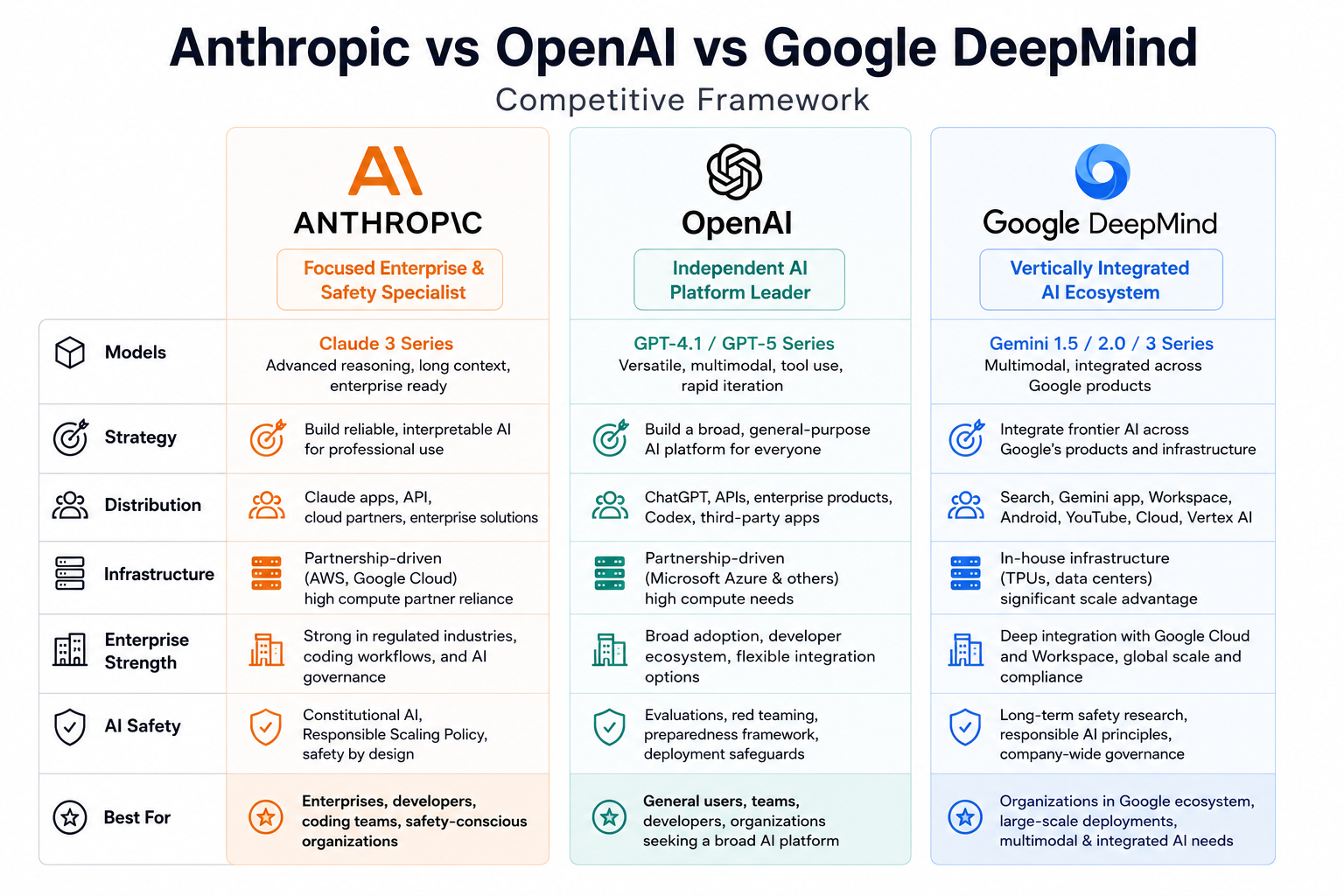
Anthropic vs OpenAI vs Google DeepMind at a Glance
The main difference between Anthropic, OpenAI and Google DeepMind is not simply which laboratory has the most capable model. Each company is building a different type of competitive system around its models.
| Comparison area |
Anthropic |
OpenAI |
Google DeepMind |
| Main model and assistant |
Claude |
GPT and ChatGPT |
Gemini |
| Strategic identity |
Focused frontier AI company |
Independent general-purpose AI platform |
AI research and model organization within Google |
| Main distribution |
Claude products, APIs, coding tools and cloud partners |
ChatGPT, enterprise products, APIs and Codex |
Search, Workspace, Android, Gemini and Google Cloud |
| Infrastructure position |
Relies heavily on strategic cloud and chip partners |
Depends on large infrastructure partnerships |
Direct access to Google infrastructure and TPUs |
| Enterprise advantage |
Focused professional, coding and governed AI positioning |
Familiar interface and broad application ecosystem |
Native connection to existing Google environments |
| Safety identity |
Constitutional AI and Responsible Scaling Policy |
Preparedness, evaluations and deployment safeguards |
Long-running safety research and Google-wide governance |
| Main strategic risk |
Smaller direct distribution base |
High capital needs and broad execution demands |
Product complexity and incumbent-business conflicts |
The table shows why a simple “best AI lab” ranking is misleading. Model capability can change with each release, but infrastructure, distribution and customer relationships are harder to reproduce.
What Is Anthropic?
Anthropic is a frontier AI company that develops the Claude model family, Claude applications, APIs and Claude Code. Its positioning is built around capable AI systems that are reliable, interpretable and easier for organizations to govern.
Anthropic’s best-known research contribution is Constitutional AI. Claude’s constitution describes the intended values and behavioral principles that influence the model’s training and responses. Anthropic also released version 3.0 of its Responsible Scaling Policy in February 2026, linking stronger safeguards to increasingly capable systems. These frameworks demonstrate a structured safety strategy, although a published policy does not prove that all model risks have been resolved.
Commercially, Anthropic is moving beyond the identity of a research laboratory. Claude is increasingly positioned for coding, document analysis, tool use and professional workflows. The company’s strategic strengths and weaknesses are explored further in Gate Learn’s analysis of Anthropic’s competitive advantage.
Anthropic’s focused positioning may improve product clarity, but the company lacks the global search, mobile and productivity distribution available to Google. It also depends more heavily on infrastructure partners. Those dependencies are important when evaluating Anthropic’s business model, valuation and potential IPO path.
What Is OpenAI?
OpenAI is an AI research and deployment company whose ecosystem includes GPT models, ChatGPT, enterprise workspaces, APIs and Codex. Its primary advantage is the connection between frontier-model development and a standalone AI product used directly by consumers, teams and developers.
ChatGPT gives OpenAI control over a direct customer relationship. OpenAI can introduce new models, tools and agent capabilities without depending entirely on another company’s search engine, operating system or productivity suite. Its API extends the same model ecosystem into third-party applications.
OpenAI’s strategy is also expanding from answering questions toward completing tasks. Codex, application connections and agentic workflows place OpenAI in competition not only with model providers but also with software-development tools, enterprise platforms and workplace applications.
This breadth creates a strong platform effect, but it also creates execution risk. OpenAI must simultaneously fund model development, secure computing capacity, operate consumer services, support enterprise requirements and build a reliable developer ecosystem. Its market position therefore depends on more than ChatGPT’s visibility.
What Is Google DeepMind?
Google DeepMind is Google’s central frontier AI research and model-development organization. Gemini models are distributed through the Gemini application, Google Search, Workspace, Android, AI Studio, Vertex AI and other Google services.
Google DeepMind’s core strategic advantage is vertical integration. Google can research models, train them on custom infrastructure, distribute them through existing products and monetize them through cloud services, subscriptions, productivity software and advertising-supported experiences.
This makes Google DeepMind different from a standalone AI laboratory. Gemini does not need to win users only through a dedicated chatbot. Google can place AI capabilities inside services that individuals and organizations already use.
Google’s breadth can also create friction. Users and enterprise buyers must distinguish between Gemini models, Gemini applications, Workspace features, developer APIs, Vertex AI and agent platforms. A wide ecosystem creates more distribution opportunities, but not necessarily a simpler purchasing or deployment decision.
How Do Their Technology Strategies Differ?
Anthropic, OpenAI and Google DeepMind all develop multimodal foundation models, but they emphasize different routes from model capability to practical value.
Anthropic Focuses on Reliable Professional Agents
Anthropic concentrates on model behavior, long-context professional work, coding and controlled agentic execution. Claude Code is strategically important because coding agents can become embedded in repositories, terminals, testing environments and deployment processes.
That creates a stronger relationship than occasional chatbot use. Once an agent understands a codebase and becomes part of a development workflow, switching costs may increase.
Anthropic’s approach is therefore best understood as focused depth: win demanding professional workloads, demonstrate reliable behavior and expand through enterprises and cloud partners.
OpenAI combines models with ChatGPT, APIs, coding tools, memory, connectors and agents. The strategy is horizontal because OpenAI wants to serve many industries and task categories through one adaptable platform.
Its reinforcing cycle is straightforward:
-
ChatGPT introduces users to new capabilities.
-
Enterprise workspaces bring those capabilities into managed environments.
-
APIs let developers build independent products.
-
Codex targets software-development workflows.
-
Agents and connectors expand the tasks completed inside the ecosystem.
The main advantage is flexibility. The main risk is complexity and the cost of competing across so many product categories.
Google DeepMind Builds a Vertically Integrated AI Layer
Google DeepMind connects frontier-model research with Google’s infrastructure, data systems, cloud platform and consumer distribution. Gemini can operate as an assistant, a developer model, a Workspace feature, a Search component or an enterprise agent layer.
Google can also optimize across chips, data centers, models and applications. Anthropic and OpenAI can secure major infrastructure partnerships, but neither controls an equivalent end-to-end consumer and enterprise technology stack.
Claude vs ChatGPT vs Gemini: Which Ecosystem Is Strongest?
Google has the broadest integrated ecosystem, OpenAI has the strongest independent AI-native ecosystem, and Anthropic has the most focused professional proposition.
| User requirement |
Strongest strategic fit |
Why |
| General-purpose standalone assistant |
ChatGPT |
Broad assistant, tool and application ecosystem |
| Google Workspace integration |
Gemini |
Native integration with Google services |
| Focused coding workflows |
Claude or Codex |
Both companies treat coding agents as a major product category |
| Google Cloud deployment |
Gemini |
Direct connection to Vertex AI and Google governance tools |
| Focused enterprise model provider |
Claude |
Clear emphasis on professional and governed AI use |
| Direct consumer distribution |
ChatGPT and Gemini |
ChatGPT has an AI-native brand; Gemini benefits from Google distribution |
| Reduced provider dependency |
Multi-model strategy |
Allows workload-specific selection and operational redundancy |
The table should not be interpreted as a fixed product ranking. Organizations need to test models against representative tasks because quality, latency, cost and tool reliability can differ substantially by workload.
How Do Their AI Safety Strategies Compare?
Anthropic makes safety the most visible part of its corporate identity, OpenAI connects safety testing with iterative deployment, and Google DeepMind combines technical safety research with broader Google governance.
Anthropic’s Constitutional AI and Responsible Scaling Policy provide a clear public framework. OpenAI emphasizes evaluations, red teaming, preparedness and safeguards around deployed products. Google DeepMind contributes long-running research in alignment, reinforcement learning, interpretability and responsible AI.
However, independent research shows that corporate AI safety remains incomplete. A 2025 analysis of 1,178 safety and reliability papers found that industry research was concentrated in pre-deployment alignment and evaluation, while important gaps remained in areas such as finance, healthcare, misinformation, hallucinations and persuasive systems.
Another literature review of Anthropic, Google DeepMind and OpenAI identified limited work in areas including multi-agent safety and safety by design. Published research therefore demonstrates investment in safety, not proof that frontier AI systems are fully understood or controlled.
Which Company Has the Strongest Enterprise Strategy?
Google has the strongest existing enterprise distribution, OpenAI has the broadest independent enterprise platform, and Anthropic has the sharpest specialist positioning.
Google can combine Gemini with Google Cloud, Workspace, data infrastructure, cybersecurity and identity systems. This is particularly attractive to organizations already standardized on Google technology.
OpenAI benefits from ChatGPT familiarity. Employees may already understand the interface, while enterprise plans, APIs and Codex create pathways from individual productivity to managed deployment.
Anthropic competes through focus. Claude is positioned for knowledge work, software development and controlled enterprise use. Its revenue strategy depends heavily on subscriptions, API consumption and enterprise agreements, as outlined in Gate Learn’s explanation of how Anthropic makes money.
No provider should be selected solely because it leads a public benchmark. Enterprise evaluation should include accuracy, security, data controls, latency, integration cost, availability, auditability and the consequences of vendor dependency.
Who Has the Strongest Market Position?
Google DeepMind has the strongest structural position, OpenAI has the strongest independent AI brand, and Anthropic has the strongest focused-challenger position.
This verdict uses six dimensions:
| Strategic layer |
Anthropic |
OpenAI |
Google DeepMind |
| Frontier model capability |
Strong |
Strong |
Strong |
| Consumer distribution |
Limited but growing |
Very strong |
Exceptional |
| Developer ecosystem |
Strong |
Very strong |
Very strong |
| Enterprise access |
Strong and growing |
Very strong |
Exceptional |
| Infrastructure control |
Partner-dependent |
Partner-dependent |
Vertically integrated |
| Strategic focus |
Highly focused |
Broad AI platform |
Broad Google ecosystem |
Google’s structural lead comes from owning infrastructure and distribution. OpenAI’s advantage comes from ChatGPT’s direct relationship with users and developers. Anthropic’s advantage comes from strategic clarity, coding adoption and the ability to position Claude as an alternative to larger platform companies.
Anthropic’s smaller distribution base and high infrastructure requirements remain material risks. Gate Learn’s review of Anthropic IPO risks examines how competition, capital intensity and partner dependence could affect the company’s long-term position. Readers considering private-market exposure should separately understand the limitations involved in trying to invest in Anthropic before an IPO.
Which AI Company Should Users Choose?
The best choice depends on the workload and operating environment.
Choose Anthropic when:
-
Claude performs best in internal coding or document evaluations.
-
A focused model provider is preferred.
-
Governed professional workflows are the main priority.
-
Provider diversification matters.
Choose OpenAI when:
-
Teams already use ChatGPT.
-
A broad assistant, API, coding and agent ecosystem is required.
-
Developers want extensive tooling and integration support.
-
A standalone AI platform is preferable.
Choose Google DeepMind and Gemini when:
-
The organization relies on Google Cloud or Workspace.
-
Search, Android or Google-product integration matters.
-
AI infrastructure and governance should remain within one ecosystem.
-
Distribution and multimodal integration are strategic priorities.
Consider a multi-model strategy when:
-
Different workloads favor different providers.
-
Business continuity requires reduced concentration.
-
Cost and latency vary materially by task.
-
Regulatory or contractual controls differ across workloads.
A multi-model architecture can improve flexibility, but it also adds evaluation, routing, security and governance complexity.
Summary
Anthropic vs OpenAI vs Google DeepMind is ultimately a comparison between three models of AI leadership.
Anthropic is the focused enterprise, coding and safety-oriented challenger. OpenAI is building the strongest independent AI-native platform. Google DeepMind combines frontier research with an infrastructure and distribution network that independent laboratories cannot easily reproduce.
Google currently holds the strongest structural position, while OpenAI has the strongest standalone AI brand. Anthropic remains highly competitive because focus can outperform scale in specific professional and developer workflows.
The foundation model competition is unlikely to produce one permanent winner. Model leadership can change quickly. Durable market power will depend on distribution, infrastructure efficiency, workflow integration, enterprise trust and the ability to convert technical capability into dependable results.
FAQs
Is Anthropic better than OpenAI?
Anthropic is not universally better than OpenAI. Claude may perform better for certain coding, document and professional workflows, while OpenAI offers a broader ecosystem through ChatGPT, APIs, Codex and enterprise products.
Is Google DeepMind ahead of OpenAI?
Google DeepMind has a stronger infrastructure and distribution position, but Gemini does not necessarily lead every model or application category. OpenAI retains a powerful independent brand and direct relationship with users.
What is the main difference between Claude, ChatGPT and Gemini?
Claude emphasizes professional work, coding and controlled model behavior. ChatGPT operates as a broad standalone assistant and AI platform. Gemini is deeply integrated with Google Search, Workspace, Android and Google Cloud.
Which company is strongest for enterprise AI?
Google has the broadest existing enterprise distribution, OpenAI has a strong independent enterprise ecosystem, and Anthropic offers the most focused Claude-centered proposition. The best choice depends on existing infrastructure and tested workloads.
Will one AI laboratory dominate the market?
Permanent dominance is uncertain. Rapid model releases, open-weight competition, infrastructure costs and workload-specific performance are likely to support several major AI ecosystems.