As high-performance Layer 1 blockchains enter the era of ecosystem competition, relying solely on high TPS or low fees is no longer enough to build a lasting edge. For PoS networks, boosting staking rates, strengthening network security, and unlocking on-chain liquidity have become critical priorities for ecosystem growth. Liquid staking protocols have emerged as a game-changer, freeing users from having to choose between "earning staking rewards" and "participating in DeFi." As a result, they are quickly becoming a cornerstone of public chain ecosystems.
From the lens of blockchain infrastructure evolution, aPriori is far more than a simple staking protocol—it's a reward coordination system that seamlessly connects validators, users, liquidity markets, and DeFi applications. As the Monad mainnet ecosystem expands, liquid staking tokens, yield-bearing assets, and capital efficiency mechanisms are laying the groundwork for the next wave of DeFi innovation.
Breaking Down aPriori's Core Architecture
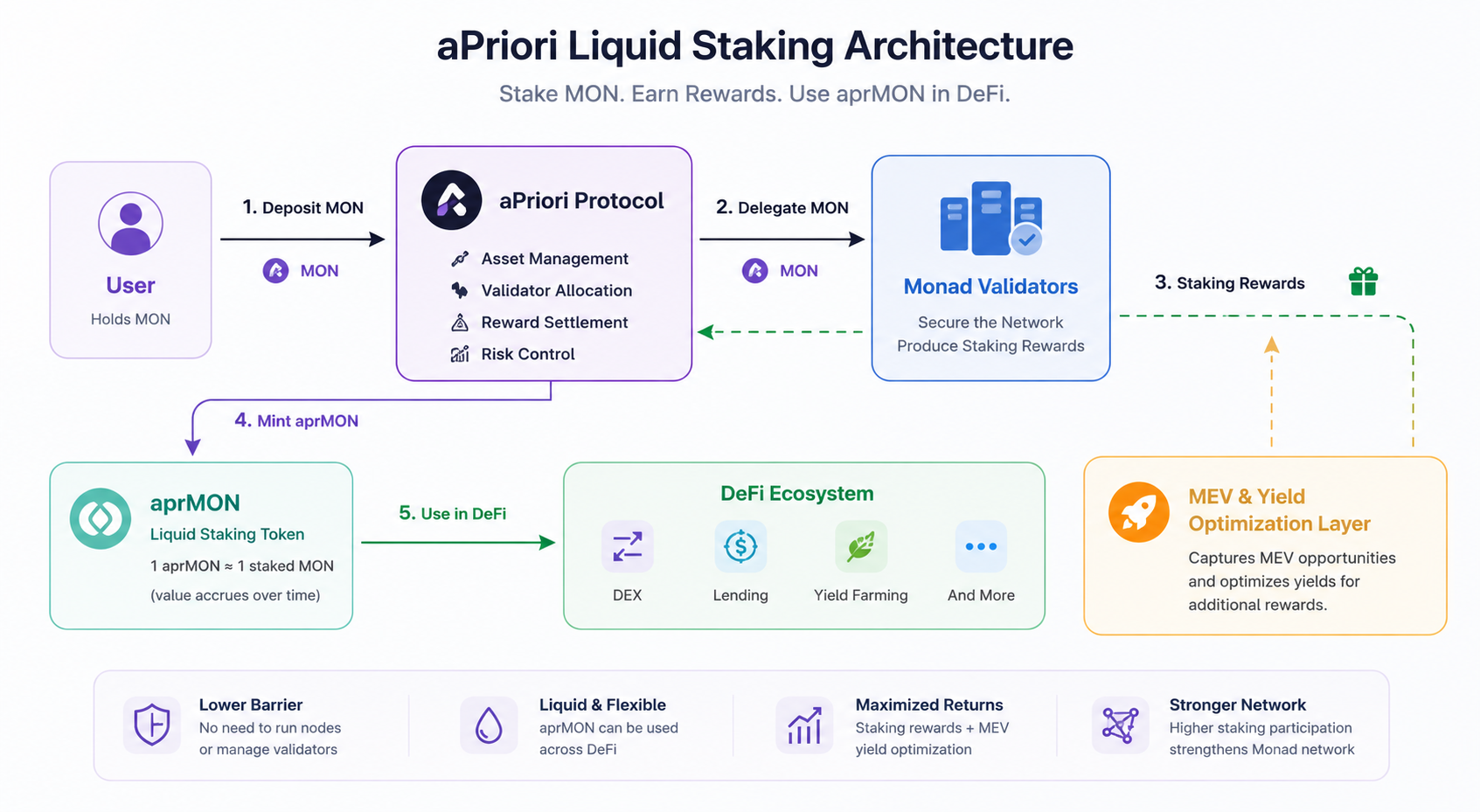
At its core, aPriori's architecture is built on four key modules:
- Staking Layer (User)
- Validator Layer (Delegation)
- aprMON Layer (Liquid Staking Asset)
- MEV Layer (Yield Optimization)
When users deposit MON into the protocol, the system automatically handles the staking process and issues an equivalent amount of aprMON. Here's the flow: Deposit MON → Protocol delegates to validators → Staking rewards accrue → aprMON is minted → Users dive into DeFi applications.
The beauty? Users don't need to run nodes or manage validators directly. The protocol takes care of:
- Asset management
- Validator allocation
- Reward settlement
- Risk control
This approach slashes the technical barrier for everyday users to stake on Monad while boosting the network's overall staking rate. Compared to traditional staking services, aPriori adds liquidity and yield enhancement layers, letting assets work harder across multiple scenarios.
Liquid Staking: Supercharging Capital Efficiency
In traditional PoS networks, staking comes with a lock-up period. You earn network rewards, but your assets are stuck—unavailable for other investments. It's a classic trade-off: staking rewards or DeFi participation.
Liquid staking flips the script. With aPriori, the aprMON you receive from staking MON is freely transferable, tradeable, and usable across other protocols. Even though the underlying MON is securing the network, you still keep the liquidity.
This is a game-changer for capital efficiency. Instead of an asset doing just one job, it now pulls double—or triple—duty. For instance, you can earn staking rewards from the underlying MON while using aprMON as collateral in lending protocols for extra yield, or providing it as liquidity to earn trading fees.
From a DeFi perspective, capital efficiency has always been a key innovation driver. Liquid staking protocols let assets flow between different protocols, creating a richer, more efficient web of financial activity. That's why Liquid Staking has become a major infrastructure track across Ethereum, Solana, and new blockchain ecosystems.
Validator Network and Node Selection: The Mechanics
Validators are the backbone of any PoS network, handling transaction verification, security, and block production. So, a liquid staking protocol's validator selection method directly impacts user rewards and network safety.
aPriori doesn't pile all user assets onto a single node. Instead, it uses a multi-validator delegation model. This reduces centralization risk and prevents any single validator's failure from disrupting the whole protocol.
When choosing validators, the protocol evaluates multiple factors: node uptime, historical block performance, technical stability, security record, and ecosystem contributions. By continuously monitoring these metrics, aPriori dynamically adjusts delegation ratios to strike the right balance between yield and risk.
For Monad, this mechanism does more than boost user returns—it fosters a healthier validator ecosystem. More quality nodes get delegation, strengthening decentralization and, in turn, the network's security and resilience.
As the Monad mainnet matures, the validator network will likely grow, and aPriori's validator management could become a key competitive differentiator.
How aPriori Powers the Monad DeFi Ecosystem
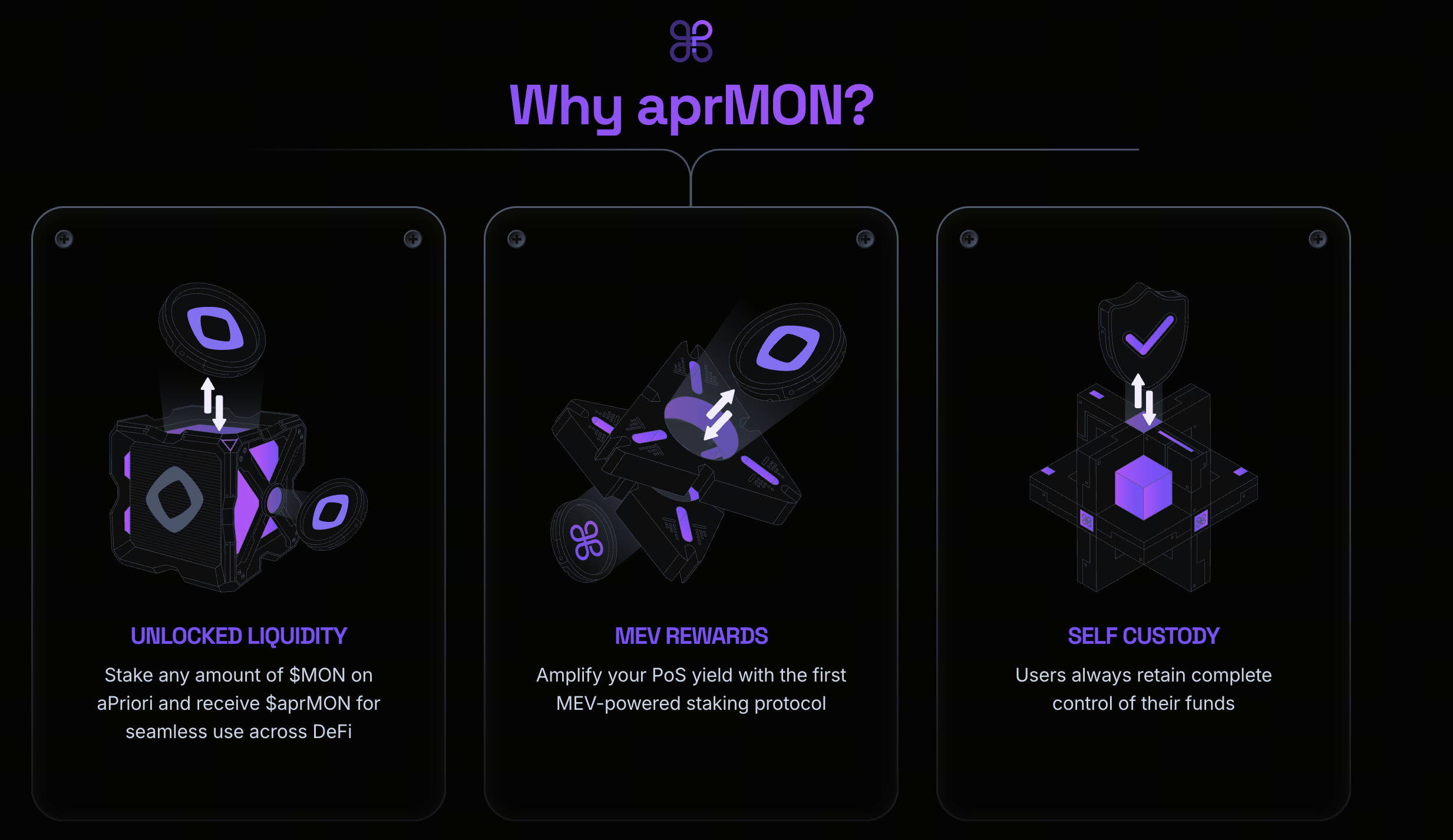
The real value of liquid staking protocols goes beyond rewards—they provide the liquidity foundation for the entire DeFi ecosystem.
In traditional staking, vast amounts of assets are locked and exit circulation. With aPriori's aprMON, those locked assets re-enter the on-chain financial system.
As more users hold aprMON, DeFi protocols can build around it. Lending platforms can accept it as collateral, DEXs can list trading pairs, and yield aggregators can create automated strategies for it.
This makes aPriori not just a staking gateway, but a liquidity source for the Monad ecosystem. History shows how stETH spurred DeFi innovation on Ethereum. Similarly, aprMON's future growth is tied to the scale of the Monad DeFi ecosystem. The more protocols integrate aprMON, the better the network's capital flow and utilization.
Liquid Staking Tokens: Putting aprMON to Work
aprMON is a yield-bearing Liquid Staking Token (LST). Unlike regular tokens, its value grows over time as underlying staking rewards accumulate. So holding aprMON means earning network rewards automatically.
Beyond holding, aprMON is versatile in on-chain scenarios. You can use it as collateral in lending markets to get extra liquidity without selling your staked position, or provide it to liquidity pools to earn trading fees and protocol incentives.
As the Monad ecosystem expands, aprMON's use cases will multiply. Future possibilities include yield derivatives, structured products, and automated investment strategies built around liquid staking assets.
This high composability is a hallmark of modern DeFi. One asset can serve multiple roles—securing the network, generating yield, and acting as collateral—dramatically boosting on-chain capital efficiency.
aPriori vs. Traditional Staking: Key Differences
At a glance, both aPriori and traditional staking aim for network rewards, but they differ sharply in logic and capital efficiency.
Traditional staking means lock-up. You earn rewards but lose liquidity. When a new opportunity appears, you're stuck waiting for the unbonding period to end.
aPriori solves this with aprMON. You get staking rewards and still have the freedom to use your assets in DeFi.
The yield sources also differ. Traditional staking relies mainly on block rewards. aPriori adds potential extra yield through MEV optimization, giving it a competitive edge.
For users chasing capital efficiency, liquid staking is clearly the way forward. That's why more emerging blockchains are making it a core part of their ecosystem.
Challenges Facing Liquid Staking
Despite being one of crypto's fastest-growing sectors, liquid staking faces several hurdles.
- Smart contract security: These protocols manage huge user funds, so any bug can be catastrophic. Security audits and risk controls are non-negotiable.
- Liquidity risk: In volatile markets, liquid staking tokens can de-peg from their underlying assets. Low liquidity can amplify this.
- Centralization risk: If a few protocols control too much of a network's staked supply, it undermines decentralization.
Balancing capital efficiency with network security remains an ongoing industry challenge.
aPriori's Future Tech Roadmap
aPriori's roadmap is evolving from a pure liquid staking platform to a comprehensive yield infrastructure. One major focus is restaking—letting already-staked assets secure other networks, boosting capital efficiency and creating new yield streams.
aPriori is also exploring more DeFi integrations. As Monad-native protocols launch, aprMON's reach will grow, strengthening network effects.
MEV infrastructure is another key direction. Unlike traditional protocols, aPriori emphasizes order flow coordination and yield optimization. If it can master MEV reward distribution, it could build a strong competitive moat.
Long-term, aPriori aims to be more than just Monad's liquid staking protocol—it's positioning as a full-stack on-chain yield infrastructure covering staking, MEV, restaking, and yield management.
Key Takeaways
aPriori is a pivotal liquid staking protocol on Monad. By issuing aprMON, it bridges network staking rewards with DeFi liquidity, solving the lock-up problem of traditional staking. Its architecture covers validator delegation, yield aggregation, liquid staking token issuance, and MEV optimization, letting users earn without sacrificing capital efficiency.
As Monad's ecosystem grows, liquid staking assets like aprMON will become foundational to on-chain finance. aPriori, with its strong technical design and ecosystem fit, is poised to be a key pillar of Monad's yield infrastructure. Still, smart contract risks, liquidity management, and market competition are factors to watch—users should always assess potential risks before diving in.