ASTER Price Analysis: Key Support, Resistance Levels and Future Trend Outlook

Beginner
Quick Reads
Last Updated 2026-03-27 16:07:47
Reading Time: 1m
A thorough breakdown of ASTER's current price, recent movements, critical support and resistance levels, and possible future trajectory is provided. This analysis evaluates whether ASTER will sustain its upward trend or is on the verge of a trend reversal.

ASTER Current Price Overview
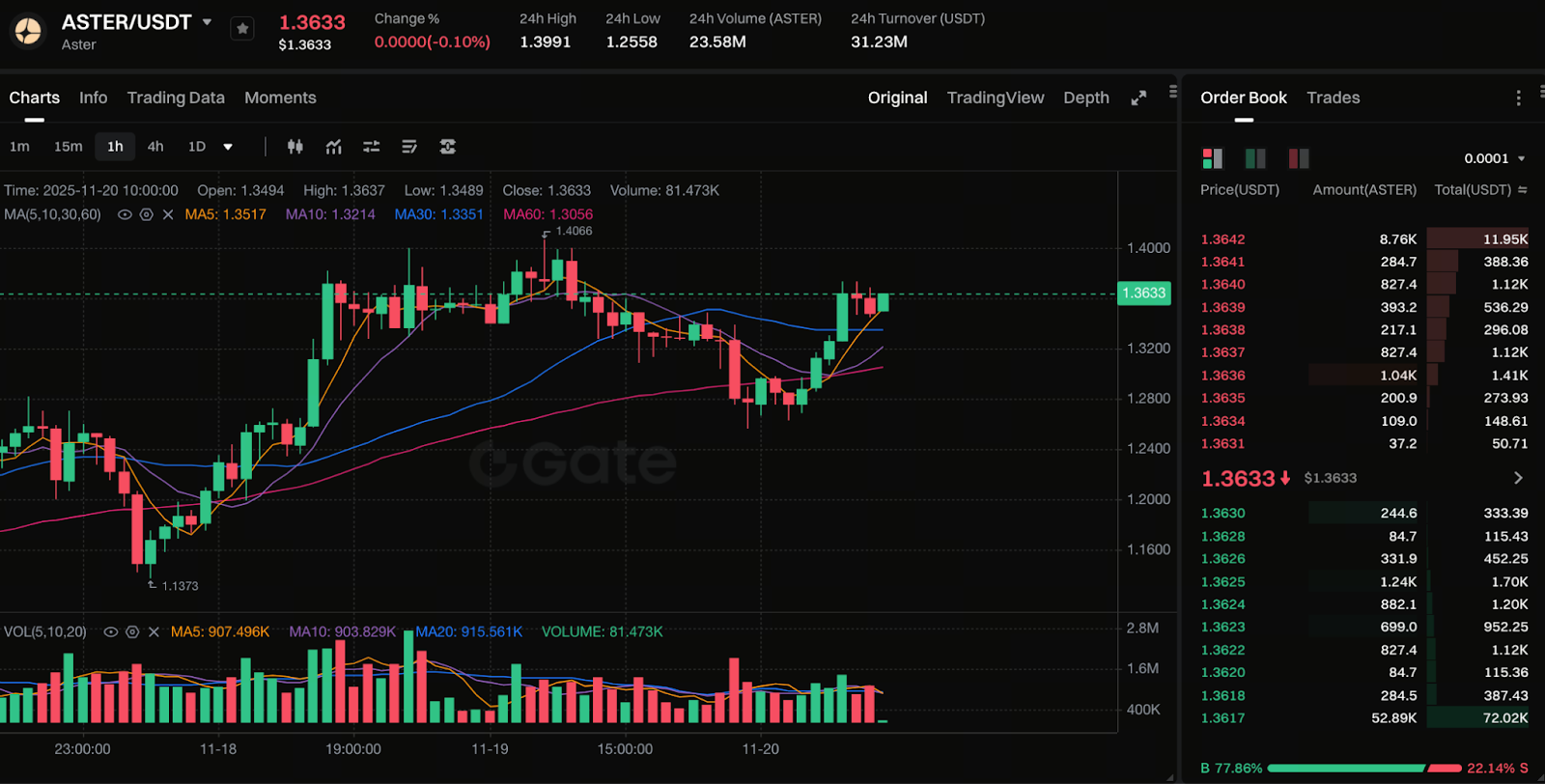

Chart: https://www.gate.com/trade/ASTER_USDT

As of November 20, 2025, ASTER is priced at roughly $1.36.

Recent Price Movement Highlights

  • Over the past 24 hours, ASTER has posted a strong rebound, climbing approximately 15%.
  • Technical analysis notes a bullish MACD crossover on the 2-hour chart, with increased buying pressure.
  • Trading volume is rising in tandem, which positively supports price momentum.
  • However, some warn that failure to break key resistance could see ASTER fall back toward $1.15 or lower.

These developments indicate that the current rally is compelling, but the uptrend is not yet fully confirmed.

Support and Resistance Level Analysis

  • Key resistance: Current short-term resistance is around $1.39. A breakout could set the stage for a move to $1.50.
  • Key support: If resistance holds, price may retrace to $1.25, with deeper pullbacks possible between $1.15 and $1.10.
  • ASTER remains in the early phase of an upward channel after dropping over 50% from its historic high. A break below this channel could result in a return to lower price levels.

Traders should closely watch the $1.39 breakout level. It serves as a critical inflection point for future price direction.

Key Factors Affecting Price

  • Whale activity: Reports show large holders are accumulating, which helps support the price.
  • Token unlocks and circulating supply: Tokenomics data indicates most ASTER supply remains locked; future unlocks will impact selling pressure.
  • Market environment and competition: Crypto market volatility, derivatives regulation shifts, and competing projects (such as other perpetual DEXs) can influence ASTER’s performance.
  • Project development and ecosystem growth: Platform trading volume, user expansion, and network upgrades are crucial variables. Achieving these metrics will strengthen price expectations.
  • Macro factors: Bitcoin price trends, capital flows, interest rates, and regulatory updates may create spillover effects.

Outlook for Future Price Trends

Based on the preceding analysis, two scenarios are possible:

  • Optimistic: If ASTER breaks above $1.39 and maintains strong trading volume and user activity, the next target could be $1.50 or higher.
  • Cautious: If resistance holds, or if unlocks, liquidity, or competition put pressure on the market, price could drop back to the $1.25–$1.10 zone.

In the medium term, if ecosystem growth remains robust, token unlocks are effectively managed, and platform fees and trading volume increase, price could trend higher. This is not guaranteed; investors should monitor key indicators closely.

Investment Considerations (Not Financial Advice; For Reference Only)

  • Consider a breakout above $1.39 as a potential entry signal, but confirm with increased trading volume.
  • If you already hold ASTER, consider establishing profit targets or planning phased exits, especially as price nears $1.50.
  • For a more conservative entry, wait for a retracement toward $1.25/$1.20 for reduced risk exposure.
  • Monitor unlock schedules, market liquidity, and competitors—these can drive short-term volatility.
  • It is important to note that crypto asset prices are highly volatile. Never invest more than you can afford to lose.

Summary

In summary, ASTER is currently in a recovery uptrend channel. Breaking the critical $1.39 resistance is pivotal for further price appreciation. Whale accumulation, growing trading volume, and ecosystem progress are all positive signs. However, token unlocks, market conditions, and competitive risks cannot be ignored. The outlook hinges on whether ASTER breaks out or reverses. A successful breakout could drive prices above $1.50, while failure may trigger a pullback. Investors should monitor price action, trading volume, network performance, and token unlock developments to guide their next moves.

Disclaimer
* The information is not intended to be and does not constitute financial advice or any other recommendation of any sort offered or endorsed by Gate.
* This article may not be reproduced, transmitted or copied without referencing Gate. Contravention is an infringement of Copyright Act and may be subject to legal action.

Related Articles

AI-Native Settlement Layers: How United Stables Is Building the Next Financial Rail
Beginner

AI-Native Settlement Layers: How United Stables Is Building the Next Financial Rail

Stablecoins were originally designed as dollar substitutes within exchanges, primarily used for asset pricing and trade settlement. As on-chain financial ecosystems have matured, their role has expanded beyond simple payments to include collateral assets, cross-chain liquidity mediums, and unified settlement units. In particular, as AI systems and automated agents begin to participate directly in economic activity, demand has risen sharply for programmable value units capable of instant settlement. This shift is pushing stablecoins toward the role of foundational financial infrastructure.
2026-03-25 03:16:17
The ve(3,3) Flywheel Explained: How AERO Tokenomics Powers Aerodrome’s DeFi Economy
Beginner

The ve(3,3) Flywheel Explained: How AERO Tokenomics Powers Aerodrome’s DeFi Economy

In the competition for DeFi liquidity, high-inflation mining alone is no longer enough to build lasting advantages. Aerodrome applies the ve(3,3) economic model to redesign token emissions, voting mechanisms, and revenue distribution, creating a liquidity flywheel centered on governance and cash flow. This article examines AERO tokenomics, the veAERO locking mechanism, and protocol revenue models to explain how Aerodrome builds a sustainable DeFi economic system.
2026-03-25 06:41:58
How Does PAXG Work? In-Depth Overview of the Physical Gold Tokenization Mechanism
Beginner

How Does PAXG Work? In-Depth Overview of the Physical Gold Tokenization Mechanism

PAXG (Pax Gold) is a tokenized asset backed by physical gold, issued by the fintech company Paxos and traded on the Ethereum blockchain as an ERC-20 token. The core concept is to tokenize physical gold on-chain, with each PAXG token representing ownership of a certain amount of gold. This structure enables investors to hold and trade gold in the form of a digital asset.
2026-03-24 19:12:51
Aerodrome Tokenomics: How ve(3,3) Powers Base's Most Profitable DEX
Beginner

Aerodrome Tokenomics: How ve(3,3) Powers Base's Most Profitable DEX

AERO is the native token of Aerodrome Finance, a core decentralized exchange and liquidity protocol in the Base ecosystem. It is primarily used for liquidity incentives and ecosystem operations. veAERO is a governance NFT that users receive by locking AERO, representing both voting power and the right to share protocol revenue. Through a dual track structure of AERO as a utility token and veAERO as a governance credential, Aerodrome separates liquidity usage value from long term governance power, allowing participants to act as liquidity providers, governance decision makers, and revenue sharers within the same system.
2026-03-25 06:40:31
How is the price of PAXG determined? Pegging mechanism, trading depth, and influencing factors
Beginner

How is the price of PAXG determined? Pegging mechanism, trading depth, and influencing factors

PAXG (Pax Gold) is a tokenized asset backed by physical gold reserves, launched by fintech firm Paxos and issued as an ERC-20 token on the Ethereum blockchain. The core concept is to digitally represent real-world gold assets, allowing investors to hold and trade gold via the blockchain network. Because each PAXG token corresponds to a specific quantity of physical gold, its price is theoretically expected to closely track the global gold market.
2026-03-24 19:11:40
Hybrid Collateral Stablecoins: Inside United Stables' Stability and Yield Architecture
Beginner

Hybrid Collateral Stablecoins: Inside United Stables' Stability and Yield Architecture

In the early stages of the crypto market, traditional stablecoins mainly relied on single-reserve or single-collateral models. Their primary focus was price stability and payment convenience, which allowed them to become foundational tools for on-chain trading and capital flows. As the market has entered a more mature financial phase, however, this structure has begun to reveal limitations, including high concentration risk and the difficulty of balancing liquidity with yield. These constraints have driven the evolution toward multi-layer collateral and portfolio-based designs, such as the dual-layer hybrid collateral architecture proposed by United Stables, which seeks to redefine the underlying logic of stable assets.
2026-03-25 03:17:39





