As the blockchain industry expands from simple asset transfers to more complex on-chain applications, public blockchain performance, scaling models, and developer ecosystems have become major areas of market focus.
Avalanche and Ethereum are among the most closely watched smart contract platforms in the blockchain industry today. Both are widely used in DeFi, NFTs, GameFi, and Web3 infrastructure. Ethereum has long held a central position in the smart contract ecosystem, while Avalanche, developed with the support of Ava Labs, explores a different scaling path through its multi-chain architecture and Subnet model.
A Brief Overview of Avalanche and Ethereum
Avalanche is a Layer1 blockchain network built around a multi-chain architecture. It mainly consists of the X-Chain, C-Chain, and P-Chain.
The C-Chain is EVM-compatible and can run Solidity smart contracts. The P-Chain manages validators and Subnets, while the X-Chain is used for creating and transferring digital assets.
Ethereum is one of today’s most important smart contract blockchain networks and a key piece of infrastructure for Web3 and DeFi. Ethereum originally operated with a PoW, or proof-of-work, mechanism, before gradually transitioning to a PoS, or proof-of-stake, structure.
Compared with Avalanche’s multi-chain architecture, Ethereum is closer to a single-chain mainnet model. Most applications run on the Ethereum mainnet and scale performance through Layer2 networks.
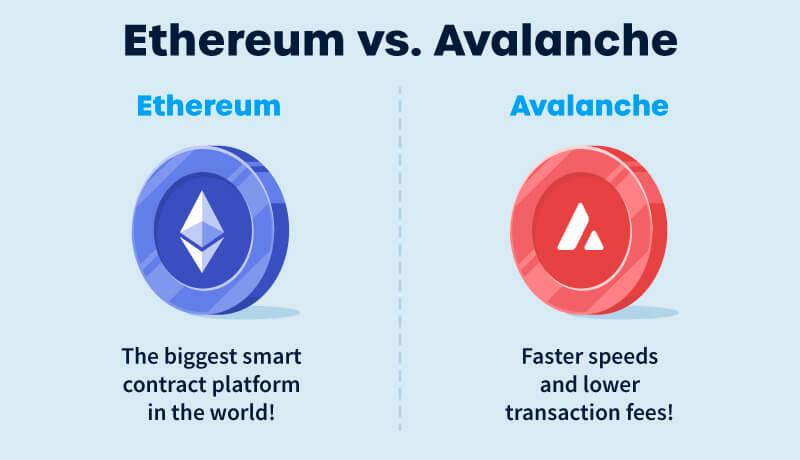
How Avalanche and Ethereum Differ in Architecture
Avalanche and Ethereum differ significantly in network structure.
Ethereum mainly operates around a single mainnet. Although Layer2 networks can expand transaction capacity, they ultimately still rely on the Ethereum mainnet for secure settlement.
Avalanche, by contrast, uses a multi-chain structure, with different chains responsible for asset transfers, smart contracts, and network management.
| Comparison |
Avalanche |
Ethereum |
| Network structure |
Multi-chain architecture |
Single-chain mainnet |
| Scaling method |
Subnet |
Layer2 Rollup |
| Smart contract chain |
C-Chain |
Ethereum Mainnet |
| Network management |
P-Chain |
Unified mainnet management |
How Avalanche and Ethereum Differ in Scaling
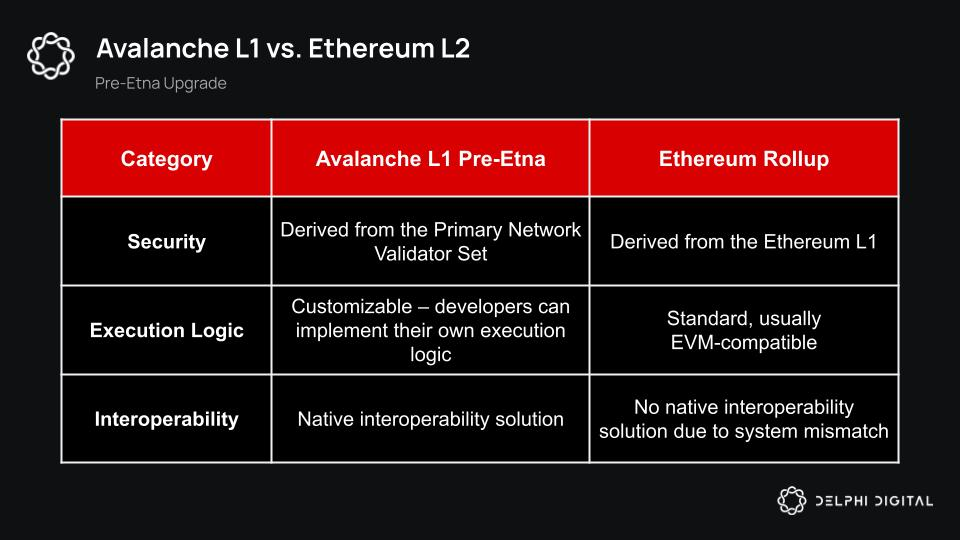
Ethereum’s core scaling strategy mainly relies on Layer2 Rollups.
Rollups process large volumes of transactions off-chain and then submit final data to the Ethereum mainnet, reducing the load on the main chain.
Avalanche places greater emphasis on an “application-specific chain” structure. Developers can use Subnets to deploy independent blockchains and create isolated operating environments for different applications.
This means Avalanche leans more toward horizontal scaling, while Ethereum improves mainnet capacity through Layer2 networks.
How Avalanche and Ethereum Differ in Consensus Mechanisms
Ethereum currently operates using a PoS consensus mechanism.
Avalanche also uses a PoS model, but its underlying consensus structure differs significantly from Ethereum’s.
Ethereum relies on validators to propose blocks and the network to confirm them, while Avalanche reaches consensus through randomized sampling, voting, and probabilistic convergence.
Avalanche Consensus and the Snowman protocol emphasize local randomized interaction, which usually allows Avalanche to achieve faster transaction confirmation times.
By comparison, Ethereum places greater emphasis on mainnet security and ecosystem stability.
Gas costs and network congestion are among the most common points of comparison for users.
Because the Ethereum mainnet has long handled large volumes of on-chain activity, Gas costs during peak network periods can rise significantly.
Avalanche’s multi-chain architecture and Subnet scaling model can reduce resource competition in certain situations, helping maintain lower transaction costs.
Avalanche also generally offers faster transaction confirmation, while Ethereum relies more heavily on Layer2 networks to improve the user experience.
However, actual costs and performance are still affected by the level of on-chain activity and broader market conditions.
How the Avalanche and Ethereum Ecosystems Differ
Ethereum currently has the most mature developer ecosystem and the largest scale of on-chain assets.
Many DeFi protocols, NFT projects, and infrastructure tools were first deployed on Ethereum, giving it strong ecosystem network effects.
Avalanche’s ecosystem is relatively smaller, but its development focus leans more toward high-performance applications, blockchain gaming, and application-specific chains.
Some projects use Avalanche Subnets to build independent blockchains so they can gain higher performance and greater customization.
As a result, the two ecosystems have somewhat different development priorities.
Which Use Cases Suit Avalanche and Ethereum
Ethereum is better suited to scenarios that place a strong emphasis on liquidity, asset scale, and ecosystem compatibility.
Because Ethereum brings together a large number of DeFi protocols and developer tools, it has a strong advantage in financial infrastructure.
Avalanche is better suited to high-frequency transactions, blockchain gaming, and application-specific chain scenarios.
Its Subnet structure allows developers to build independent operating environments, reducing the reliance of complex applications on shared network resources.
Challenges Facing Avalanche and Ethereum
Although both are major Layer1 networks, they face different challenges.
Ethereum’s main issues include mainnet scaling pressure and Gas cost concerns, which is why it needs to keep advancing its Layer2 ecosystem.
Avalanche needs to expand its developer ecosystem and user base, while also addressing the potential liquidity fragmentation that Subnets may create.
In addition, as modular blockchains, Rollups, and cross-chain infrastructure develop rapidly, competition among Layer1 networks continues to evolve.
Conclusion
Avalanche and Ethereum are both important Layer1 networks for smart contracts and Web3 applications, but they differ clearly in architectural design and scaling logic.
Ethereum mainly relies on Layer2 Rollups to expand mainnet performance, while Avalanche uses a multi-chain architecture and Subnet model to support application isolation and horizontal scaling.
Ethereum has clear advantages in developer ecosystem and asset scale, while Avalanche places greater emphasis on performance, customization, and application-specific chain structures.
FAQs
What is the biggest difference between Avalanche and Ethereum?
The biggest difference between Avalanche and Ethereum lies in their scaling methods. Ethereum mainly scales through Layer2 Rollups, while Avalanche uses a multi-chain architecture and Subnet model.
Is Avalanche compatible with Ethereum applications?
Yes. Avalanche’s C-Chain supports the EVM, so Solidity smart contracts can be migrated to Avalanche.
Is Avalanche faster than Ethereum?
In most cases, Avalanche has faster transaction confirmation, but actual performance depends on network activity and application structure.
Why does Ethereum need Layer2?
Because the Ethereum mainnet handles a large number of applications and transactions, it needs Layer2 networks to reduce congestion and improve scalability.
Are Avalanche Subnets the same as Ethereum Layer2?
Not exactly. A Subnet is closer to an independent blockchain environment, while Layer2 usually relies on the Ethereum mainnet for final security settlement.
Which ecosystem is larger, Avalanche or Ethereum?
At present, Ethereum has a larger overall developer ecosystem, greater on-chain asset scale, and more protocols.







