As competition among Layer 1 public blockchains continues to intensify, tokenomics are no longer just about simple payment utility. They also affect network security, validator incentives, and the ability of an ecosystem to scale.
Avalanche, developed with the support of Ava Labs, uses AVAX to build its PoS staking system. It also combines a transaction fee burn mechanism with the Subnet expansion model, allowing AVAX to play an important long term role in the Avalanche network.
What Is AVAX?
AVAX is the native token of the Avalanche network and the core asset of the Avalanche blockchain ecosystem.
When users transfer assets, deploy smart contracts, or perform on-chain operations on Avalanche, they need to pay AVAX as Gas fees. AVAX is also used for validator staking, network security, and Subnet creation.
Unlike some tokens that are used only for payments, AVAX is also involved in Avalanche’s network operations, resource allocation, and economic incentive structure.
What Are the Main Uses of AVAX?
AVAX serves several functions in the Avalanche ecosystem.
Its most basic use is paying transaction fees. Whether users are transferring assets, executing smart contracts, or interacting on-chain, they need to spend AVAX as a fee for network resources.
AVAX is also used in the PoS staking system. Validators must lock up a certain amount of AVAX to participate in network validation and earn rewards by helping maintain network operations.
In addition, AVAX is connected to Avalanche’s Subnet mechanism. Creating a new Subnet also requires the use of AVAX.
How Does Avalanche’s Staking Mechanism Work?
Avalanche uses a PoS, or proof of stake, mechanism to operate its network.
Validators must stake AVAX to participate in block validation and network consensus. During the staking period, validators need to keep their nodes online and maintain stable network operations.
Avalanche’s staking mechanism differs in some ways from traditional PoS networks. Its validation rewards do not depend on an on-chain punitive slashing mechanism. Instead, the system places more emphasis on stable participation and normal operation.
In addition to running their own validator nodes, users can also delegate AVAX to other validators to participate in staking.
This mechanism lowers the technical barrier for ordinary users to take part in network validation.
Where Do AVAX Staking Rewards Come From?
Staking rewards on the Avalanche network mainly come from protocol issuance.
The system distributes AVAX rewards to eligible validators according to network rules. The amount of rewards is related to factors such as staking size, operating duration, and validator stability.
However, if validators fail to meet uptime or operational requirements, they may not receive the full reward.
Unlike some PoS networks, Avalanche does not use a frequent penalty mechanism. Instead, it encourages validators to maintain stable operations through missed rewards.
What Is the AVAX Supply Mechanism?
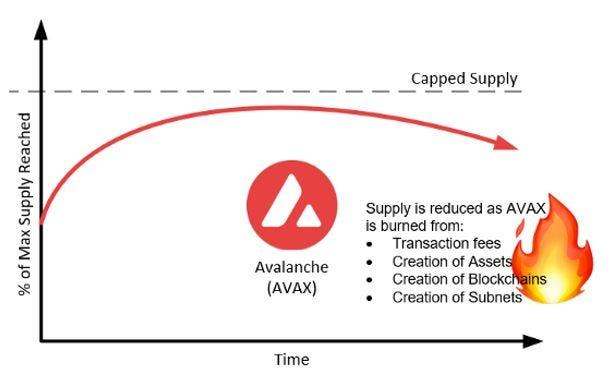
AVAX has a maximum supply. According to the official formula, the total supply of AVAX will not exceed 720 million tokens, helping avoid inflation caused by unlimited issuance.
At the same time, the network reduces the amount of AVAX in circulation through a transaction fee burn mechanism. This structure of “limited issuance plus a burn mechanism” is used to balance network incentives with long term supply control. However, the market price of AVAX is still affected by market sentiment, ecosystem development, and broader crypto market volatility.
What Is the Relationship Between AVAX and Avalanche Subnets?
AVAX is not only the native asset of the Avalanche main network, but also closely connected to the Subnet scaling structure.
When developers create an Avalanche Subnet, they need to use AVAX for network operations. Since Subnets are an important part of Avalanche’s scaling ecosystem, AVAX is directly linked to Avalanche’s chain level expansion capabilities.
As more application specific chains and modular blockchains are deployed on the Avalanche network, AVAX gains a broader range of use cases within the ecosystem.
This means AVAX is not limited to basic payment functions. It is also directly tied to Avalanche’s network expansion model.
What Challenges Does AVAX Face?
Although AVAX plays a core role in the Avalanche network, it still faces certain challenges.
As competition among Layer 1 and Layer 2 networks continues to intensify, different public blockchain ecosystems are still competing for developers, users, and liquidity.
In addition, demand for AVAX is closely tied to the activity level of the Avalanche ecosystem. If growth in on-chain applications slows, demand for AVAX as a network utility token may also be affected.
Conclusion
AVAX is the core token of the Avalanche network. It is used to pay transaction fees, participate in staking validation, create Subnets, and maintain network security.
Through its PoS validation mechanism and transaction fee burn model, Avalanche gives AVAX a key role in network operations and ecosystem expansion. Compared with digital assets that function only as payment tools, AVAX is closer to a fundamental resource and security asset within the Avalanche network.
FAQs
What Is AVAX Used For?
AVAX is mainly used to pay Gas fees, stake validators, create Subnets, and maintain network security.
What Is Avalanche’s Staking Mechanism?
Avalanche uses a PoS model. Validators must stake AVAX to participate in network validation and earn rewards.
Is AVAX Burned?
Yes. Some transaction fees on the Avalanche network are directly burned to help control token supply growth.
Does AVAX Have a Supply Cap?
Yes. AVAX has a maximum total supply, and the network also reduces circulating supply through transaction fee burns.
What Is the Relationship Between AVAX and Avalanche Subnets?
Creating an Avalanche Subnet requires AVAX, so AVAX is directly connected to Avalanche’s scaling ecosystem.







