As Web3 gaming and the metaverse continue to develop, the market is seeing different types of ecosystem models emerge. Some projects focus more on open creation and virtual land economies, while others place greater emphasis on entertainment IP, community culture, and game interaction.
BabyShark and Sandbox represent these two different development paths. Together, they also show how the Web3 metaverse ecosystem is gradually evolving from a single model into a more diverse structure.
A Brief Overview of BabyShark and Sandbox and Their Core Differences
As a Web3 gaming ecosystem built around Baby Shark Universe, BabyShark uses NFTs, an open world, user generated content, or UGC, and a digital asset system to build an on chain interactive platform. The project attempts to combine entertainment IP with blockchain technology, allowing users to own, use, and trade digital assets in a virtual world.
Because Baby Shark already has strong mainstream recognition, BabyShark Universe is more focused on a model that combines entertainment IP with Web3 gaming.
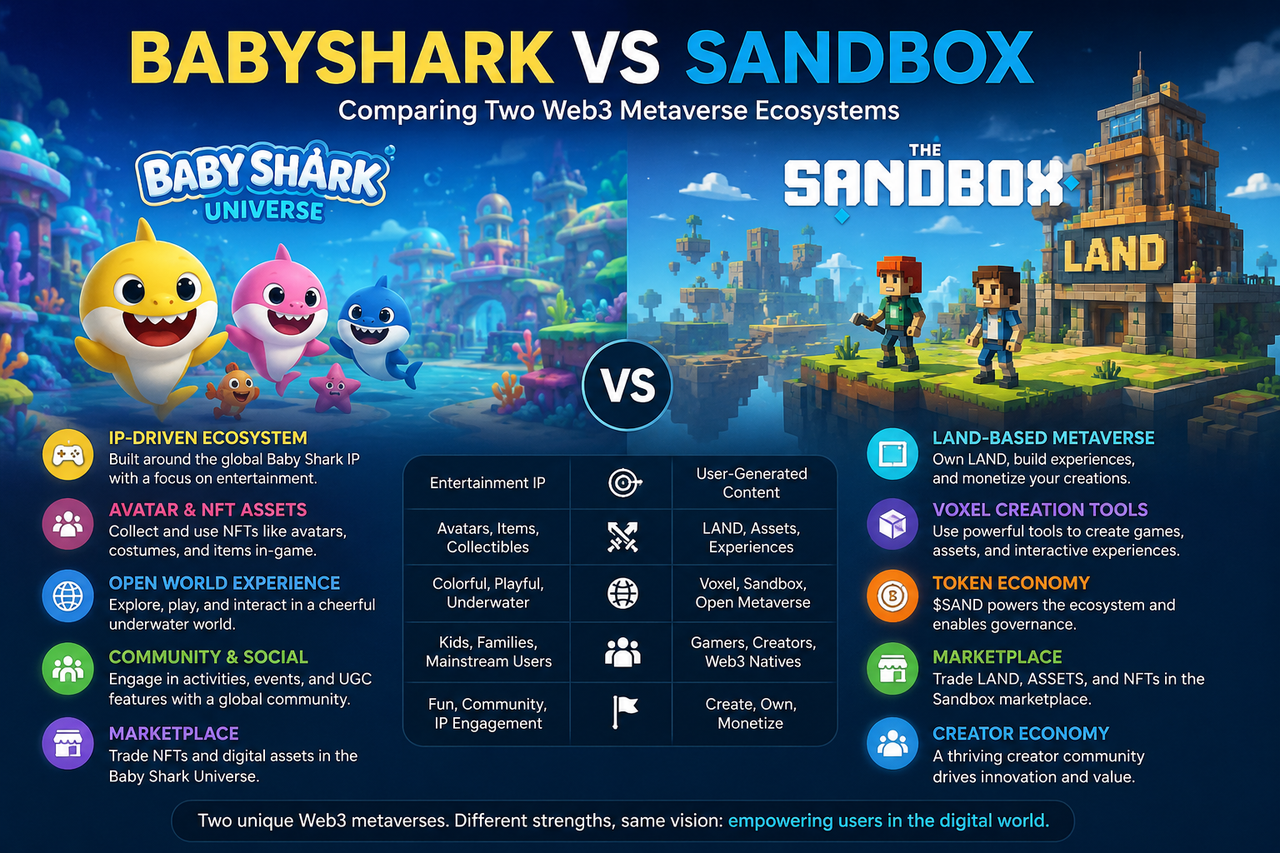
The Sandbox is one of the earlier representative projects in the Web3 metaverse space. Its core direction is an open virtual world and a user creator ecosystem. Sandbox allows users to purchase virtual land, create game content, and build a digital economy through NFTs and token systems.
| Comparison Dimension |
BabyShark |
Sandbox |
| Core Direction |
Entertainment IP + Web3 gaming |
Open metaverse platform |
| NFT Focus |
Avatars, items, interactive assets |
LAND, creator assets |
| Open World Structure |
Entertainment interaction based |
Virtual land based |
| User Base |
Mainstream entertainment users |
Web3 creators |
| Core Ecosystem |
Community interaction and gaming experience |
Creator economy |
| Main Feature |
IP driven |
LAND driven |
How Do BabyShark and Sandbox Differ in Their Core Positioning?
Although both belong to the Web3 metaverse category, their core positioning is clearly different.
BabyShark places greater emphasis on entertainment interaction and an IP driven ecosystem. Its focus is to lower the barrier for everyday users to enter Web3 through familiar characters and community culture. The project gives more weight to digital entertainment, user interaction, and open world experiences.
Sandbox, by contrast, is closer to an open metaverse platform. Its focus is on a creator ecosystem and a virtual land economy. Users can not only take part in interactions, but also build their own virtual spaces and form independent content systems.
This difference means their ecosystem goals are not exactly the same. BabyShark leans more toward entertainment focused Web3 gaming, while Sandbox is closer to an open digital creation platform.
What Are the Differences Between the NFT Systems of BabyShark and Sandbox?
NFTs are an important part of both ecosystems, but they are used in different ways.
In BabyShark, NFTs are more closely connected to Avatars, game items, community interaction, and digital identity. Their main role is to enhance the game interaction experience and build an on chain asset system for users.
Sandbox’s NFT structure, on the other hand, places greater emphasis on land, or LAND, virtual spaces, and creator assets. Users can use LAND to establish their own virtual areas and deploy content and interactive experiences within them.
In addition, Sandbox’s NFTs are more closely tied to the creator economy, while BabyShark’s NFTs lean more toward entertainment IP and community interaction.
How Do the Open World Structures of BabyShark and Sandbox Differ?
Both adopt an open world design, but their structural focus is clearly different.
Sandbox places greater emphasis on the concept of virtual land. Its open world is made up of a large number of LAND parcels, where users can build content, host events, or carry out commercial collaborations. As a result, its open world structure is closer to a decentralized digital real estate system.
BabyShark’s open world, however, focuses more on game interaction and user experience. The project places more emphasis on Avatars, social interaction, and entertainment content, rather than building a complete economic system around virtual land.
From the perspective of user experience, Sandbox is more like a creator platform, while BabyShark is closer to an entertainment driven Web3 gaming world.
How Do the User Bases of BabyShark and Sandbox Differ?
Sandbox’s main users typically include Web3 native players, NFT collectors, content creators, and virtual real estate participants. Because its ecosystem structure is relatively open, it is more likely to attract users who want to build content and operate digital spaces.
BabyShark, by contrast, attempts to reach a more mainstream user base. Backed by entertainment IP and community culture, the project focuses more on lowering the Web3 entry barrier and attracting ordinary game users through familiar characters and interactive formats.
How Do the Economic Models of BabyShark and Sandbox Differ?
Sandbox’s economic structure is closely tied to its LAND system. Virtual land is one of the core resources in the ecosystem, so LAND scarcity and the creator economy together form its main value system.
By comparison, BabyShark places greater emphasis on NFTs, community interaction, and the gaming experience. Its economic system is built more around digital entertainment content and user participation, rather than relying purely on virtual real estate logic.
In addition, Sandbox places greater emphasis on open markets and creator monetization, while BabyShark gives more weight to its IP ecosystem and community activity.
Although the metaverse concept continues to develop, different Web3 projects still face their own challenges.
Sandbox needs to keep its creator ecosystem and LAND economy active over the long term. If user generated content is not updated often enough, the open platform model may face pressure in retaining users.
BabyShark, meanwhile, depends more on entertainment content and community operations. For IP based Web3 projects, sustaining user interaction and keeping the community engaged are important long term development challenges.
In addition, both need to address common user barriers in Web3 gaming, including wallet management, gas fees, and the complexity of NFT operations.
Conclusion
BabyShark and Sandbox are both important representatives of the Web3 metaverse ecosystem, but their development directions are clearly different. Sandbox places greater emphasis on an open creator platform and virtual land economy, while BabyShark leans more toward entertainment IP, community interaction, and the Web3 gaming experience.
As the metaverse and NFT ecosystems continue to evolve, different types of Web3 projects are also beginning to form more clearly differentiated positions. The IP driven Web3 gaming model represented by BabyShark and the open creator platform model represented by Sandbox both show that digital virtual worlds are moving in a more diverse direction.
FAQs
What Is the Biggest Difference Between BabyShark and Sandbox?
BabyShark places greater emphasis on entertainment IP and game interaction, while Sandbox focuses more on virtual land and the creator ecosystem.
Why Does Sandbox Emphasize LAND?
LAND is a core resource in the Sandbox ecosystem. Users can create content and build virtual spaces through LAND.
Does BabyShark Also Support User Generated Content?
Yes. BabyShark’s ecosystem includes a UGC, or user generated content, mechanism that allows the community to participate in content creation.
Do Both Use NFTs?
Yes. Both use NFTs to manage digital assets, but their use cases and ecosystem focuses are different.
Which Is More GameFi Oriented, BabyShark or Sandbox?
Both are part of the Web3 gaming ecosystem, but BabyShark leans more toward entertainment interaction based GameFi, while Sandbox is closer to a creator and metaverse platform model.