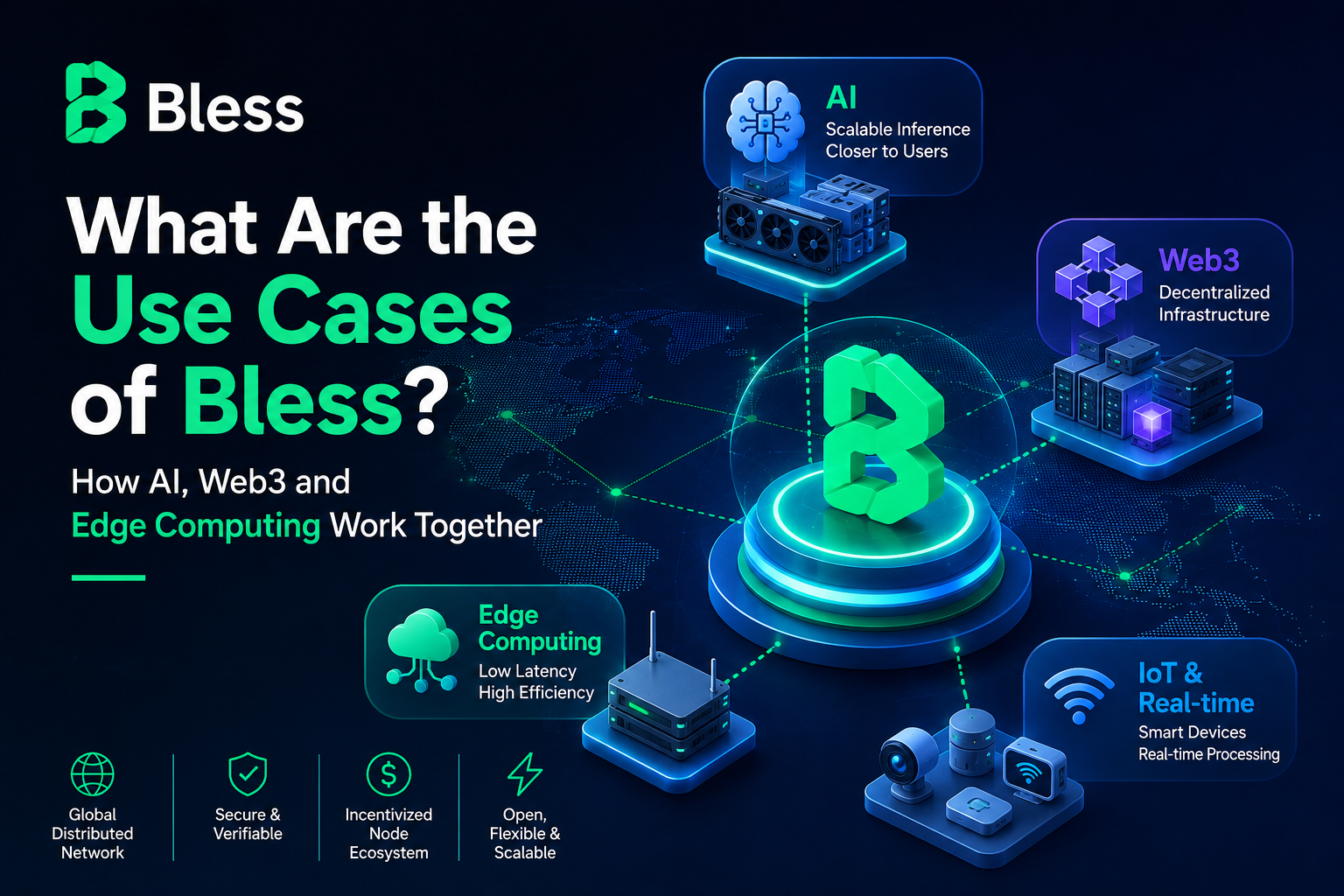
As generative AI, Web3, and smart devices evolve, more applications are prioritizing computing power, latency, and resource scalability. Bless aims to connect global nodes into a unified computing platform through a decentralized edge computing network, delivering more open infrastructure for a wide range of applications.
Why Bless is Better Suited for AI Applications
AI applications typically require continuous, substantial computing resources, with model inference speed and response time directly impacting user experience. By integrating distributed CPU, GPU, and other resources, Bless provides developers with on-demand computing power, enabling AI services to scale flexibly based on actual needs.
Unlike deploying models in a single data center, Bless can distribute computing tasks across nodes in different regions, bringing inference closer to end users. This edge deployment approach helps reduce network latency in certain scenarios and improves resource utilization.
For large language models, intelligent agents, or multimodal AI services that require continuous operation, Bless provides underlying computing power—not specific AI models. Developers can integrate different models based on business needs and leverage distributed computing power across the network to complete inference tasks.
Why AI Inference Needs Edge Computing
The core goal of AI inference is to respond quickly to user requests after model training. As model sizes grow, sending all requests to a remote data center may increase network transmission time and degrade real-time interactive experiences.
Edge computing reduces data transmission distances by deploying computing tasks closer to users, enabling voice assistants, AI agents, real-time translation, and video analysis to complete inference faster. This is a key reason why more AI infrastructure is adopting edge computing architectures.
Bless combines edge computing with a decentralized node network, freeing computing resources from fixed data centers and enabling dynamic scheduling based on task requirements. This model enhances network resilience and provides more flexible resource allocation for AI applications.
How Bless Supports Web3 Infrastructure
Beyond blockchain networks, Web3 applications require substantial off-chain computing resources. Tasks such as data indexing, AI analysis, content processing, and complex computations may exceed blockchain processing capacity and rely on external computing networks.
The distributed computing resources provided by Bless serve as critical infrastructure for Web3 applications, delivering computing power for decentralized applications (DApps), on-chain data analysis, AI agents, and other compute-intensive services—without dependence on a single cloud provider.
As AI infrastructure and decentralized computing networks continue to evolve, more Web3 projects are exploring models that combine on-chain consensus with off-chain computation. Bless aims to provide a more open and scalable computing layer for such applications.
Applications in Gaming, IoT, and Real-Time Computing
Beyond AI and Web3, Bless is also well-suited for real-time applications requiring low-latency computing power. Online gaming, the Internet of Things (IoT), smart manufacturing, and real-time video processing demand fast responses and consistent compute resources—edge computing reduces latency caused by data traveling to and from central servers.
Take multiplayer online games: player actions must sync in milliseconds, and network latency directly affects the experience. By deploying compute tasks to nodes closer to users, edge computing improves response speed and reduces load on centralized servers.
For IoT devices, sensors continuously generate real-time data. Transmitting all data to a remote cloud platform increases bandwidth consumption and may impact response efficiency. Bless's distributed computing resources allow data analysis at edge nodes, with results then synced to the central system.
| Application Scenario |
Capabilities Provided by Bless |
Key Value |
| AI Inference |
Distributed CPU, GPU computing power |
Improved inference efficiency and resource elasticity |
| Web3 Infrastructure |
Off-chain computing support |
Reduced on-chain computing load |
| Online Gaming |
Edge node deployment |
Lower network latency |
| IoT |
Edge data processing |
Enhanced real-time responsiveness |
| Real-Time Video Analysis |
Distributed computing |
Faster data processing |
The common thread across these scenarios is the need to balance computing power, response speed, and resource scalability. Bless's decentralized edge computing network offers developers an alternative to traditional centralized cloud computing.
How Developers Can Build Applications on Bless
Bless is positioned as computing infrastructure, so developers don't need to build global server clusters—they can access distributed computing resources through the network. According to official materials, developers submit computing tasks (e.g., AI inference, data processing) to the network, and the protocol automatically handles resource scheduling and node allocation.
From a development perspective, developers focus on application logic while resource acquisition, node matching, and task execution are coordinated by the network. This model reduces the complexity of underlying resource management, allowing teams to invest more time in business development rather than infrastructure operations.
As more nodes and development tools mature, Bless's application scope is expected to expand into more AI and Web3 scenarios. However, supported development interfaces, SDKs, and deployment methods should be confirmed via official documentation and future announcements.
| Development Step |
Bless Network Responsibility |
| Submit computing tasks |
Receive developer requests |
| Schedule computing resources |
Automatically match appropriate nodes |
| Execute computing tasks |
Nodes complete computation and return results |
| Network settlement |
Complete resource settlement and distribute rewards per protocol |
For developers, Bless acts as an open computing infrastructure layer, enabling applications to dynamically acquire computing power based on actual needs—without being constrained by fixed data center deployment models.
Summary
Bless's use cases extend beyond AI inference to Web3 infrastructure, edge computing, IoT, real-time data processing, and more. By integrating global distributed computing resources, Bless provides developers with a more flexible infrastructure option, supporting on-demand compute for applications of varying scales.
As AI applications move toward real-time and distributed architectures, edge computing is becoming increasingly important. Bless aims to deliver scalable computing power through an open node network and dynamic resource scheduling, driving the adoption of decentralized computing networks in more real-world business scenarios.
FAQ
Which application scenarios is Bless suitable for?
Bless is primarily focused on AI inference, Web3 infrastructure, edge computing, IoT, real-time data processing, and any scenario requiring distributed computing resources.
Why does AI inference need edge computing?
AI inference demands low latency and fast response. Edge computing deploys compute tasks closer to users, reducing network transmission time and improving real-time interactive experiences.
How does Bless support Web3 applications?
Bless provides off-chain computing resources for Web3 projects, supporting compute-intensive tasks such as data processing, AI analysis, and content generation—complementing blockchain networks.
Can Bless be used for game development?
Yes. For real-time applications like multiplayer online games and cloud gaming, Bless's edge computing model can reduce network latency in certain scenarios and improve compute resource scheduling efficiency.
Why do IoT devices need Bless's computing power?
IoT devices continuously generate large volumes of real-time data. Bless uses edge nodes to handle some data processing, reducing remote transmission pressure and improving system response efficiency.
Is Bless only for AI applications?
No. While AI is a key focus, Bless's decentralized edge computing capabilities also apply to Web3, real-time computing, IoT, video processing, and other scenarios requiring elastic compute power.







