The fundamental distinction between oracles and ZK coprocessors like Brevis centers on data direction: oracles are designed to bring external, off-chain data onto the blockchain, while ZK coprocessors such as Brevis focus on verifiable computations over existing on-chain historical data, returning results that can be mathematically validated. As a Web3-oriented verifiable computation platform, Brevis (BREV) addresses the questions of “how to compute on-chain data and prove its correctness,” whereas oracles are concerned with “how to bring off-chain data on-chain.”
Smart contracts on blockchains lack direct access to external data and face significant challenges replaying large volumes of historical transactions on-chain. These limitations have driven the development of oracles and ZK coprocessors: oracles bridge the gap for external data to enter the blockchain, while ZK coprocessors enable trusted computation over historical on-chain data. Understanding this distinction is crucial for determining which infrastructure to deploy or how to combine both for specific use cases.
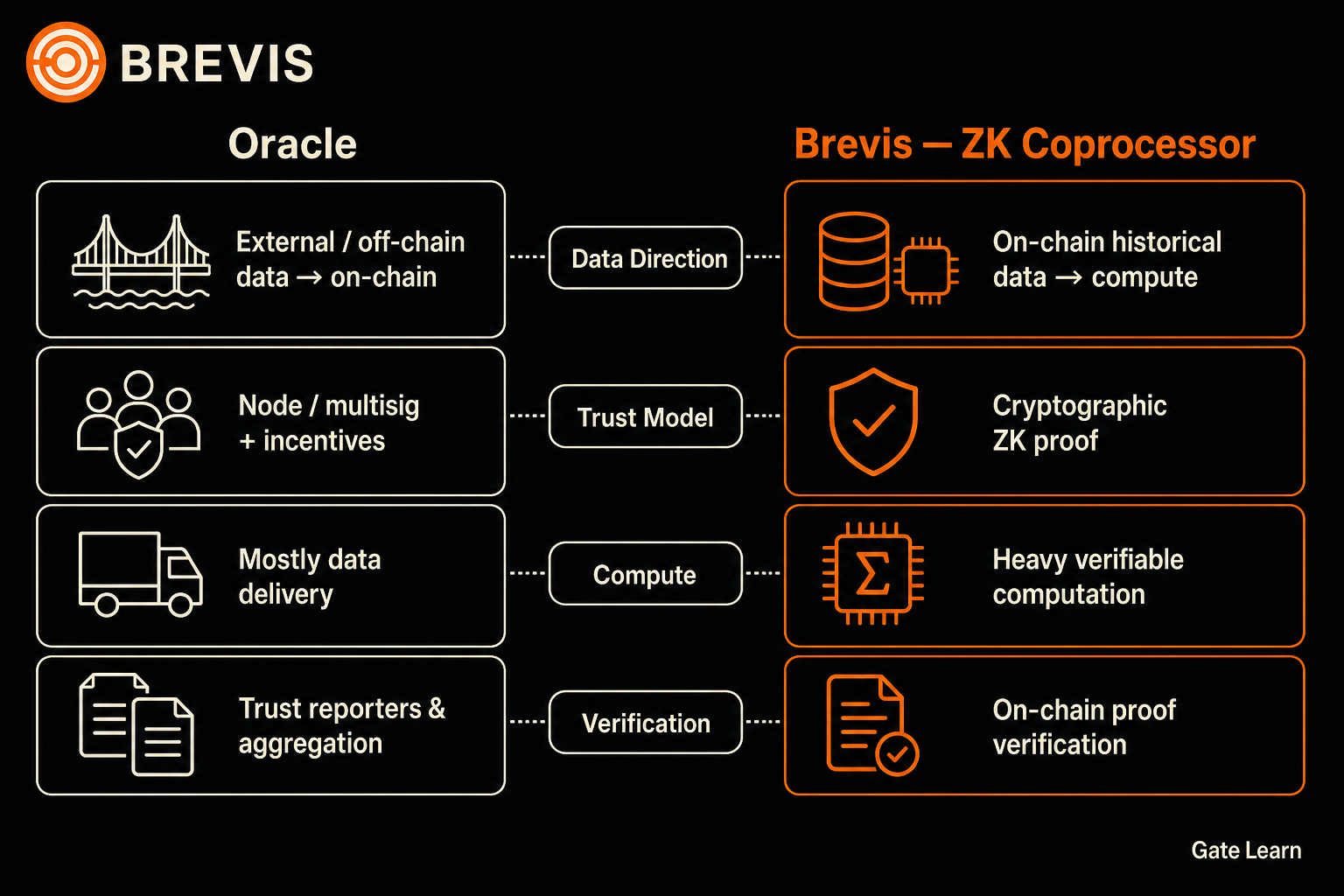
Figure 1. Comparison of Brevis ZK Coprocessor and Oracle across four dimensions: Data Direction, Trust Model, Compute, and Verification.
What Is an Oracle and What Problems Does It Address?
An oracle serves as the data bridge between blockchains and the external world, with its primary role being to securely deliver off-chain or external data to on-chain smart contracts. Common use cases include price feeds, random number generation, event result reporting, and cross-system state synchronization.
Operating within a closed, deterministic environment, smart contracts cannot directly access off-chain APIs or real-world data. Oracles leverage node networks to collect, aggregate, and write data on-chain, enabling contracts that depend on external market conditions—such as lending liquidations and derivatives settlements—to function effectively.
The trustworthiness of oracles is typically based on assumptions about the integrity of node networks, multisig arrangements, data aggregation mechanisms, and economic incentives. Data accuracy ultimately hinges on the honesty of reporting nodes and the robustness of the aggregation process, rather than on-chain mathematical proofs.
What Are ZK Coprocessors Like Brevis?
ZK coprocessors like Brevis are designed to process historical and cross-chain data already present on-chain, executing complex computations off-chain and returning both the results and zero-knowledge proofs. These proofs allow smart contracts to mathematically verify the correctness of computations on-chain. ZK data coprocessors access authentic data from archive nodes off-chain, perform computations, and then return both results and proofs on-chain, establishing a complete “off-chain computation, on-chain verification” workflow.
Brevis is powered by a ZK data coprocessor and Pico zkVM, operating under two security models: pure-ZK (pure zero-knowledge) or the coChain (OP) model described in BREV Token and coChain. The pure-ZK model relies on cryptographic proofs, while the coChain model incorporates Ethereum-based staking and slashing for additional crypto-economic security.
Unlike oracles, ZK coprocessors do not depend on honest data reporting. Instead, they allow the computation process itself to be verifiable: as long as the proof is valid, the contract can confirm the existence and correctness of the relevant on-chain data and computations, minimizing trust requirements.
How Do Data Sources and Trust Models Differ?
For data sources, oracles ingest external, off-chain data (prices, events, API data), while ZK coprocessors utilize existing on-chain data (historical transactions, balances, cross-chain states).
In terms of trust models, oracles rely on trusted node reporters or multisig arrangements, supported by economic incentives—essentially, trust in the data reporters, which is a social and economic trust model. ZK coprocessors, by contrast, rely on the mathematical verifiability of zero-knowledge proofs—trust in the computation itself, representing a cryptographic trust model.
Neither model is categorically superior. External data cannot be proven true solely through cryptography, and whether on-chain prices match real-world market prices ultimately requires a reliable source. However, computations over existing on-chain data can be directly verified via ZK proofs.
How Do Their Computing Capabilities Differ?
With respect to computing capabilities, oracles primarily handle “data transport”: transmitting and aggregating external data for on-chain use, without engaging in complex on-chain data analysis. ZK coprocessors, on the other hand, are capable of “heavy computation,” performing large-scale statistics, aggregation, and even model inference on historical data off-chain.
Smart contracts have limited access to historical data, and replaying extensive transaction histories on-chain is prohibitively costly. ZK coprocessors shift such computations off-chain and provide succinct proofs, enabling rapid on-chain verification and overcoming block Gas limitations on computational scale.
Table: Key Differences Among Brevis, Oracles, and Other ZK Coprocessors
The table below compares ZK coprocessors like Brevis, other ZK coprocessors, and oracles across four dimensions: data direction, trust model, compute capability, and verification method.
| Dimension |
Oracle |
Brevis (ZK Coprocessor) |
Other ZK Coprocessors |
| Data Direction |
External/off-chain to on-chain |
On-chain historical/cross-chain compute |
Mostly on-chain historical compute |
| Trust Model |
Node/multisig + incentives |
Cryptographic proofs (optional coChain crypto-economics) |
Individual proof systems and models |
| Compute |
Mainly data transport |
General-purpose, verifiable heavy compute |
Varies by compute scope and zkVM |
| Verification |
Relies on reporter honesty/aggregation |
On-chain ZK proof verification |
On-chain verification of respective proofs |
| Typical Use |
Price feeds, external events |
Data-driven incentives, behavioral risk control |
On-chain data access, verifiable computation |
Key points: Oracles and ZK coprocessors occupy opposite ends of the data flow. “Other ZK coprocessors,” as similar foundational infrastructure, each make trade-offs in data access, proof systems, and security models. Brevis stands out with its general-purpose Pico zkVM and dual pure-ZK/coChain models. This table provides a categorical overview and does not draw conclusions about unconfirmed third-party projects.
Which Type Should Be Used in Which Scenario?
The choice depends on whether the application needs “external data on-chain” or “on-chain historical data computation.” Oracles are preferred for real-time asset prices, off-chain event outcomes, or random numbers. ZK coprocessors are better suited for incentivizing users based on long-term on-chain behavior, risk control, or cross-chain aggregation.
Data-on-chain scenarios are typically handled by oracles, such as lending liquidation prices, derivatives settlement, and insurance event triggers. Historical data computation scenarios are best served by ZK coprocessors, such as rewarding based on actual trading volume, calculating loyalty by holding duration, or aggregating cross-chain assets for risk control. In practice, both are often used together: a DeFi application might use oracles for external pricing and ZK coprocessors for evaluating historical on-chain contributions—they are complementary, not interchangeable.
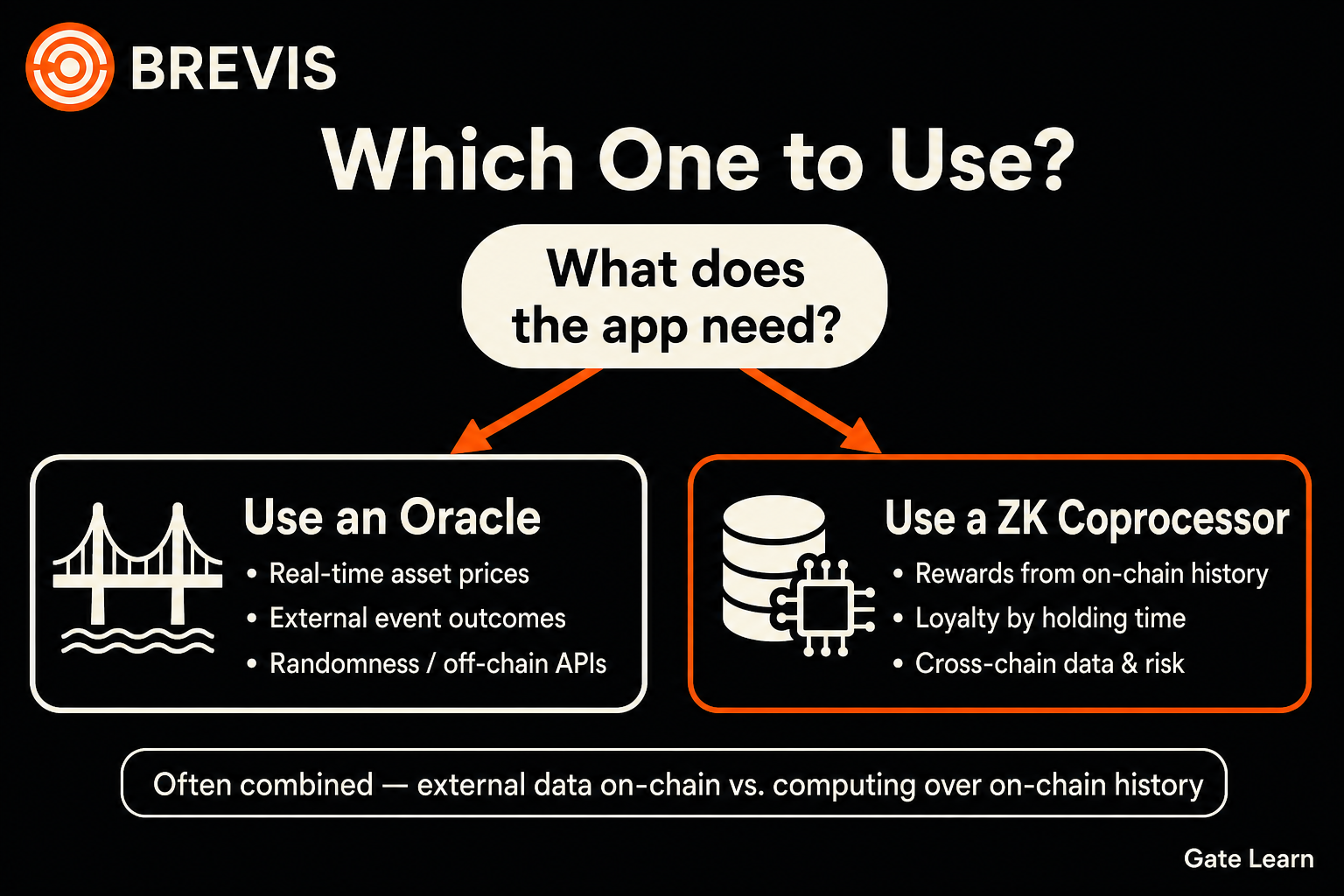
Figure 2. Scenario selection: use oracles for external data on-chain, ZK coprocessors like Brevis for verifiable on-chain historical computation; both can be combined.
What Are the Limitations and Considerations in Such Comparisons?
Terminology boundaries are not absolute: “oracle” and “ZK coprocessor” are functional categories, but real-world products often integrate multiple capabilities, and these boundaries can blur as designs evolve. “Other ZK coprocessors” should be viewed as a general category—avoid drawing definitive conclusions about third-party projects without public confirmation.
Hybrid solutions are increasingly common: some infrastructure combines external data input with verifiable computation, or uses zero-knowledge proofs to enhance oracle data integrity. Choosing strictly between one or the other may overlook these hybrid models.
Cost and latency are also significant factors. Generating ZK proofs requires specialized hardware and has higher overhead for general-purpose computation compared to native execution. Oracles are affected by update frequency, node coverage, and aggregation latency. Comparisons should be scenario-specific, not based on a single metric.
Summary
Oracles and ZK coprocessors like Brevis address distinct challenges at opposite ends of blockchain data flows: oracles bring external data on-chain, relying on trust assumptions and economic incentives; ZK coprocessors enable verifiable computation on historical on-chain data, relying on the mathematical integrity of zero-knowledge proofs. Each serves a unique role in terms of data direction, trust model, and compute capability, and their boundaries are not absolute. In practice, hybrid approaches are often employed for maximum effectiveness.
FAQ
Can Oracles and ZK Coprocessors Replace Each Other?
No, they cannot directly replace one another. Oracles are responsible for bringing external, off-chain data on-chain, while ZK coprocessors perform verifiable computation on existing on-chain historical data. They operate at different points in the data flow and are often used collaboratively or in combination within a single application.
What Is the Core Difference Between Brevis and Oracles?
The core difference lies in data direction and trust model. Oracles primarily bring external data on-chain, with trust based on nodes/multisig and economic incentives. Brevis and similar ZK coprocessors compute on-chain historical data and return zero-knowledge proofs, allowing mathematical verification of results directly on-chain.
Why Are ZK Coprocessors Considered Trust-Minimized?
ZK coprocessors make the computation process itself verifiable: as long as the on-chain zero-knowledge proof is valid, it confirms the relevant data exists and the computation was executed correctly—no need to trust third parties for data reporting or computation. This is why they are considered trust-minimized.
Do Oracles Use Zero-Knowledge Proofs?
Some oracle solutions use zero-knowledge proofs to enhance data integrity or privacy, but their main function remains to bring external data on-chain. In oracles, zero-knowledge proofs are typically an enhancement, while in ZK coprocessors, they are the core mechanism for verifying computational correctness.
Can an Application Use Both Oracles and ZK Coprocessors?
Yes. For example, a DeFi application might use oracles to obtain real-time asset prices and ZK coprocessors to calculate incentives or risk control based on users’ actual on-chain history, addressing both “external data on-chain” and “on-chain historical data computation” requirements.







