Alibaba Group Holding Limited is listed in Hong Kong under stock code 9988. For users comparing Gate Stocks with a traditional Hong Kong brokerage account, the main question is not simply whether the price moves with Alibaba’s Hong Kong-listed shares. The more important question is how the position is accessed, funded, settled, recorded, and treated for rights-related events.
Gate Stocks gives eligible users a way to access stock price exposure through a crypto-native account environment using USDT. A traditional broker usually gives users direct brokerage-based market access through a securities account, often funded in fiat currency or local market currency. Both routes can provide exposure to Alibaba’s market price, but they are not identical in workflow, settlement asset, documentation, shareholder participation, or transfer assumptions.
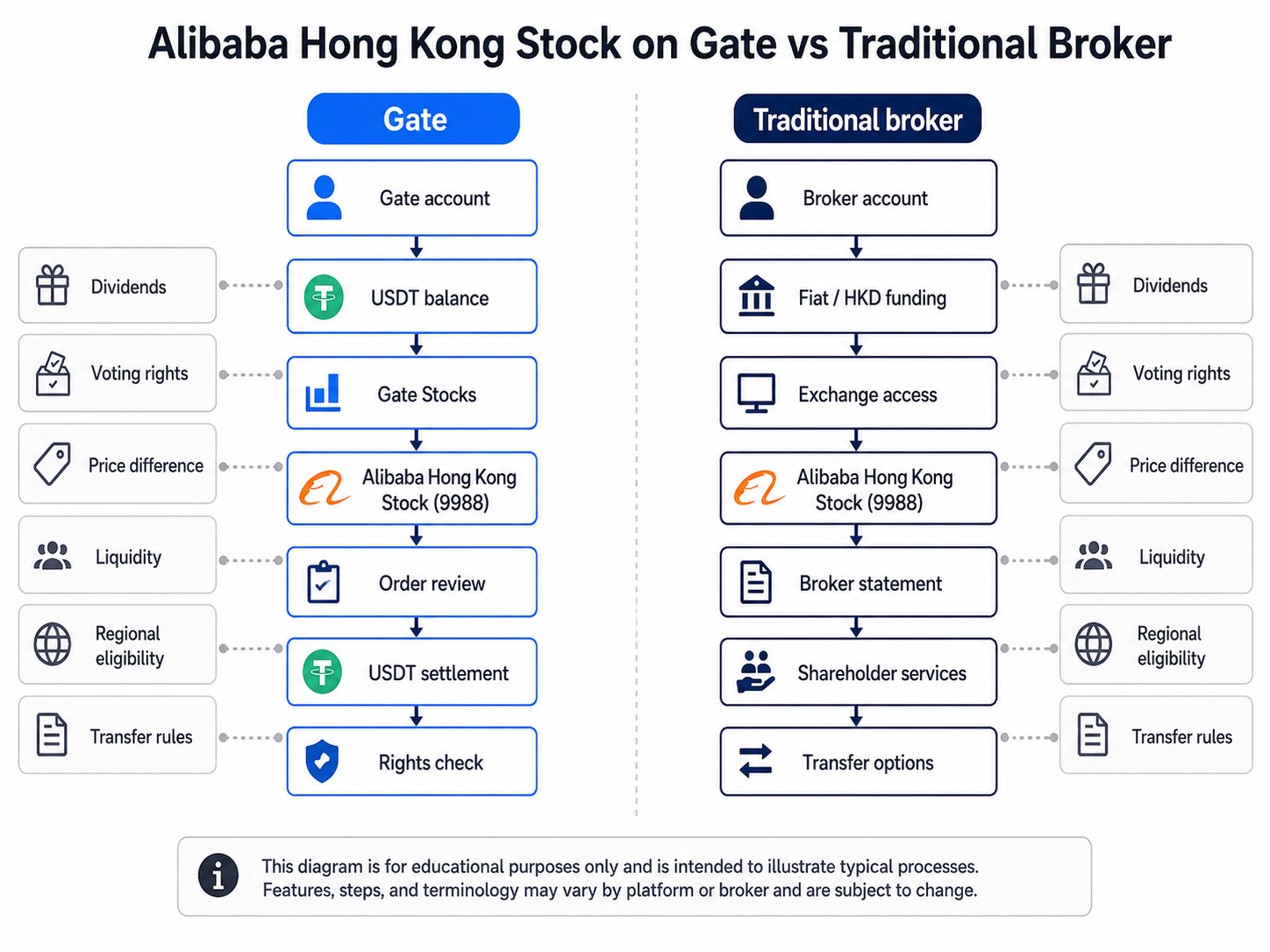
What Is the Key Difference Between Buying Alibaba Hong Kong Stock on Gate and Buying It Through a Traditional Broker?
The key difference between buying Alibaba Hong Kong Stock on Gate and buying it through a traditional broker is the product structure. Gate Stocks gives eligible users access to Alibaba Hong Kong Stock price exposure through Gate’s stock trading service, with USDT used as the main funding and settlement asset where the product flow supports it. A traditional broker usually gives users access through a securities account connected to the Hong Kong market, with funding, settlement, statements, and shareholder services handled through brokerage infrastructure.
Users who want the operational process for the Gate route can refer to buying Alibaba Hong Kong Stock with USDT on Gate. The important point is that a familiar digital asset funding flow does not automatically make the position identical to shares held through a traditional brokerage account. Gate Stocks may support stock-related economic exposure and certain corporate action processing, but users should still verify the latest product rules as of June 2026 before assuming the same rights, transfer options, or documentation that a broker provides.
A practical preparation checklist should come before comparing the two routes:
| Preparation item |
Gate Stocks route |
Traditional broker route |
Why it matters |
| Stock name and code |
Alibaba Hong Kong Stock, 9988 |
Alibaba Group Holding Limited, 9988 |
Helps avoid confusing the Hong Kong listing with the U.S. ADR |
| Product type |
Gate Stocks price exposure |
Brokerage-held market access |
Defines account structure and rights treatment |
| Funding asset |
USDT where supported |
Usually HKD, USD, or local fiat conversion |
Affects settlement and cost review |
| Dividend rule check |
Verify Gate Stocks rules as of June 2026 |
Check broker dividend treatment |
Dividend timing, currency, and records may differ |
| Voting rights check |
Verify current Gate product rules |
Usually handled through broker or nominee structure |
Governance participation may not be the same |
| Transfer rule check |
Do not assume external broker transfer unless clearly supported |
Broker transfers may be available depending on broker rules |
Important for users who may later move positions |
| Regional eligibility |
Depends on Gate account status and region |
Depends on broker onboarding and local rules |
Access may change by jurisdiction |
| Risk review |
Market, product, USDT, liquidity, price difference, platform risk |
Market, broker, FX, custody, and market access risk |
Both routes require careful review |
These preparation points matter because users are comparing two different access models, not only two interfaces. A Gate user may value USDT funding and a unified account flow. A broker user may value traditional statements, securities account services, transfer options, and shareholder-related processes. Neither route should be described as universally superior. The correct comparison depends on the user’s account needs, documentation requirements, rights expectations, and risk tolerance.
The broader mechanics of Gate Stocks trading are useful here because they show why stock access through a digital asset account can feel simpler operationally while still requiring product-specific risk checks. In contrast, a traditional broker usually involves a separate securities account, bank funding, currency conversion, and broker-specific market access rules. The final decision should be based on how the user wants to manage settlement, records, rights, and long-term account flexibility.
| Comparison dimension |
Buying Alibaba Hong Kong Stock on Gate |
Buying Alibaba Hong Kong Stock through a traditional broker |
| Access method |
Through Gate Stocks, subject to eligibility and product availability |
Through a securities brokerage account |
| Price exposure |
Exposure to Alibaba Hong Kong Stock price movements |
Exposure through broker-held stock position |
| Funding and settlement |
USDT-based funding and settlement where supported |
Usually fiat or market-currency funding, often HKD or converted currency |
| Account structure |
Crypto-native Gate account environment |
Traditional securities account environment |
| Dividend handling |
Must be verified from Gate’s latest product rules as of June 2026 |
Usually handled through broker and market custody system |
| Voting rights |
May differ from direct shareholder participation |
Usually available through broker or nominee process when supported |
| Transfer options |
Do not assume external transfer unless Gate rules clearly support it |
Broker-to-broker transfers may be available depending on broker and market rules |
| Statements and reporting |
Gate account records and stock account activity |
Broker statements, tax reports, and market documents where supported |
| Product-rule dependency |
High, because rights and processing follow Gate rules |
Broker and market rules apply |
| Risk profile |
Market risk plus product-structure, USDT, platform, and eligibility risk |
Market risk plus broker, FX, custody, and market access risk |
The comparison shows that both routes can connect users to Alibaba Hong Kong Stock price movements, but they solve different user problems. Gate Stocks focuses on access from within a digital asset account environment. A traditional broker focuses on conventional securities account services. The difference matters most when users care about dividends, voting, account documentation, transfers, and how the position is treated beyond simple price movement.
How Are Dividends Handled for Users Holding Alibaba Hong Kong Stock on Gate?
Dividend handling for users holding Alibaba Hong Kong Stock on Gate should be verified from Gate’s latest official product rules before trading, as of June 2026. Gate Stocks articles describe stock-related economic benefits and supported corporate actions, including cash dividends, stock dividends, stock splits, reverse splits, and certain cash-based corporate action events, but the exact treatment for a specific stock, date, market, and user account can depend on current platform rules.
The important distinction is between economic rights and shareholder rights. Economic rights relate to financial outcomes connected to a stock position, such as a supported dividend or corporate action adjustment. Shareholder rights relate to governance participation, registered shareholder status, voting, and related company-level decisions. Users should understand economic rights and shareholder rights on Gate Stocks before assuming that dividend handling on Gate works the same way as a traditional brokerage account.
In a traditional broker account, dividends are usually processed through the broker, custodian, and market infrastructure. Depending on the broker, users may receive dividends in the relevant currency, see dividend statements, or access tax-related documents. Some brokers may support dividend election options or corporate action choices when available, though this depends on the market, broker, and account type.
On Gate, dividend-related processing follows the Gate Stocks product framework. If a cash-based economic benefit is supported, it may be credited according to platform rules and reflected in the user’s account records. Users should review the stock account transaction history, dividend records, corporate action records, applicable fees, currency treatment, timing, eligibility, and any product notices shown in the interface as of June 2026.
For Alibaba Hong Kong Stock specifically, users should not assume dividend timing, currency, tax treatment, election rights, or documentation will match a Hong Kong broker. The safer editorial position is that dividend handling may be supported where Gate’s current product rules provide for it, but the user must check the latest rules and order-page information before trading or holding the position for income-related reasons.
Do Users Holding Alibaba Hong Kong Stock on Gate Have Shareholder Voting Rights?
Users holding Alibaba Hong Kong Stock on Gate should not assume that shareholder voting rights are the same as holding shares through a traditional broker. As of June 2026, Gate Stocks materials distinguish between stock-related economic exposure and registered shareholder-style rights. Gate Stocks users may have exposure to the stock’s price movement and supported economic benefits, but shareholder voting rights may not be generally available in the same way as direct or broker-facilitated shareholder participation.
This distinction is important because voting rights are not only about the ability to benefit from price changes. They relate to company governance. A shareholder voting process may involve annual general meetings, special resolutions, board elections, corporate proposals, or other decisions that require participation through recognized shareholder or nominee channels. Traditional brokers may support these processes depending on the broker, market, custody chain, and account type.
Gate Stocks should be understood through its product rules rather than through assumptions based on direct shareholding. If Gate’s product rules state that certain shareholder rights are not available, users should treat the position as different from a traditional shareholder framework even if the price exposure tracks the underlying listed stock. If Gate updates its product rules later, users should rely on the latest version rather than older article text, screenshots, or third-party summaries.
The practical question is simple: does the user only need price exposure to Alibaba Hong Kong Stock, or does the user also need governance participation? If the user requires shareholder voting, meeting participation, rights offering access, broker letters, or other formal shareholder services, a traditional broker may be more suitable. If the user mainly wants price exposure through a USDT-funded Gate Stocks flow, Gate may be more suitable, provided the user accepts the current rights structure and product limitations.
Why May Gate’s Alibaba Hong Kong Stock Price Differ from the Exchange Price?
Gate’s Alibaba Hong Kong Stock price may differ from the Hong Kong exchange reference price because the displayed price, executable price, order timing, liquidity, spread, settlement asset, and product infrastructure may not be identical to a traditional broker’s quote view. Price differences should not be described as manipulation or guaranteed arbitrage. They are usually part of how market access, order routing, liquidity, conversion, and execution review work across different platforms.
A traditional broker may show a Hong Kong market quote in HKD, with access depending on market data permissions, order type, and market session. Gate Stocks may show a stock quote through its own interface and calculate the user’s estimated cost in USDT. If Alibaba Hong Kong Stock is priced against a Hong Kong market reference but funded through USDT, users should review the displayed price, estimated total, exchange-rate or conversion effect if shown, fee estimate, order size, and final confirmation page.
Several factors can create visible differences. Liquidity can change during active or thin trading periods. Spreads can widen around market open, market close, earnings news, macro events, holidays, or periods of lower order book depth. Execution timing matters because a quote seen before confirmation may change before the order executes. Order type matters as well. A market order may prioritize execution, while a limit order may control price but may not fill.
Users comparing Gate Stocks, traditional brokers, and stock CFDs should also remember that products can show similar market exposure while using different account and execution models. A CFD quote, a broker quote, and a Gate Stocks quote are not automatically interchangeable. For Alibaba Hong Kong Stock on Gate, the safest process is to review the live order page before every order and avoid relying on old screenshots, delayed third-party quotes, or assumptions from a different market listing such as the U.S. ADR.
Can Users Transfer Alibaba Hong Kong Stock from Gate to Another Broker?
Users should not assume that Alibaba Hong Kong Stock positions held through Gate Stocks can be transferred to an external brokerage account unless Gate’s official product rules clearly support such transfers as of June 2026. Transferability is one of the most important differences between a product-based stock access route and a traditional brokerage account.
In a traditional brokerage setting, users may be able to transfer positions between brokers, depending on the broker, market, custody structure, account type, transfer destination, and local rules. This process may involve forms, fees, settlement checks, market restrictions, and identity verification. Even in traditional finance, transferability is not automatic in every case, but the brokerage system usually provides a defined process when transfers are supported.
Gate Stocks should be evaluated based on Gate’s current transfer rules. If the product is designed mainly for buying, holding, and selling stock exposure within the Gate account environment, users should not treat the position as if it can be freely moved to an outside securities broker. A user who plans to consolidate all securities holdings at a specific Hong Kong broker, needs external custody records, or expects future broker-to-broker transfer flexibility should check this point before opening or increasing a position.
The practical approach is to separate liquidity from transferability. A user may be able to sell a Gate Stocks position when the product is available, the market is open, liquidity exists, and account rules allow it. That is different from transferring the same position to another brokerage account. Selling converts the position according to the platform’s trading and settlement process. Transferring would require the product and custody framework to support outbound movement. For Alibaba Hong Kong Stock on Gate, transfer assumptions should be checked directly from current product rules and any account notices shown before trading.
When Is Buying Alibaba Hong Kong Stock on Gate More Suitable, and When Is a Traditional Broker More Suitable?
Buying Alibaba Hong Kong Stock on Gate may be more suitable for users who already hold USDT, are eligible for Gate Stocks, want access to Alibaba Hong Kong Stock price exposure through a crypto-native account environment, and prefer a simplified flow that avoids opening a separate traditional brokerage account. This route may also fit users who already manage digital assets and want stock exposure displayed alongside other assets in a unified platform interface.
The broader use of crypto assets for traditional market exposure is part of a wider trend. Users can already compare stock access with other traditional market products, such as using crypto assets to trade gold, silver, and oil. The common theme is convenience and cross-market access from a digital asset account. However, convenience does not remove market risk, product-structure risk, or the need to verify eligibility and rules.
A traditional broker may be more suitable for users who need direct securities account services, full broker statements, formal tax reports, shareholder voting participation where supported, broker-to-broker transfer options, local market documentation, advanced order tools, research services, or broader securities market access. A traditional broker may also be preferred by users who want to fund in fiat currency, keep stock holdings separate from crypto assets, or follow an existing compliance and accounting workflow.
The neutral answer is that Gate and traditional brokers serve different needs. Gate may fit users who prioritize USDT settlement and a crypto-native product flow. Traditional brokers may fit users who prioritize full brokerage services and formal shareholder processes. Users should not frame the question as which route is universally superior. The better question is which structure matches the user’s rights expectations, settlement preference, reporting needs, transfer plans, and risk tolerance as of June 2026.
What Risks Should Users Understand Before Buying Alibaba Hong Kong Stock on Gate?
Users should understand several risk categories before buying Alibaba Hong Kong Stock on Gate. Market risk comes first. Alibaba Hong Kong Stock can rise or fall based on company performance, earnings, regulation, consumer demand, competition, macroeconomic conditions, liquidity, geopolitical events, and broader Hong Kong market sentiment. Price exposure means users participate in price movements, including adverse movements.
Stock-specific risk also matters. Alibaba Group is affected by business execution, platform competition, cloud and commerce trends, regulatory changes, corporate actions, and investor sentiment toward Chinese and Hong Kong-listed equities. A user should not treat a familiar company name as a substitute for risk analysis. Familiarity does not reduce volatility.
Product-structure risk is central to Gate Stocks. Users should understand that the Gate route may differ from traditional broker-held shares in dividend processing, voting rights, transfer options, statements, and shareholder-related participation. Rights interpretation risk appears when users assume that every stock-like benefit is identical across account types. That assumption may be wrong.
Liquidity and price difference risk can affect execution. The final order price may differ from an estimate due to spread, market movement, market session, order type, available liquidity, and settlement calculations. Larger orders may be more sensitive to market depth. Users should carefully review the order page, quantity, estimated cost, fees, settlement asset, and risk notices before confirmation.
Platform risk and operational risk also apply. Users must secure their Gate account, protect credentials, complete required verification, and understand account access rules. Regional eligibility risk matters because Gate Stocks availability may depend on user location, KYC status, product restrictions, and applicable laws as of June 2026. USDT-related risk is relevant because USDT may be used as the funding or settlement asset. Stablecoins can involve issuer, redemption, liquidity, market, and regulatory risks.
Transfer limitation risk should not be overlooked. If a user expects to move Alibaba Hong Kong Stock to a traditional broker later, the user should verify whether such transfers are supported before trading. If they are not supported, selling through Gate may be different from transferring the position externally.
Summary
Buying Alibaba Hong Kong Stock on Gate differs from buying it through a traditional broker because the two routes use different account structures, settlement assets, rights frameworks, and operational rules. Gate Stocks can provide Alibaba Hong Kong Stock price exposure through a USDT-based product flow for eligible users, while traditional brokers usually provide securities account access through brokerage infrastructure.
The key checks are practical: confirm the Alibaba Hong Kong listing and stock code 9988, review product availability, understand USDT settlement, verify dividend handling, confirm whether voting rights apply, avoid assuming external transfer support, and review the live order page before confirmation. Users who want a direct process can start from the Alibaba Hong Kong Stock with USDT tutorial, while users comparing product structures should review the broader Gate Stocks rights and broker-comparison materials.
Gate may be more suitable for users who already hold USDT and want price exposure through a crypto-native account environment. A traditional broker may be more suitable for users who need shareholder voting, broker statements, tax documents, transfer flexibility, and direct securities account services. The choice should be based on product understanding, not on assumptions that both routes are identical.
Stock investing involves market risk, and prices may fluctuate significantly. Please make decisions carefully based on your own risk tolerance. This article does not constitute investment advice.
FAQs
Is the Alibaba Hong Kong Stock bought on Gate a real stock?
Alibaba Hong Kong Stock bought on Gate gives users stock price exposure through Gate Stocks, subject to Gate’s current product structure and rules. Users should distinguish price exposure and supported economic benefits from registered shareholder status and traditional broker-held share treatment. The latest Gate Stocks product rules should be checked before trading.
Can I hold Alibaba Hong Kong Stock on Gate for the long term?
Alibaba Hong Kong Stock on Gate may be held according to the product’s current availability, account rules, and market conditions as of June 2026. Users who plan long-term holding should review dividend handling, rights treatment, transfer limitations, account records, fees, and regional eligibility before relying on the product for long-term exposure.
Do I receive dividends when holding Alibaba Hong Kong Stock on Gate?
Alibaba Hong Kong Stock dividend handling on Gate depends on Gate’s latest product rules as of June 2026. Supported economic benefits may be processed according to platform rules, but users should not assume the timing, currency, tax treatment, or election options are identical to a traditional brokerage account.
Do I get voting rights when buying Alibaba Hong Kong Stock on Gate?
Alibaba Hong Kong Stock held through Gate may not provide the same voting rights as shares held through a traditional broker. Gate Stocks materials distinguish economic exposure from registered shareholder-style governance rights, so users should verify current voting-rights treatment before trading.
Can I transfer my Alibaba Hong Kong Stock position from Gate to another broker?
Alibaba Hong Kong Stock positions on Gate should not be assumed transferable to an external broker unless Gate’s current product rules clearly support that function. Selling a position inside Gate and transferring a position to another brokerage account are different actions with different requirements.
Why can Gate’s Alibaba Hong Kong Stock price differ from a broker quote?
Gate’s Alibaba Hong Kong Stock price may differ from a broker quote because of liquidity, spreads, reference pricing, timing, settlement asset, order type, and live execution conditions. Users should rely on the final order review page rather than delayed quotes or screenshots.







