Robinhood Markets (HOOD) provides a foundational overview of HOOD across three key dimensions: company entity, business structure, and Gate trading path. Before placing an order, it’s essential to differentiate between the company’s fundamentals and the trading rules shown on the interface. The HOOD Stock Business Model details how trading revenue, net interest, and Gold subscriptions make up the revenue structure. These should not be conflated with order types, fee fields, or available USDT balances.
A more secure process is to first verify whether your account and USDT are eligible for stock orders. Then, search for Robinhood Markets, Inc. using the code HOOD, select the appropriate order type, and review the trading record. The fintech sector features several assets with similar names or overlapping business scopes—code-based verification helps prevent mistakes, such as confusing Robinhood with Coinbase Global, Inc. (NASDAQ: COIN). The HOOD vs COIN comparison highlights industry differences in revenue structure and regulatory exposure.
What Should You Prepare Before Buying HOOD on Gate?
Before trading HOOD with USDT, confirm your account status, identity verification, stock trading permissions, available USDT, product accessibility, and regional eligibility. Different accounts and regions may have varying interface rules, so always refer to the features displayed on the Gate Stocks page.
The purpose of the preparation phase is not to place an order, but to eliminate basic issues such as ineligible trading, unavailable funds, code confusion, and fee misinterpretation. Any unclear preparation item can lead to issues like “market data visible but unable to submit orders” or “order amount not matching available balance.”
| Preparation Item |
Checklist |
Common Impact |
| Account Permissions |
Access to Stocks/US stock trading features |
Determines ability to place orders |
| USDT Funds |
Whether available USDT is in the stock account |
Affects order amount and tradable size |
| Product Availability |
Whether HOOD shows as tradable on the page |
Determines order submission capability |
| Asset Identification |
Consistency of name, code HOOD, and NASDAQ info |
Ensures correct stock selection |
| Fee Rules |
Trading fees, minimum unit, settlement standards |
Impacts actual trades and records |
The checklist above breaks down preparation into actionable items. Complete all preparations before searching and placing orders to minimize invalid actions due to permission or funding issues.
Step 1: How to Prepare USDT and Your Stock Trading Account
First, ensure your Gate account has completed the identity and permission setup required for stock trading. Then, confirm your USDT balance is in the account or sub-account available for Stocks orders. If funds are still in contracts, spot, or other wallets, transfer them to your stock trading balance according to platform rules.
When preparing funds, set aside enough for fees and the minimum order size to avoid “market accessible but insufficient balance” issues. Fund preparation only addresses payment capability—asset identification must be done on the search page.
Step 2: How to Search for HOOD on Gate Stocks
Go to the Gate Stocks page or enter HOOD in the Stocks search box. Verify that the company name is Robinhood Markets, Inc. and the market is NASDAQ. If you see assets with similar names but different codes, always rely on the HOOD code.
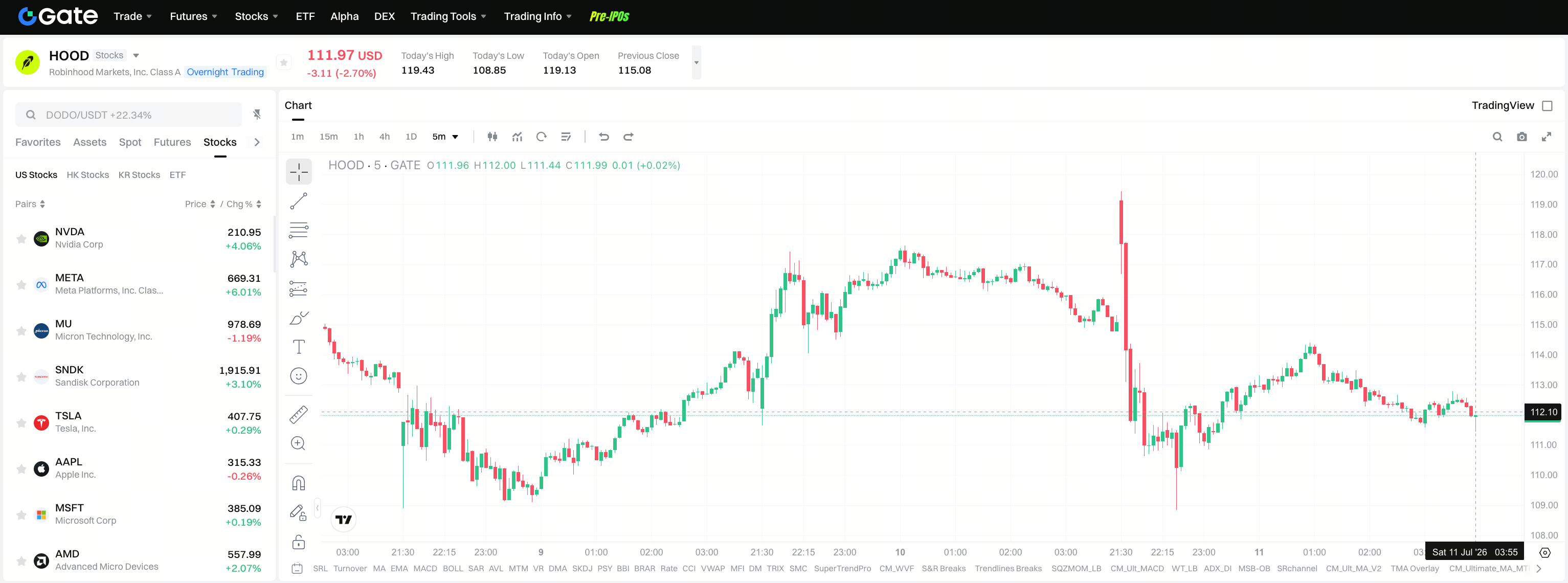
During the search, also confirm the trading status, reference price data, and essential info on the page. Market data is for order book observation only and does not replace independent assessment of the company’s business and risks. For regulatory and compliance details, see HOOD Regulation and Compliance.
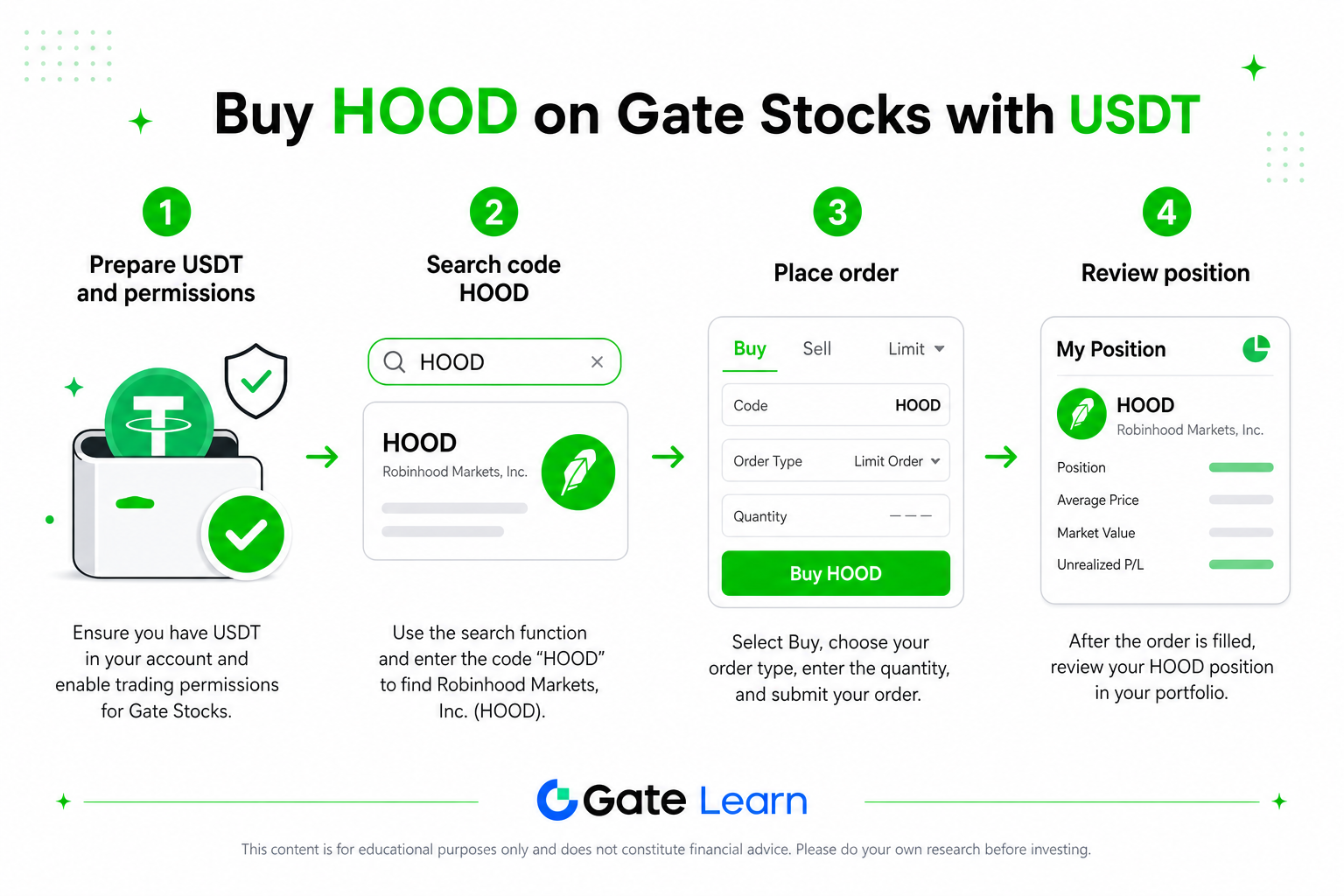 Figure 1. Gate Stocks HOOD trading flow: USDT preparation → search code → place order → position review.
Step 3: How to Place a Buy or Trade Order for HOOD
Once you’ve confirmed the correct asset, choose the buy or sell side, enter the quantity or amount, and select the order type (market, limit, etc., as shown on the page). Before submitting, double-check: code HOOD, company name, side, quantity, price conditions, and estimated fees.
After placing the order, review its status in the order record (unfilled, partially filled, filled, or canceled). For limit orders, understand that orders may remain pending if price conditions aren’t met. Market orders prioritize immediate execution and require awareness of slippage—follow the page prompts for specifics.
| Checklist |
Before Order |
After Transaction |
| Code & Name |
HOOD / Robinhood Markets, Inc. |
Position list consistency |
| Side & Quantity |
Buy/Sell, number of shares or amount |
Filled quantity match |
| Order Type |
Market/Limit, etc. |
Order completion status |
| Fees |
Estimated trading fee |
Traceability of actual deduction |
| Funds |
Sufficient available USDT |
Correspondence of balance & position |
This table aligns pre- and post-order checks to develop consistent operational habits.
What Fees and Order Rules Should Be Confirmed When Trading HOOD?
Fees generally include trading fees and other platform-announced charges. The display may vary by account level, promotions, or product type—refer to the order confirmation page and fee details. Order rules also cover minimum trading size, price precision, trading hours, and whether pre-market or after-hours trading is supported. Orders placed outside tradable hours may not execute immediately.
Fees and rules are execution-level details and should not be confused with the company’s “zero-commission retail model.” The app’s commission structure and Gate Stocks’ trading fees are separate rule sets.
What Risks Should You Understand Before Buying or Trading HOOD?
Company-level risks include changes in retail trading activity, interest rate impacts on net interest, PFOF and brokerage regulation, crypto business volatility and compliance costs, and fintech competition. Execution risks include code errors, misuse of order types, insufficient balance, trading hour restrictions, and underestimating fees.
These risk statements are for awareness and do not constitute investment advice or imply future price or returns. For insights into revenue mechanisms, refer to the business model section—not the order page.
Summary
Trading HOOD with USDT on Gate Stocks follows a repeatable process: prepare permissions and funds, search and verify Robinhood Markets, Inc., select order type, confirm fees, and review positions. This ensures operational accuracy; understanding HOOD as a retail brokerage stock still requires analysis of its business structure, industry peers, and regulatory constraints.
FAQ
How Do I Buy HOOD Stock with USDT on Gate?
Once you’ve confirmed stock trading permissions and available USDT, search for HOOD, verify Robinhood Markets, Inc. and NASDAQ details, select the order type, and submit. Review results in your positions and order records.
How Is Trading HOOD on Gate Different from Traditional Brokers?
Gate Stocks uses platform accounts and USDT for settlement; traditional brokers use securities accounts and fiat. Differences include account setup, trading hours, fee fields, and fund transfer paths. Always follow the rules shown on each platform.
Is There a Minimum Purchase Requirement for HOOD?
Minimum quantity, amount, and precision are shown in real time on the Gate Stocks page and may change with product rules. Always check the confirmation page for available quantity and estimated fees before placing an order.
What Industry Is HOOD In?
Robinhood Markets, Inc. operates in the fintech and retail brokerage sector, offering multi-asset trading and subscription services. Industry classification aids search but does not replace a review of the revenue structure.
What If I Accidentally Buy COIN? How Do I Tell the Difference?
Always check the code before ordering: HOOD is Robinhood Markets, Inc.; COIN is Coinbase Global, Inc. If you made a mistake, check if you can cancel or reverse the order according to platform rules and review the order record. Do not rely solely on company abbreviations in memory.