Users can directly buy Samsung Electronics stock on Gate using USDT without opening a traditional brokerage account, with trading available through Gate Stocks as of June 2026. Samsung Electronics is listed on the Korea Exchange under ticker 005930. Gate’s Korean stock service lets eligible users access KRX-listed stocks through a Gate stock account, with settlement handled in USDT.
USDT is a U.S. dollar-pegged stablecoin widely used for crypto transfers and settlement. In this workflow, users do not need to fund a Korean brokerage account in KRW first. They can use USDT inside Gate, then review the converted settlement amount before confirming a Korean stock order.
The basic process has five steps: prepare a Gate account, hold or deposit USDT, transfer funds to the stock account, search for Samsung Electronics in Gate Korean Stocks, and confirm the order after reviewing price, fees, exchange-rate conversion, and risk notes.
For crypto users who already hold USDT, the main difference is the funding route. Korean stock market information may display in KRW, while fees and settlement amounts are converted into USDT. Users comparing this route with USDT stock trading without a brokerage account should still check eligibility, fees, order rules, product rights, exchange-rate conversion, and regional restrictions.
Gate launched Korean stock trading with initial support for 1,000 KRX-listed stocks by market capitalization across KOSPI and KOSDAQ. Samsung Electronics was included among the first featured Korean stocks, alongside SK hynix, NAVER, Hyundai Motor, and Celltrion. Gate Korean stock trading follows Korea Exchange regular market hours, not round-the-clock crypto trading.
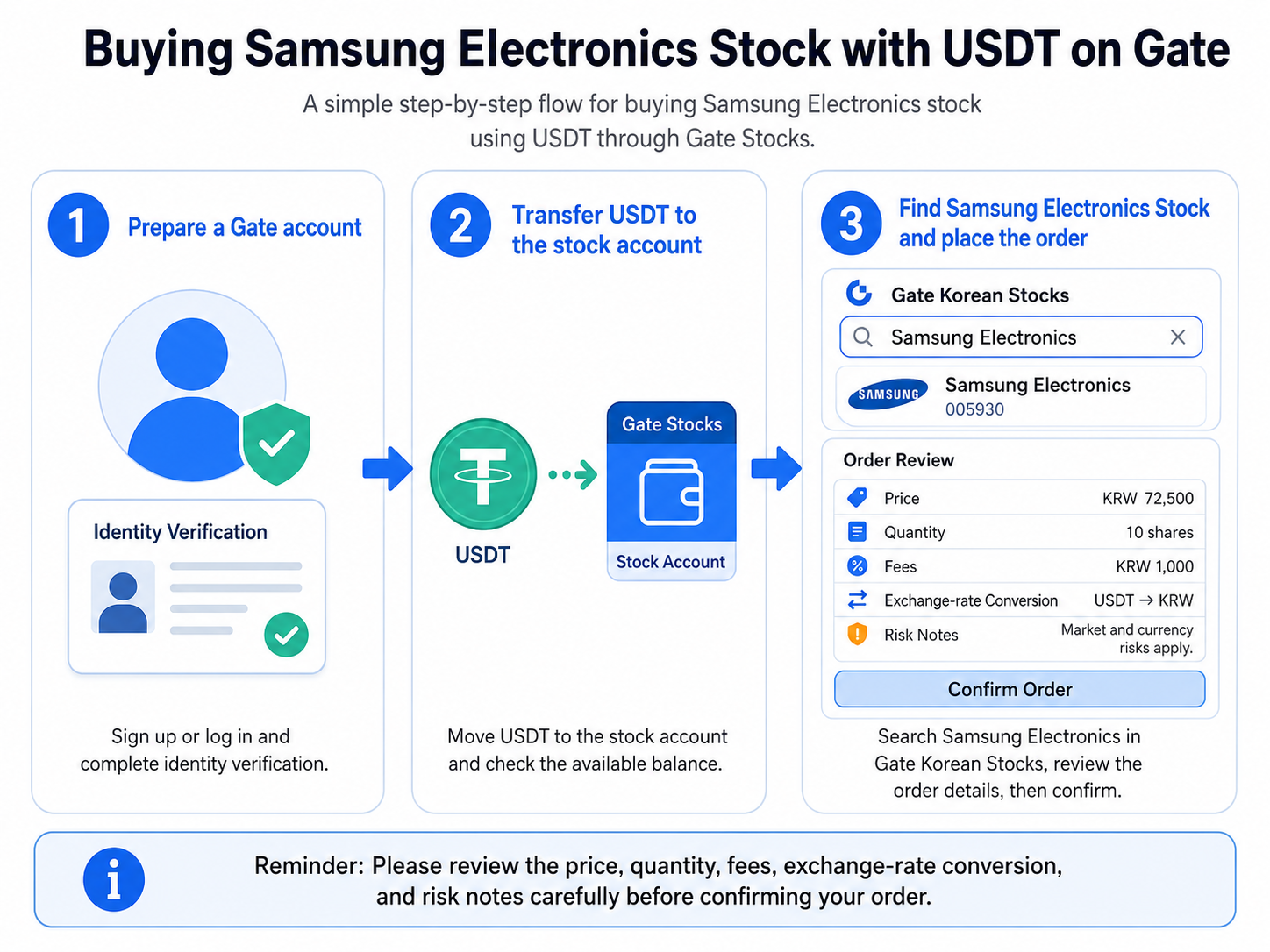
What Do You Need Before Buying Samsung Electronics Stock on Gate?
Before buying Samsung Electronics Stock with USDT on Gate, users need a Gate account, access to Gate Stocks, a sufficient USDT balance, and regional eligibility for Korean stock trading. Identity verification may also be required for stock trading access, related features, or compliance checks.
Preparation should go beyond funding the account. Users should understand the trading session, settlement asset, product structure, corporate action rules, and possible differences from a Korean securities account. The Gate Stocks entry point is where users can access stock products inside Gate, while the Korean Stocks section is used for KRX-listed assets such as Samsung Electronics Stock (005930).
| Requirement |
Why it matters |
User note |
| Gate account |
Needed to access Gate Stocks and stock account functions |
Complete account setup before trading |
| Identity verification |
May affect access, rewards, and compliance checks |
Follow the latest Gate prompts |
| USDT balance |
Korean stock settlement is handled in USDT |
Confirm available balance before placing an order |
| Stock account transfer |
Funds may need to move from Spot or Unified Account to Stock Account |
Check the transfer path before trading |
| Korean Stocks access |
Samsung Electronics is a KRX-listed stock |
Regional restrictions may apply |
| Product rule review |
Fees, corporate actions, and order rules can change |
Verify the latest Gate terms before confirming an order |
This checklist is only an operational framework. It does not suggest that users should buy Samsung Electronics Stock. It helps users understand the account, funding, and product steps before using Gate Stocks.
Users familiar with buying U.S. stocks with USDT on Gate should not assume Korean stock rules are the same. Korean stocks follow Korea Exchange rules, use KRW market display, and rely on USDT conversion for settlement inside Gate.
Step 1: How to Deposit USDT on Gate
To buy Samsung Electronics Stock on Gate, users first need USDT in their Gate account. USDT may be added through funding routes shown inside Gate, such as supported on-chain transfers or other available account methods. Available routes can vary by region, account status, and current product rules.
For an on-chain USDT deposit, users should check the asset, network, deposit address, memo or tag requirement, and minimum deposit rule. A wrong network or unsupported route may delay funds or make them difficult to recover. The safer habit is to copy the deposit address directly from Gate and verify the network before sending funds.
After USDT arrives, users may need to transfer funds to the Stock Account. Gate’s Korean stock flow includes a transfer step from Spot Account or Unified Account into the Stock Account. The Stock Account balance should be checked before searching for Samsung Electronics Stock (005930) or placing an order.
Step 2: How to Find Samsung Electronics Stock on Gate
To find Samsung Electronics Stock on Gate, open Gate Stocks and go to the Korean Stocks section. On web, the route is Stocks, then Korean Stocks. On app, Gate describes the path as TradFi, Stocks, Markets, and Korean Stocks.
Samsung Electronics should be identified by its full company name and KRX ticker 005930. This helps users avoid confusing the common share with similarly named assets, preferred shares, derivatives, stock futures, or other Samsung-related products. The order page should show the market, ticker, quantity, estimated price, fee information, exchange-rate conversion, and USDT settlement details.
Product availability can change. Samsung Electronics was part of the featured Korean stock list at launch, but users should confirm live availability inside Gate Stocks before trading.
Related tutorials such as Buy Tesla Stock with USDT, How to Buy NVIDIA Stock with USDT on Gate, and Buy Microsoft Stock with USDT follow a similar tutorial structure for U.S.-listed stocks. Korean stocks still require separate checks for market hours, currency display, exchange-rate conversion, and eligibility.
Step 3: How to Place an Order for Samsung Electronics Stock
After locating Samsung Electronics Stock, users can review the order ticket and enter the intended quantity or amount. Gate states that Gate Stocks supports fractional trading from 0.01 share, but the exact minimum for Samsung Electronics Stock should be checked on the live order page.
If market and limit orders are available, users should understand how they differ. A market order is designed to execute against available liquidity. The final execution price may differ from the displayed quote. A limit order lets the user set a price condition, but execution is not guaranteed.
Before confirming a Samsung Electronics Stock order, review these fields:
The difference between stock spot exposure and stock futures matters because a fully funded Gate Stocks order differs from a margin-based stock position. Users comparing products should also understand that US stock contract leverage involves margin, liquidation, and leverage risk.
What Are the Trading Fees for Samsung Electronics Stock on Gate? (As of June 2026)
Gate states that stock trading fees can be as low as 0.023% (As of June 2026). The actual fee for buying Samsung Electronics Stock may depend on the user’s account level, order page, product settings, and current fee rules. Users should verify the latest fee schedule on Gate before placing an order.
Gate also describes its stock product as having no platform fees, no commissions, and no hidden charges (As of June 2026). Even so, the live order page should be treated as the final reference. Fee rules, supported assets, account requirements, and product settings may change.
Fees are not the only cost factor. Users should also consider spread, market liquidity, KRW-to-USDT conversion, and the gap between the displayed quote and final execution price. This can matter more during fast-moving markets or thin-liquidity periods.
The Gate US stock liquidity and spread concept is useful here because bid-ask spread, order size, and execution timing can affect the final result. Korean stocks also add currency conversion, so the order confirmation page is the key cost checkpoint.
Unlike Gate U.S. stocks extended-hours trading, Gate Korean stock trading follows the Korea Exchange regular session. Gate states that Korean stock orders can be placed between 09:00 and 15:20 Korea Standard Time, with continuous auction trading during the regular session.
What Risks Should You Understand Before Buying Samsung Electronics Stock?
Buying Samsung Electronics Stock with USDT on Gate involves several risks. These include market risk, stock-specific risk, liquidity risk, regulatory risk, platform risk, product-structure risk, exchange-rate risk, and regional eligibility risk.
Samsung Electronics shares may rise or fall based on company earnings, semiconductor demand, consumer electronics cycles, macro conditions, currency movements, and Korean market sentiment. Past performance does not guarantee future results.
Product-structure risk also matters. Gate describes its stock product as real stock access. It also says corporate actions such as cash dividends, stock dividends, stock splits, and reverse splits are handled automatically according to product rules. Users should still avoid assuming that every right, transfer process, voting procedure, tax treatment, or account feature is identical to a traditional Korean brokerage account.
Users comparing product rights should understand how Gate Stocks economic rights and shareholder rights may differ from direct brokerage-held shareholding. Product rights, corporate actions, voting rights, transfer rules, and regional access should be checked against Gate’s latest product terms.
| Comparison dimension |
Gate Stocks for Samsung Electronics |
Traditional Korean broker |
| Funding asset |
USDT is used for settlement |
Usually KRW or local fiat funding |
| Market access |
Korean Stocks section within Gate Stocks |
Direct securities account access |
| Display currency |
Korean stock data may display in KRW |
Usually KRW |
| Settlement |
Fees and settlement convert into USDT |
Usually fiat brokerage settlement |
| Account setup |
Gate account and eligibility checks |
Brokerage account and local requirements |
| Order timing |
Korea Exchange regular session |
Depends on broker and market access |
| Fractional access |
Gate states 0.01-share support for Gate Stocks |
Varies by broker |
| Corporate actions |
Processed under Gate product rules |
Processed under broker and market rules |
| Transfers and rights |
Must be checked in Gate terms |
Depends on broker and jurisdiction |
| Risk type |
Market, platform, conversion, product, and eligibility risk |
Market, broker, tax, custody, and regulatory risk |
The table shows that USDT funding may simplify the path for some users. It does not remove market or product risk. Users comparing traditional brokers and crypto platforms for stock access should focus on settlement asset, rights handling, order mechanics, fees, and regulatory access.
USDT-related risk should also be considered. Since funding and settlement use USDT, users face stablecoin-related considerations. These include transfer risk, account funding risk, and any market or operational issue that affects USDT availability. KRW-to-USDT conversion may also affect the amount paid or received.
Summary
Buying Samsung Electronics Stock with USDT on Gate is a Korean stock trading workflow built around Gate Stocks, USDT settlement, and Korea Exchange regular-session access. The basic process is simple: prepare a Gate account, deposit or hold USDT, transfer funds to the Stock Account, find Samsung Electronics in Korean Stocks, and confirm the order after reviewing costs and risks.
Samsung Electronics is a KRX-listed stock and was included among the first featured Korean stocks at Gate’s Korean stock launch. Users should verify live availability, account eligibility, trading hours, fees, corporate action rules, and regional access before placing any order. This route may reduce the need for a separate Korean brokerage account or KRW funding path, but it does not remove market risk.
FAQs
Is Samsung Electronics Stock purchased on Gate the same as buying through a traditional broker?
Samsung Electronics Stock purchased through Gate Stocks gives users access through Gate’s product structure and USDT settlement process. Gate describes its stock product as real stock access. Users should still verify current product terms for corporate actions, rights handling, transfers, account structure, and regional rules.
What is the minimum amount required to buy Samsung Electronics Stock on Gate?
Samsung Electronics Stock minimum order requirements should be checked on the live Gate order page before trading. Gate states that fractional share trading starts from 0.01 share for Gate Stocks. The exact minimum may depend on current product settings and availability.
Can I sell my Samsung Electronics position at any time on Gate?
Samsung Electronics Stock trading on Gate follows the Korean stock trading rules supported by Gate. Gate states that Korean stock orders follow the Korea Exchange regular session, with orders available between 09:00 and 15:20 Korea Standard Time. Users should not assume 24-hour stock trading access.
Are dividends available when holding Samsung Electronics Stock on Gate?
Samsung Electronics Stock corporate actions are handled according to Gate product rules. Gate states that cash dividends, stock dividends, stock splits, and reverse splits are handled automatically. Users should verify the latest distribution timing, tax treatment, eligibility conditions, and rights structure.
Does Gate charge custody or account maintenance fees for Samsung Electronics Stock?
Gate states that stock trading fees can be as low as 0.023% (As of June 2026). Gate also describes its stock product as having no platform fees, no commissions, and no hidden charges (As of June 2026). Users should still verify the latest fee schedule and account rules inside Gate.
Do I need KRW to buy Samsung Electronics Stock on Gate?
Users do not need to fund with KRW to buy Samsung Electronics Stock through Gate Stocks. Gate’s Korean stock service may display Korean stock information in KRW. Fees and settlement amounts are converted and settled in USDT.
Stock investing involves market risk, and prices may fluctuate significantly. Please make decisions carefully based on your own risk tolerance.







