As demand grows for real world behavioral data in robotics AI and embodied AI, decentralized data networks are becoming an important direction for AI infrastructure.
Caspius and traditional AI data platforms are both used to collect AI training data, so they are often compared with one another. Although both serve AI model training, they differ clearly in how data is controlled, how value is distributed, and how their ecosystems are structured.
What Is Caspius?
Caspius is a data infrastructure protocol built for robotics AI and embodied AI. It collects real world behavioral data through an open network and provides data sources for AI model training.
The project focuses on first person videos, motion trajectories, and environment interaction data needed during robotics training. This type of data helps robotic systems learn action execution, spatial relationships, and physical feedback in the real world.
Unlike traditional AI data platforms, Caspius uses blockchain-based incentive mechanisms so ordinary users can also participate in data contribution. After users upload valid training data, they can receive rewards through the CAS token.
In terms of positioning, Caspius is closer to an open AI data network and DePIN infrastructure project.
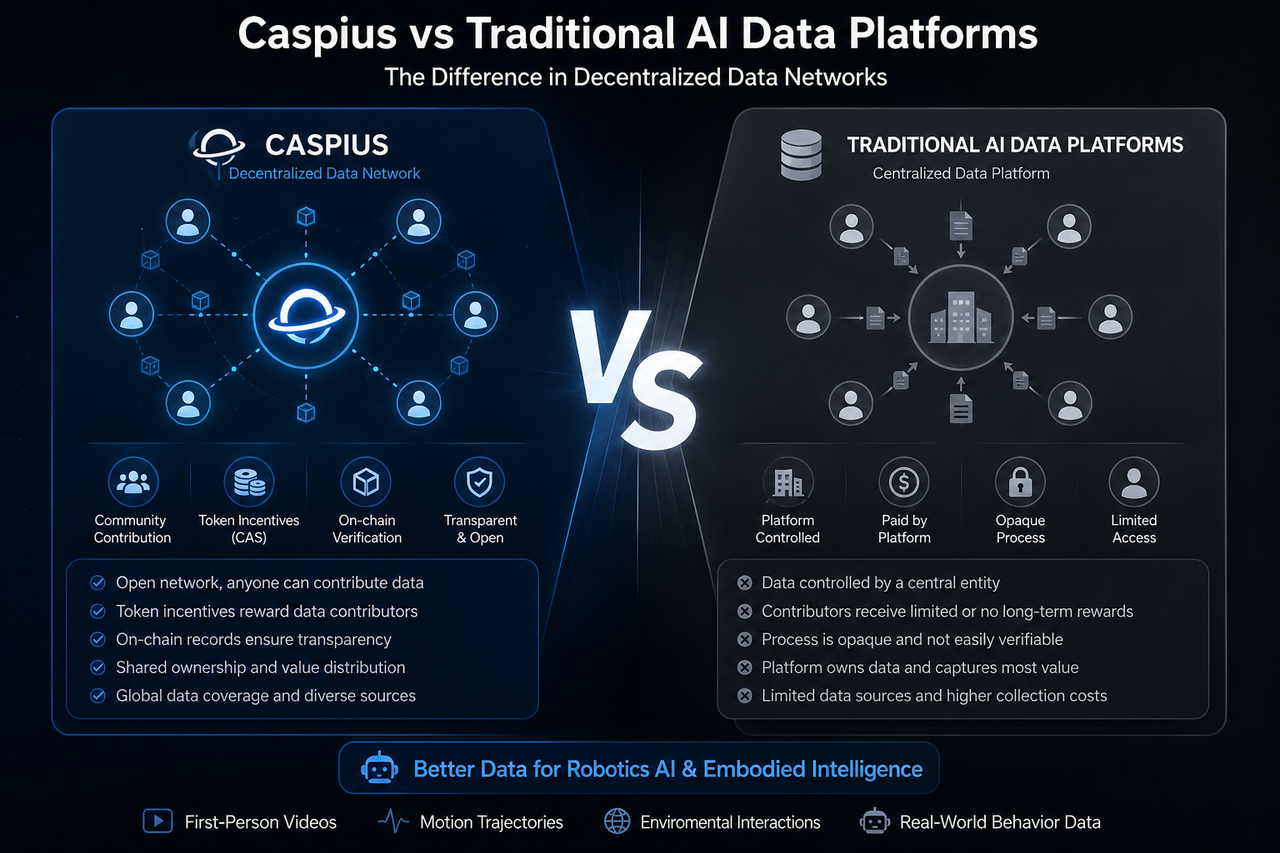
Traditional AI data platforms are usually operated by centralized companies and are responsible for collecting, labeling, organizing, and selling AI training data.
Under the traditional model, the platform organizes the data collection process in a unified way. Annotation teams then classify and process the data before the final training data service is provided to AI companies. Many large language models, image recognition systems, and autonomous driving models currently rely on data support from these kinds of platforms.
This model has been used in the AI industry for many years. Its advantages include relatively high management efficiency and more mature data review systems. At the same time, however, data control and revenue distribution are usually concentrated in the hands of the platform operator.
Data ownership is one of the important differences between Caspius and traditional AI data platforms.
Traditional AI data platforms usually use centralized management. The platform is responsible for collecting, storing, and commercializing the data, while data contributors often find it difficult to participate in the long term distribution of data value.
Caspius places greater emphasis on open collaboration and on-chain incentive logic. In theory, data contributors can not only upload training data, but also participate in the circulation of ecosystem value through token mechanisms.
The differences in their data structures are as follows:
| Comparison Dimension |
Caspius |
Traditional AI Data Platforms |
| Data control method |
Open network |
Centrally controlled by the platform |
| Data contribution model |
Community collaboration |
Enterprise collection |
| Revenue distribution |
on-chain incentive mechanism |
Platform led |
| Data transparency |
Verifiable mechanism |
Black box process |
| Network structure |
Decentralized |
Centralized |
This difference in model also brings Caspius closer to the Web3 data economy.
Traditional AI data platforms usually use a fixed payment model. For example, the platform pays data collectors or annotation teams, then sells the processed data to AI companies.
Caspius uses token incentives to expand the supply of data. After users upload valid training data, they can receive CAS rewards, and the network uses economic incentives to attract more participants to contribute data.
The core feature of this model is open participation. Compared with traditional platforms, which mainly rely on enterprise organized data collection systems, Caspius places greater emphasis on community collaboration and global data sources.
However, token incentive models may also be affected by market cycles, token price volatility, and the pace of ecosystem development, so their long term sustainability still needs to be observed.
Traditional AI data platforms usually follow a closed management model. External users often find it difficult to understand data sources, filtering logic, and review standards.
Caspius attempts to improve transparency through on-chain mechanisms. For example, some data processes may include on-chain records, verifiable contributions, and community review mechanisms, helping improve the efficiency of open collaboration.
Transparency is becoming increasingly important for AI data networks. As AI models continue to scale, the market is paying closer attention to where training data comes from and how its quality is controlled.
That said, for robotics training data, relying on on-chain records alone is usually not enough to solve every quality issue, so data review mechanisms remain critical.
What Challenges Does Caspius Face?
Although decentralized AI data networks have growth potential, Caspius still faces several challenges.
The first is authenticity. Robotics training data requires a high level of accuracy. Low quality or falsified data may affect model training results, making verification mechanisms especially important.
The second is privacy and regulation. Real world video and behavioral data may involve user privacy, geographic information, and regional regulatory requirements.
In addition, large AI companies themselves also have strong data collection capabilities. Whether open data networks can develop a long term competitive advantage still needs to be tested over time.
As a crypto asset, CAS may also be affected by industry cycles and market volatility.
Conclusion
Caspius and traditional AI data platforms both serve AI model training, but they differ clearly in data network structure, value distribution logic, and ecosystem model.
Traditional AI data platforms mainly use centralized management, while Caspius places greater emphasis on open collaboration, community contribution, and on-chain incentive mechanisms. As robotics AI and embodied AI develop rapidly, the importance of real world training data continues to rise, and decentralized data networks are also becoming an important direction for AI infrastructure.
However, the AI data market is still changing quickly. Issues such as data quality, regulatory compliance, and ecosystem sustainability will continue to shape the industry over the long term.
FAQs
Traditional AI data platforms are usually operated by centralized companies and are responsible for data collection, labeling, management, and commercial distribution.
The biggest difference lies in the data network structure. Caspius places greater emphasis on open collaboration and on-chain incentives, while traditional platforms usually follow a centralized management model.
Why Does Robotics AI Need Large Amounts of Real World Data?
Robotic systems need to learn action execution, spatial relationships, and environmental interaction. Relying only on text data usually cannot support complex behavioral training.
What Are the Risks of Decentralized AI Data Networks?
Decentralized data networks may face issues such as data authenticity, privacy compliance, data quality, and ecosystem sustainability.