As one of the world’s largest options exchange operators, CBOE holds an important position in the U.S. capital market. Whether market participants trade equity options, index options, volatility products or stocks through its platforms, CBOE can earn fee income from those transactions. At the same time, as financial markets become increasingly digital, market data and index licensing have gradually become important sources of growth.
For the exchange industry, trading volume, liquidity and product ecosystem often determine long term competitiveness. Understanding CBOE’s business model helps explain how modern financial market infrastructure creates value, and why exchange operators can become such important participants in capital markets.
CBOE is the ticker symbol for CBOE Global Markets after its listing on the Chicago Board Options Exchange in the United States, and it is currently publicly traded in the U.S. capital market. The company is headquartered in Chicago, United States, and is one of the world’s most influential exchange groups.
CBOE was first established in 1973 and became well known for launching a standardized equity options trading market. After decades of development, the company has grown from a single options exchange into a diversified exchange group covering equities, options, futures, foreign exchange and market data services.
Unlike many financial institutions, CBOE does not take on large amounts of credit risk, nor does it depend on rising asset prices to make money. Its business is closer in nature to that of a market infrastructure operator. By providing trading venues, matching systems and data services, it supports the functioning of capital markets. For this reason, many investors view CBOE as an important window into financial market activity.
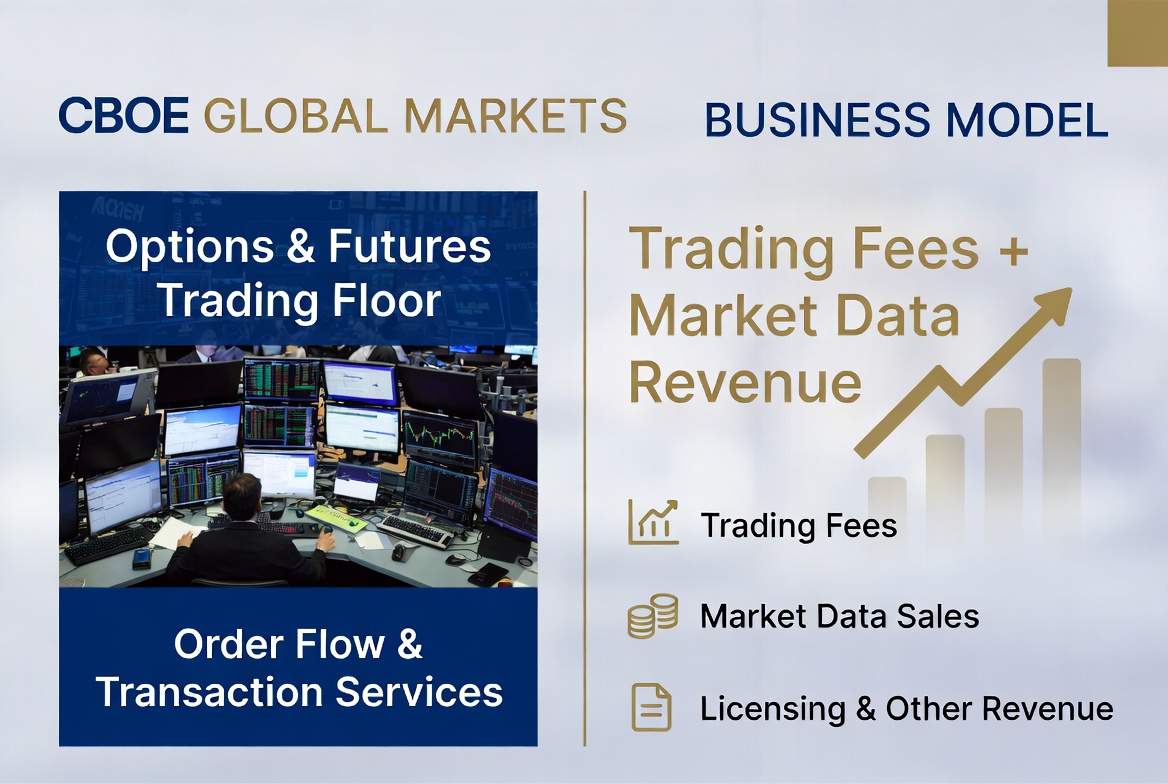
What Are CBOE’s Revenue Sources?
CBOE’s revenue structure is mainly built around trading activity and market services. Because the exchange itself does not directly participate in market investing, its revenue primarily comes from various service fees generated during platform operations.
Overall, CBOE’s revenue sources can be divided into several core areas:
| Revenue Source |
Main Content |
| Trading fees |
Fees generated by equities, options and futures trading |
| Market data services |
Real time quotes, historical data and analytical tools |
| Index licensing revenue |
Licensing of indices such as the VIX and product usage fees |
| Clearing and related services |
Market services related to trading activity |
| Technology and connectivity services |
Trading system access and network services |
This revenue structure allows CBOE to benefit from both active market trading and the long term growth of data demand. Even when market trends change, as long as trading activity continues, the exchange can still maintain its revenue sources.
How Trading Fees Generate Revenue
Trading fees are one of CBOE’s most important revenue sources. Whenever investors, institutions or market makers complete trades on its platforms, the exchange charges fees according to defined rules.
In the options market, trading volume is often much higher than in traditional equity markets. Many investors use options for risk management, income enhancement or market speculation, making options trading one of the most valuable businesses for an exchange. As one of the world’s largest options trading platforms, CBOE has long maintained a relatively high market share, allowing it to generate steady revenue from trading activity.
Trading fee revenue has clear economies of scale. When market volatility intensifies, investors’ demand for trading usually rises, and growth in trading volume can often translate directly into higher revenue. For example, during periods of sharp market swings, investors use options more frequently for risk hedging, which increases trading activity.
This business model creates a mutually dependent relationship between the exchange and market participants. The more active the market is, the higher the trading volume becomes, and the more fee income the exchange earns.
How Market Data Services Contribute to Growth
As electronic trading has become widespread, market data has become a critical resource in the financial industry. Investment institutions, quantitative funds, asset management companies and financial technology firms all need real time market information to support investment decisions, making market data services an increasingly important source of revenue for exchanges.
CBOE processes large volumes of trading information every day, including price changes, trading volume, order flow and market depth data. After this data is organized and licensed, it can be commercialized as services for professional investors and institutional clients.
Compared with trading fees, market data businesses often have higher margins and more stable revenue characteristics. Once clients connect the data to their own systems, they tend to subscribe to related services over the long term, creating recurring revenue.
In addition, data products built around the VIX index and other market indicators further strengthen CBOE’s competitive advantage in market information services. For many institutional investors, data is no longer merely a supporting tool. It has become essential infrastructure for investment decision making.
Why Options and Derivatives Trading Creates Scale Effects
Derivatives markets have significant network effects and economies of scale. As the number of traders increases, market liquidity improves as well, and stronger liquidity attracts even more participants into the market.
CBOE has focused deeply on the options market for many years, building a strong liquidity advantage. Large numbers of institutional investors, market makers and individual investors trade on the same platforms, helping keep bid ask spreads relatively narrow and improving market efficiency.
This liquidity advantage further strengthens the exchange’s competitiveness. Even if new entrants have advanced technology, it is difficult for them to quickly replicate the market depth and customer base accumulated by mature exchanges. As a result, leading exchanges can usually maintain high market share.
For CBOE, the development of the options ecosystem not only drives growth in trading revenue, but also promotes the expansion of index products, market data and derivatives innovation businesses, creating a multi layered revenue system.
How the Global Trading Network Strengthens Business Stability
Although CBOE began as a U.S. options exchange, the company has expanded over time into a global exchange group covering multiple regions and asset classes.
Through acquisitions and international expansion, CBOE has gradually entered markets such as Europe, Canada and Australia, building a trading network that serves clients worldwide. Different regional markets have different demands, allowing the company to diversify the risks of relying on a single market.
At the same time, CBOE’s product system has become increasingly diversified. Beyond traditional equity options, the company also operates equities markets, futures markets and volatility product markets. These businesses create synergies with one another, making revenue sources more balanced.
For the exchange industry, a multi market presence means stronger resilience across market cycles. When trading activity declines in one market, other markets may remain active, helping the company maintain overall business stability.
How to Buy CBOE Global Markets Stock
CBOE is the stock ticker of CBOE Global Markets in the U.S. securities market. Traditionally, investors can buy CBOE stock through brokerage accounts that support U.S. stock trading, allowing them to participate in the development of the global exchange industry.
Because CBOE’s revenue is closely related to trading volume, derivatives market activity and the level of participation in financial markets, many investors view it as one of the important companies for observing global capital market activity.
As digital asset markets and traditional financial markets gradually converge, more trading tools linked to U.S. stock price movements have also appeared in the market. For example, some platforms offer CFD products linked to stock prices, allowing users to participate in price changes without directly holding the underlying shares.
Taking Gate TradFi as an example, users can follow digital assets, U.S. stocks, ETFs, indices and commodity markets within a unified account system. Some markets also offer Gate CFD products, providing more options for cross market asset allocation and price tracking.
Regardless of how investors participate in the market, they should fully understand the product structure, trading mechanism and regulatory requirements in their region.
Summary
CBOE’s business model is built on exchange operations and market infrastructure services. Through trading fees, market data services, index licensing and its global trading network, the company can continue generating revenue from financial market activity. The scale effects of the options market and the unique advantages of the VIX ecosystem further strengthen CBOE’s competitive position. As one of the world’s leading exchange operators, CBOE’s development also reflects the growing demand in modern capital markets for liquidity, data and risk management tools.
FAQs
How does CBOE mainly make money?
CBOE mainly generates revenue through trading fees, market data services, index licensing and related market services, with trading fees remaining one of its most important revenue sources.
Why is options trading so important to CBOE?
CBOE is one of the world’s largest options trading platforms. The options market has high trading activity, which allows it to continuously generate substantial trading fee revenue.
Does the VIX index generate revenue for CBOE?
Yes. VIX related products, index licensing and data services all generate revenue for CBOE and form an important part of the company’s unique competitive advantage.
Why is the market data business becoming increasingly important?
Financial institutions and quantitative investors need large amounts of real time data to support decision making, so market data has become one of the fastest growing businesses in the exchange industry.
How is CBOE’s business model different from that of traditional banks?
Traditional banks mainly earn profits from loan interest and financial services, while CBOE generates revenue by operating trading platforms and providing market services. It does not take on large scale credit risk.
What is the biggest difference between CBOE and CME?
CBOE focuses more on the options market and volatility product ecosystem, while CME is stronger in futures and commodity derivatives markets. The two differ clearly in product structure and market positioning.