CFDs and futures contracts are both widely used for trading price movements, so they are often compared side by side. Although both allow traders to participate in rising and falling markets through leverage, they differ clearly in trading structure, settlement methods, risk mechanisms, and market environment.
As global derivatives markets have developed, CFDs and futures have become important trading tools in both traditional finance and digital asset markets. CFDs are more commonly seen on retail brokerage platforms, while futures are widely used in exchange traded markets and institutional risk management.
A Brief Overview of CFDs and Futures Contracts, and Their Core Differences
A CFD, or Contract for Difference, is a financial derivative settled based on changes in an asset’s price. Traders do not need to actually hold assets such as stocks, foreign exchange, commodities, or cryptocurrencies. Instead, profit and loss are calculated from the difference between the opening price and the closing price.
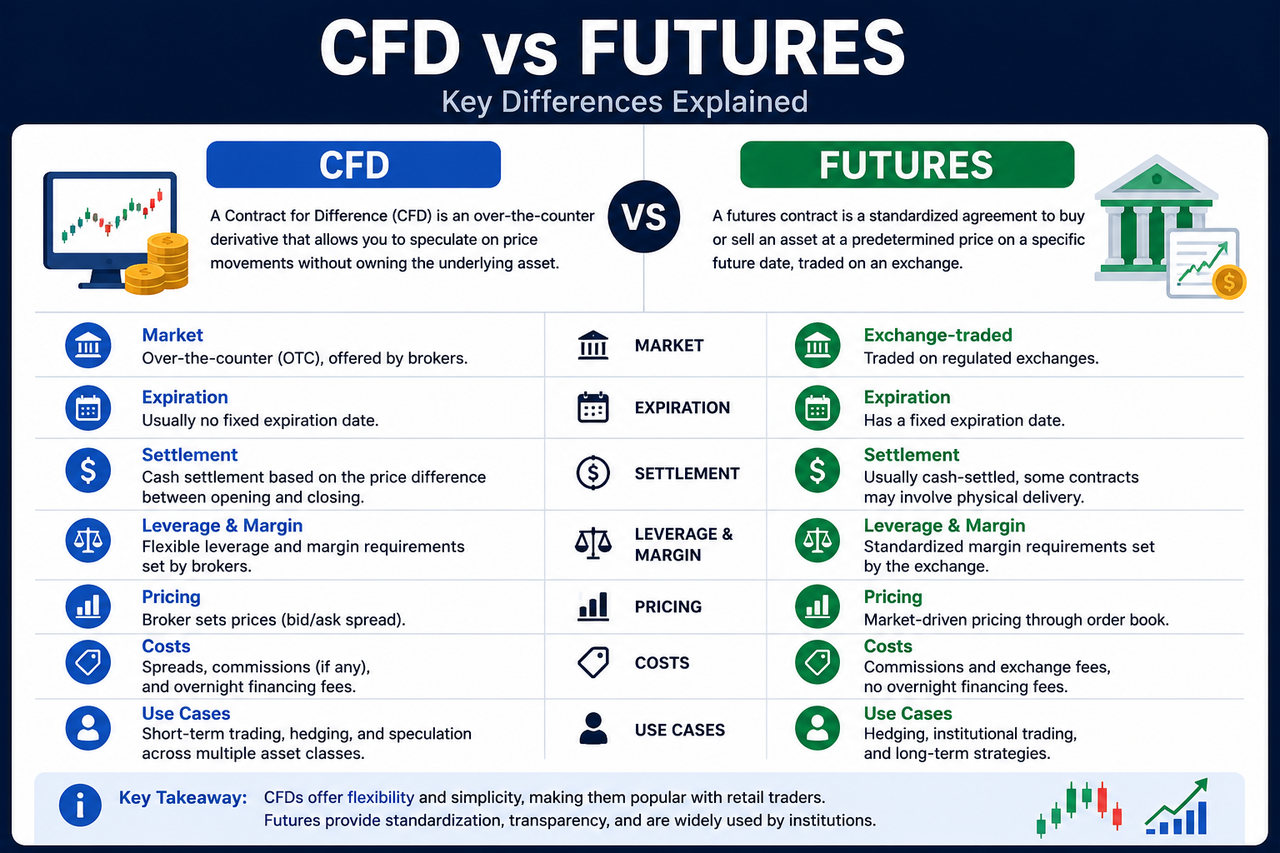
Futures contracts are standardized derivative contracts in which two parties agree to buy or sell an asset at a specified price on a specified future date.
Traditional futures markets were first used for risk management in agricultural products and commodities, and later expanded into stock indexes, interest rates, foreign exchange, and cryptocurrency markets. Unlike CFDs, futures contracts are usually governed by rules set uniformly by an exchange, including contract size, expiration date, margin requirements, and delivery rules.
| Comparison Dimension |
CFD |
Futures Contract |
| Market type |
Broker market |
Exchange market |
| Expiry date |
Usually none |
Yes |
| Price formation |
Market maker quotes |
Order book matching |
| Delivery involved |
Usually not |
Some contracts involve delivery |
| Holding cost |
Overnight financing fee |
Rollover cost |
| User type |
More retail traders |
More institutional and professional traders |
| Leverage mechanism |
Set by broker |
Set by exchange |
| Trading flexibility |
Higher |
More standardized |
How Do the Settlement Mechanisms of CFDs and Futures Differ?
The core structure of CFDs is “settlement by price difference.” After closing a position, traders calculate profit or loss only based on the price difference, without any real asset delivery.
Futures contracts can also be used to profit from price movements, but most futures products have a fixed expiration date. After expiry, some contracts are settled in cash, while others may involve physical delivery.
This difference means CFDs place more emphasis on flexible trading, while futures place more emphasis on standardized contract structures and time cycle management.
How Do the Leverage Structures of CFDs and Futures Differ?
Both CFDs and futures use margin trading, so both have leverage characteristics.
CFD leverage is usually set by the broker, and it may vary from one platform to another. In some markets, CFD leverage ratios can be relatively high, which means price movements may have a larger impact on account equity.
In futures markets, margin requirements are usually set uniformly by the exchange and may be adjusted dynamically based on market volatility. Since futures markets have stronger institutional participation, their risk control systems are usually more standardized.
In addition, long term CFD positions usually incur overnight financing fees, while traditional futures more often reflect holding structure through contract rollover costs.
How Do the Market Structures of CFDs and Futures Differ?
CFD markets mainly rely on brokers or market makers to provide liquidity. Users usually trade directly with the platform, so quote structures may be affected by the platform’s liquidity model.
Futures markets more commonly use exchange based order book matching, where prices are formed collectively by market participants. Because order transparency is higher, large institutions and professional traders usually prefer futures markets.
In the cryptocurrency sector, perpetual contracts combine, to some extent, the flexibility of CFDs with the matching structure of futures, which has made them an important form of derivative in the digital asset market.
How Do the Use Cases of CFDs and Futures Differ?
CFDs are more commonly used in short term trading and retail market scenarios. Because account opening barriers are relatively low and tradable products are diverse, some users use CFDs to participate in price movements in foreign exchange, indexes, or crypto assets.
Futures markets are more often used for hedging, institutional trading, and standardized asset allocation. For example, commodity producers may use futures markets to lock in future price risks, while institutional investors may use stock index futures for portfolio management.
Because the two differ in market structure and risk model, their practical use also varies across trading scenarios.
Conclusion
CFDs and futures contracts are both derivative trading instruments and are widely used in stocks, foreign exchange, commodities, and digital asset markets. However, they differ clearly in market structure, expiration mechanisms, settlement logic, and risk models.
CFDs place more emphasis on flexibility, lower entry barriers, and a retail trading experience, while futures markets place more emphasis on standardization, transparency, and institutional risk management structures.
FAQs
What is the biggest difference between CFDs and futures?
The biggest difference lies in market structure and expiration mechanism. CFDs usually have no fixed expiry date, while futures are standardized contracts with defined expirations.
Do CFDs involve real asset delivery?
Usually not. CFDs are mainly cash settled through price differences.
Why are futures markets more common in institutional trading?
Because futures markets are more standardized and have more transparent liquidity, they are better suited to institutional risk management and large scale trading.
Are CFDs riskier than futures?
Both are high risk leveraged products, but the high leverage and market maker structure of CFDs may give their risks a different form.
What is the relationship between CFDs and perpetual contracts?
Perpetual contracts combine, to some extent, the no expiry structure of CFDs with the order book matching model of futures.
Why are perpetual contracts more common in the cryptocurrency market?
Perpetual contracts support 24 hour trading, leverage, and a no expiry structure, which makes them better aligned with trading habits in the digital asset market.