The telecom industry is a typical infrastructure industry. Individual users need mobile networks and home broadband, while enterprise customers need dedicated networks, cloud services, and data security solutions. Together, these needs form the foundation of Chunghwa Telecom’s revenue.
As the digital economy develops, data centers, cloud computing, and enterprise digital solutions beyond traditional communications services are gradually becoming new growth areas. Chunghwa Telecom is also transforming from a traditional telecom operator into a provider of integrated digital infrastructure services.
Chunghwa Telecom CHT is one of the largest integrated telecom operators in Taiwan, with businesses covering mobile communications, fixed line telephony, broadband networks, enterprise communications, international communications, and digital infrastructure services.
From an industry classification perspective, Chunghwa Telecom belongs to the telecommunication services sector, and it is also regarded as an important participant in digital infrastructure.
Chunghwa Telecom owns large scale communications networks, fiber optic systems, international submarine cables, and data center resources. These assets form an important foundation for the company’s long term operations.
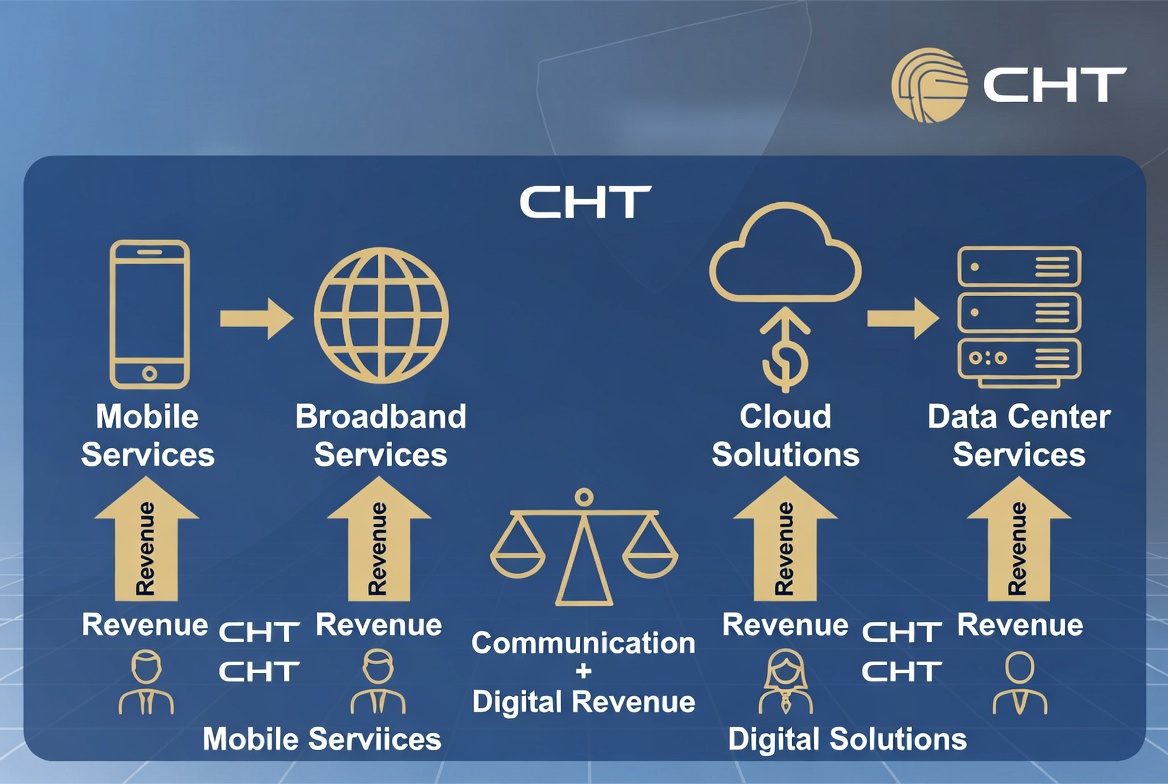
What Are Chunghwa Telecom’s Revenue Sources
Chunghwa Telecom’s revenue mainly comes from two major segments: communications services and digital services. Among them, the communications business remains the core foundation of its overall revenue structure. As one of Taiwan’s largest integrated telecom operators, Chunghwa Telecom has a large base of mobile communications users, broadband network users, and enterprise customers, allowing it to generate stable cash flow by continuously providing network connectivity services.
In its communications business, revenue mainly comes from mobile communications services, home broadband networks, fixed line telephony, and enterprise dedicated line services. Mobile users pay monthly service plan fees, while enterprise customers usually sign long term service agreements. As a result, these businesses have a strong recurring revenue profile. For telecom operators, user scale, network coverage, and customer retention often have a direct impact on revenue performance.
In addition to traditional communications services, Chunghwa Telecom has continued to expand its digital business layout in recent years. Data centers, cloud computing services, cybersecurity solutions, and enterprise digital transformation services are gradually becoming new sources of growth. As more companies migrate their business systems to cloud platforms, digital service revenue is also becoming increasingly important within the overall revenue structure.
| Revenue Source |
Main Content |
| Mobile communications services |
Mobile phone communications and data traffic |
| Broadband network services |
Home and enterprise internet access |
| Enterprise communications services |
Dedicated lines, networks, and communications solutions |
| Data center services |
Colocation and infrastructure services |
| Cloud computing services |
Cloud resources and digital platforms |
| International communications business |
International network connectivity services |
This diversified revenue structure helps reduce the impact of fluctuations in any single business.
How the Mobile Communications Business Generates Revenue
The mobile communications business has long been one of Chunghwa Telecom’s most important revenue sources.
Users gain mobile network connectivity by purchasing monthly plans, data traffic services, and value added communications services, while Chunghwa Telecom earns revenue by continuously providing communications services.
The core feature of the mobile communications business is its large user base.
When users continue using network services, the operator can generate relatively stable monthly revenue.
As 5G networks become more widely adopted, mobile communications revenue no longer comes mainly from voice services, but increasingly from the growth in mobile data traffic and demand for digital applications.
For modern telecom operators, data services have gradually replaced traditional voice services as an important driver of revenue growth.
How Broadband and Enterprise Services Contribute to Growth
Broadband network services are another important source of revenue for Chunghwa Telecom.
Home users access the internet through fiber broadband, while enterprise customers need more complex network solutions.
Enterprise services usually include:
-
Enterprise dedicated networks
-
Cybersecurity services
-
Data transmission services
-
Cloud connectivity services
-
Communications solutions
Enterprise customers usually sign long term service contracts, so enterprise services can provide a more stable source of revenue.
At the same time, the trend toward enterprise digital transformation is encouraging more companies to increase investment in network infrastructure and digital services.
This makes enterprise services an increasingly important part of Chunghwa Telecom’s growth.
How Cloud Services and Data Center Businesses Expand the Revenue Structure
Cloud computing and data center businesses are becoming important growth areas for Chunghwa Telecom.
Traditional telecom businesses mainly provide network connectivity, while cloud services extend further into computing resources, storage capacity, and digital solutions.
Through the construction of data centers and cloud platforms, Chunghwa Telecom provides enterprise customers with:
-
Cloud computing resources
-
Data storage services
-
Disaster recovery solutions
-
Hybrid cloud architecture
-
Cybersecurity services
As demand grows for artificial intelligence, cloud native applications, and digital transformation, enterprises need more computing resources.
For Chunghwa Telecom, data centers and cloud services can create new revenue sources while increasing the added value of its overall business.
Compared with traditional communications services, these digital services usually offer greater growth potential.
Why Recurring Revenue Improves Business Stability
Recurring revenue is an important feature of the telecom operator business model.
Most communications users pay monthly fees, while enterprise customers usually sign long term service contracts.
This model makes revenue highly predictable.
The advantages of recurring revenue are mainly reflected in the following areas:
| Feature |
Impact on the Company |
| Long term customer relationships |
Improves user retention |
| Monthly subscription model |
Strengthens cash flow stability |
| Dependence on network infrastructure |
Increases customer stickiness |
| Long term enterprise contracts |
Reduces revenue volatility |
Compared with companies that rely on advertising or one time sales revenue, telecom operators usually have more stable operating cash flow.
This is also one of the important reasons why the communications industry has long been viewed as a defensive sector.
As the share of cloud services and enterprise digital businesses increases, Chunghwa Telecom’s recurring revenue profile is further strengthened.
CHT is listed on the New York Stock Exchange and is one of the important listed companies through which international investors can understand the development of Taiwan’s communications industry and digital infrastructure.
Investors can buy CHT stock through brokerage accounts that support U.S. stock trading, and participate in the potential returns and risks related to the company’s operating performance and industry development.
As digital assets and traditional financial markets gradually converge, more trading tools linked to stock price movements have also appeared in the market. For example, some platforms offer CFD products linked to the prices of related assets, allowing users to participate in market movements through price changes without directly holding the underlying shares.
Taking Gate TradFi as an example, users can follow not only the digital asset market, but also traditional financial assets such as stocks, ETFs, indices, and commodities within the same ecosystem. Some markets also offer Gate CFD products, allowing users to participate in price movement trading for related assets through a digital asset account.
No matter how investors choose to participate in the market, they should fully understand the product structure, trading rules, liquidity characteristics, and regulatory requirements in their region.
Conclusion
Chunghwa Telecom’s (CHT) business model is built on communications networks and digital infrastructure. Mobile communications and broadband services form its traditional revenue base, enterprise communications services provide stable growth, and cloud computing and data center businesses have become new development directions. Supported by long established network resources and a broad customer base, Chunghwa Telecom has built a business model with strong recurring revenue characteristics, and it continues to transform into a provider of integrated digital infrastructure services.
FAQs
What Businesses Does Chunghwa Telecom Mainly Make Money From?
Chunghwa Telecom mainly generates revenue from mobile communications services, broadband network services, enterprise communications solutions, data center services, and cloud computing businesses.
Why Is the Mobile Communications Business Important?
The mobile communications business has a large user base and continuous monthly fee revenue, so it has long been one of Chunghwa Telecom’s most important revenue sources.
Enterprise customers usually need dedicated networks, cybersecurity, and digital solutions, and they often sign long term contracts. This provides a stable source of revenue.
What Does the Data Center Business Mean for Chunghwa Telecom?
The data center business can support demand for cloud computing, artificial intelligence, and enterprise digital transformation, while helping Chunghwa Telecom expand into new growth areas beyond traditional communications services.
Telecom services usually use a subscription-based fee model, with users and enterprise customers continuously paying service fees. As a result, revenue is relatively predictable.
Chunghwa Telecom originated from traditional telecom operations, but with the development of cloud computing, data centers, and enterprise digital services, it has gradually transformed into a provider of integrated digital infrastructure services.