As Real World Assets (RWA) and NFT technologies evolve, an increasing number of collectibles are moving onto the blockchain. Collector Crypt represents a new model for digital collectible trading, while eBay remains a major player in the traditional collectibles marketplace. These two approaches reflect the contrasting directions of digitization and traditional trading systems within the industry, making them a common point of comparison among collectors.
Collector Crypt vs. eBay: A Snapshot
Collector Crypt is a platform focused on tokenizing physical collectible cards, building a full trading ecosystem through a Vault custody system, NFT ownership mapping, and an on-chain Marketplace.
The core idea behind Collector Crypt is to bind physical collectible cards to NFTs. The physical assets are stored in professional custodial vaults, while the NFTs circulate on the market as digital ownership certificates.
eBay is a globally recognized online marketplace and a key venue for trading collectible cards.
On eBay, sellers list physical card products, and buyers receive the physical items via shipping after payment. Ownership transfers upon delivery.
Over the years, eBay has become a significant secondary market for Pokémon cards, sports trading cards, and a wide range of collectibles.
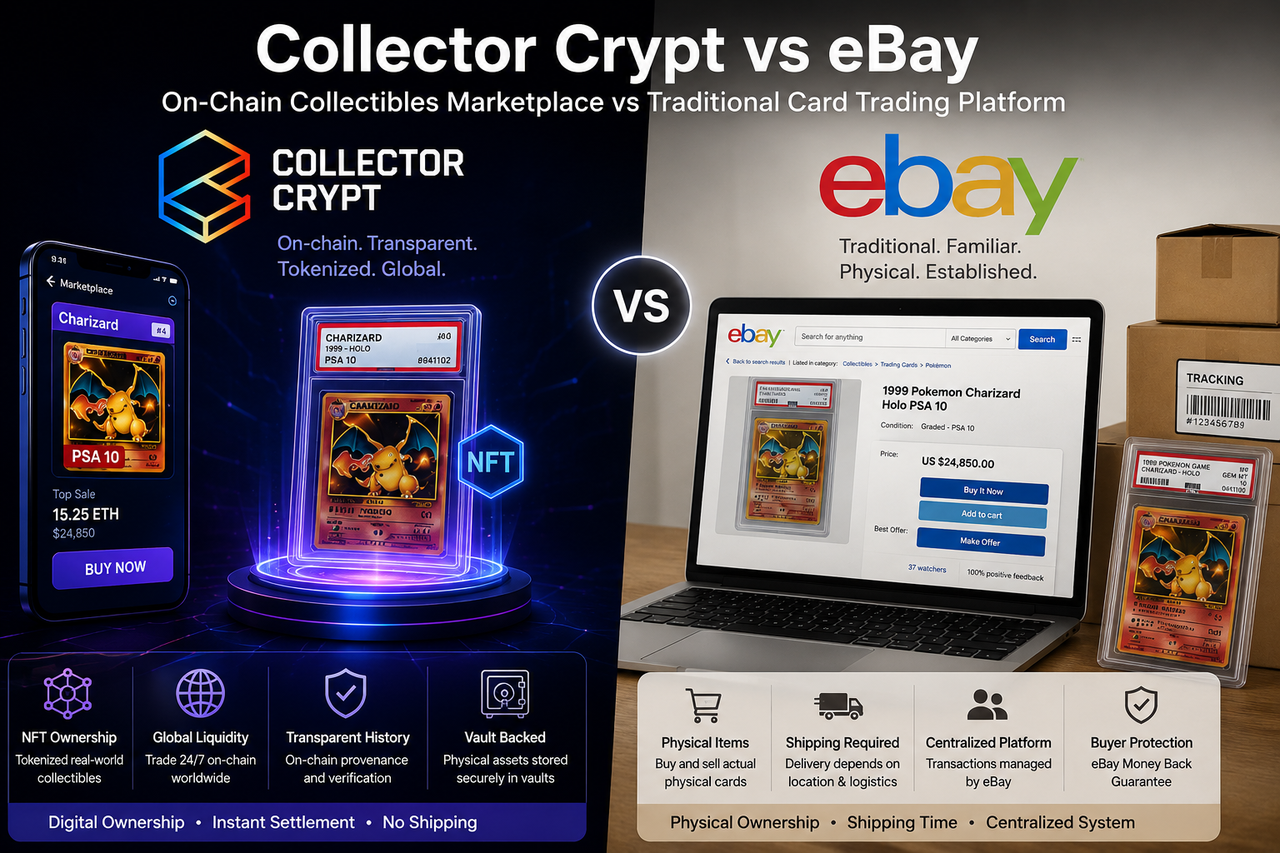
How Do Ownership Management Methods Differ Between Collector Crypt and eBay?
The most fundamental difference lies in how ownership is recorded.
On Collector Crypt, NFTs represent digital ownership of collectibles. Every transaction is recorded on the blockchain, making ownership changes publicly verifiable.
On eBay, ownership relies on physical delivery. Transaction records are stored in the platform's database, but the assets themselves lack a unified digital ownership system.
Thus, the two represent a digital ownership model versus a traditional physical ownership model.
How Do the Trading Processes Differ?
Collector Crypt's trading process is closer to that of a digital asset market.
After purchasing an NFT, ownership transfers almost instantly—no waiting for shipping. Once the trade is complete, the physical card remains in the Vault.
eBay transactions follow a traditional e-commerce flow: listing, payment, seller shipping, logistics, and buyer confirmation.
For cross-border transactions, shipping times and costs often extend the trading cycle significantly.
How Do the Liquidity Structures Differ?
Liquidity is a key distinction between these two markets.
NFTs on Collector Crypt can be listed for sale on the on-chain market at any time. Since physical assets don't need to be moved repeatedly, this can theoretically boost trading frequency and market velocity.
eBay benefits from a massive user base, but every trade involves physical delivery, limiting transaction speed due to logistics and geographic constraints.
For high-frequency traders, on-chain markets generally offer more flexible asset movement.
How Do the Asset Custody Models Differ?
Collector Crypt uses a centralized custody model.
All tokenized collectible cards are stored in a professional Vault, where they are held, verified, and managed by the custodian.
eBay, by contrast, uses a user self-custody model. Sellers keep the collectibles themselves, and buyers take possession after the transaction.
Each model has its strengths. Custody improves trading efficiency, while self-custody allows collectors to hold and display physical items directly.
How Does Market Transparency Differ?
Collector Crypt leverages blockchain to increase asset transparency.
An NFT's entire transaction history, ownership changes, and provenance are all queryable on-chain. Market participants can trace the full asset journey.
eBay offers buyer/seller ratings and product descriptions, but it cannot provide a unified, tamper-proof historical record like a blockchain.
For high-value collectibles, verifiable provenance is often crucial.
How Do User Engagement Methods Differ?
Beyond standard trading, Collector Crypt introduces interactive features like the Gacha Machine.
Users can purchase specific assets or obtain collectible card NFTs through random pack openings—blending collecting with gamification.
eBay's core function remains buying and selling. Users typically find collectibles via search, auctions, or direct purchase.
In short, Collector Crypt feels more like a digital collectibles ecosystem, while eBay is a traditional commerce platform.
Core Differences: Collector Crypt vs. eBay
| Dimension |
Collector Crypt |
eBay |
| Asset Form |
NFT representing a physical asset |
Physical collectible |
| Ownership Record |
On-chain blockchain record |
Platform order record |
| Physical Custody |
Vault custody |
User self-custody |
| Transaction Settlement |
On-chain transfer |
Logistics delivery |
| Global Circulation |
24/7 on-chain market |
Relies on cross-border shipping |
| Liquidity |
Higher |
Relatively limited |
| History Tracking |
Verifiable on-chain |
Platform records only |
| Gamification |
Supports Gacha |
Not supported |
Collector Crypt vs. eBay: Which Model Fits the Collectibles Market?
Collector Crypt and eBay aren't strictly competitors.
Collector Crypt appeals to users who prioritize digital ownership, market liquidity, and on-chain asset trading. For those looking to buy or sell collectibles quickly or engage with the NFT collectibles space, this model is highly attractive.
eBay remains ideal for traditional collectors. For those who want to physically hold cards, participate in auctions, or hunt for specific items, the traditional platform still offers significant value.
Summary
Both Collector Crypt and eBay can satisfy collectible card trading needs, but their core logic is entirely different. Collector Crypt uses NFTs and blockchain for digital ownership management, boosting liquidity through Vault custody and on-chain markets. eBay leverages a mature e-commerce system to handle physical goods transactions.
From an industry perspective, Collector Crypt represents the future of collectible RWA and NFT markets, while eBay embodies the traditional collectibles trading system.
FAQs
What is the biggest difference between Collector Crypt and eBay?
Collector Crypt uses NFTs and blockchain to record collectible ownership, while eBay uses a traditional e-commerce model for buying, selling, and delivering physical goods. That is the most fundamental distinction.
Does Collector Crypt actually hold the physical collectible cards?
Yes. Collector Crypt's NFTs typically correspond to physical collectible cards stored in a Vault. The NFT holder has digital ownership of that asset.
Can collectible cards on eBay be tokenized?
eBay itself does not offer tokenization. Sellers are selling physical collectibles, not corresponding NFTs or on-chain assets.
Why doesn't Collector Crypt need to ship cards frequently?
Collector Crypt uses a Vault custody system. Physical cards remain stored long-term in a warehouse. Users trade the ownership represented by the NFT, so physical shipping isn't needed for each transaction.
Why is Collector Crypt's liquidity generally higher than traditional markets?
Because NFTs can be transferred instantly on-chain, Collector Crypt avoids waiting for shipping and physical settlement. As a result, asset turnover is typically faster than in traditional collectibles markets.