Concordium and Worldcoin are both central to discussions around “blockchain + identity,” but each addresses fundamentally different core problems. World ID focuses on proving “you are human and can only claim once,” while Concordium is designed to prove “who is authorized and who is accountable for on-chain or Agent actions.” As Agents begin to sign and transact on behalf of users, both types of proof may become necessary, but they are not interchangeable.
Concordium’s official X account put it this way: the World Network asks, “Is this a real person?” while Concordium asks, “When an AI Agent acts on your behalf, who is responsible?” This distinction is key to understanding Protocol-Level Identity and Zero-Knowledge Proof and Agent Registry Registration and Verification Process.
What Is the Core Problem Concordium Solves?
Concordium is built on the principle of accountability: every Concordium account is linked at the protocol level to a human or legal entity that has been verified by an Identity Issuer; the Agent Registry further anchors each Agent to its corresponding account. Before any transaction or authorization, counterparties can verify that there is an accountable entity behind the Agent, and—using zero-knowledge proofs—check attributes like age, residency, or credentials, all without requiring full KYC disclosure.
Concordium’s primary narrative is not about building a “global unique human graph,” but rather about serving RegTech, PayFi, and the need for authorization chains and auditability within the Agent economy. Its privacy tool is selective disclosure via ZKP, not orb scanning or the World ID credential system.
What Is the Core Problem Worldcoin / World ID Solves?
Worldcoin, through World ID and Proof of Personhood, aims to prove that users are unique, real people—combating multiple accounts, bots, and AI-generated identities. Orb scanning and World ID credentials allow users to present proof of “I am a verified human” to applications, without revealing their full personal data.

World ID’s typical use cases include Sybil-resistant airdrops, one-person-one-vote elections, and access to services that require human verification. Its strength lies in scalable human authentication and preventing duplicate human identities, rather than establishing a KYB/KYC authorization chain between on-chain accounts and legal entities, or being tailored for Agent ownership. The World App and orb network serve as distribution channels, and when applications integrate World ID, the primary benefit is the “human uniqueness” credential—not enterprise KYB fields or Agent-level signing authority.
At-a-Glance: Proof Targets, Privacy, and Agent Scenarios
| Dimension |
Worldcoin / World ID |
Concordium |
| Core Question |
Is this a unique human? |
Who is responsible for the action? |
| Main Output |
Proof of humanity |
Verified account + Agent authorization chain |
| Typical Privacy |
World ID ZK credentials |
Protocol-level ID + attribute ZKP |
| Agent Context |
Filters bots/confirms humans |
Agent bound to authorizer + Badge |
| Compliance |
Not primary narrative |
Proof of age, jurisdiction, credentials, etc. |
| Cross-chain |
World ID ecosystem integration |
CIS-8 + Registry cross-chain verification |
From an Agent economy perspective: World ID helps confirm that “a human is involved,” while Concordium clarifies “which verified entity authorized which Agent and whether business criteria are met.” Relying on just the former, high-trust financial or enterprise Agent scenarios may still lack an auditable authorization chain.
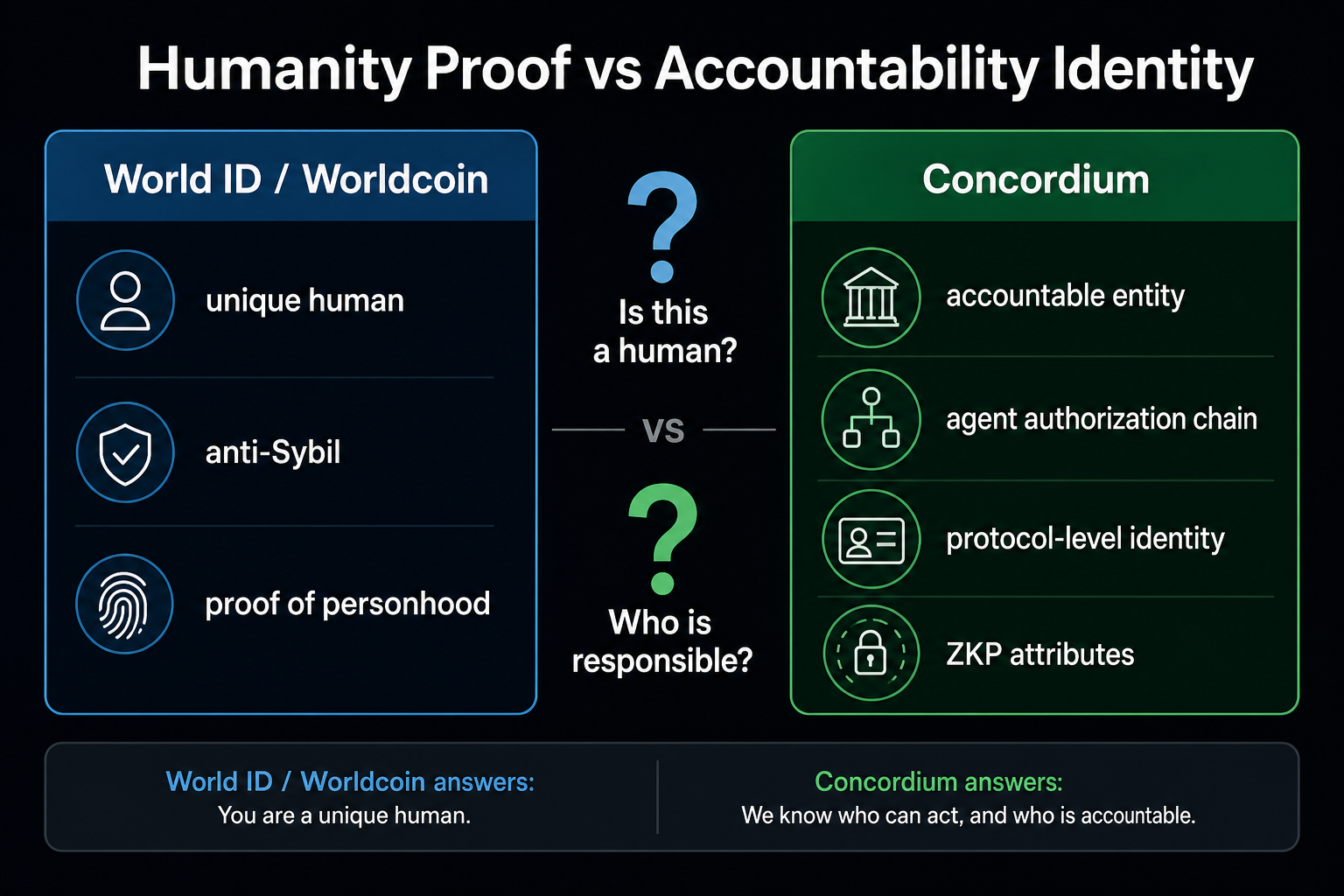 Figure 1. Concordium vs Worldcoin: humanity proof (unique human) and accountable identity (authorization chain) address different challenges.
Which Proof Is Most Needed in the Agent Economy?
For scenarios like social voting, airdrop claims, or “only allow humans to click once,” World ID-style human proof is more relevant. For scenarios involving Agents managing assets, purchasing restricted services, or enterprises deploying external support Agents, counterparties need to know: which verified entity registered the Agent, who is legally responsible, and whether jurisdictional and spending controls are satisfied.
Concordium’s Agent Registry and Verified Badge address these needs; World ID can filter out non-humans or duplicate humans at the entry level, but does not establish an on-chain relationship between Agents and authorized accounts. The industry consensus is that the Agent era will likely require both a “human proof layer” and an “accountability layer,” provided by different infrastructures. For Gate ecosystem users who use both World App and Concordium tools, World ID should be viewed as a human proof supplement, and Concordium as the Agent and settlement accountability stack—not as alternatives to be chosen between.
What Are the Limitations in Comparison? Can We Simply Say Which Is “Better”?
It’s not accurate to claim one is “better.” World ID depends on the orb and World App ecosystem, with coverage, regulatory stance, and user adoption varying by region; Concordium relies on the Identity Issuer network and protocol-level account model, with integration complexity and regional compliance standards also differing. World ID does not provide enterprise-level KYB accountability by default; Concordium does not aim for a global census of unique humans. Both use cryptographic credentials to minimize unnecessary disclosure, but the types of statements they prove, issuers, and verification processes differ and are not interchangeable.
For developers: choose based on the type of proof required—“unique human” or “verified accountable entity authorizing this agent”—not brand loyalty. Both could coexist in integrated solutions: human proof via World ID, Agent registration and attribute checks via Concordium. For example, an application could require World ID to exclude bots, then require Agents to hold a Verified by Concordium Badge and complete jurisdictional attribute checks, creating a layered gate.
From a regulatory perspective, frameworks like the EU AI Act stress traceability and accountability for high-risk AI systems. Concordium’s approach embeds “identifiable authorized entities” into the infrastructure, while World ID focuses on consumer-facing anti-bot and one-person-one-vote use cases. When selecting a solution, map legal obligations to specific proof layers, rather than expecting a single identity product to meet all compliance needs.
Summary
Concordium and Worldcoin occupy different layers of the identity stack: World ID focuses on human proof and Sybil resistance; Concordium focuses on protocol-level accountability and Agent authorization chains. Understanding these differences helps you select or combine the right verification tools for Agents, PayFi, and compliance applications. For products that target both consumer anti-bot and enterprise Agent settlement, layered integration is typically more effective than relying on a single identity protocol for all scenarios.
FAQ
What’s the Difference Between Concordium and Worldcoin?
Worldcoin’s World ID is designed to prove a user is a unique, real human, often for Sybil resistance. Concordium’s protocol-level identity proves who is responsible for Concordium accounts and Agent actions, and supports compliance attribute zero-knowledge proofs. The former focuses on “are you human,” the latter on “who is accountable.”
Can World ID Replace Concordium’s Agent Verification?
Not directly. World ID does not provide on-chain Agent identity, Owner binding, or cross-chain key structures like the CIS-8004 Agent Registry. High-trust Agent scenarios require auditable authorization chains and attribute checks—this is Concordium’s focus.
Does Concordium Also Prove “You Are Human”?
Concordium verifies humans or legal entities via Identity Issuers, but its focus is on accountability and authorization, not a global unique human graph. Compared to World ID’s Proof of Personhood, the proof targets and credential systems differ, with some overlap and some complementarity.
Why Does the Agent Economy Need “Accountability” and Not Just “Human Proof”?
Once Agents can autonomously sign and transfer value, counterparties must know who is legally responsible for Agent actions and whether those actions are within the authorized scope. Simply proving “a human is involved” is not enough for enterprise settlement or regulatory audits; a verifiable link between Agent and verified entity is also required.
What Are the Limitations When Comparing Concordium and Worldcoin?
World ID is limited by orb deployment, regulation, and user acceptance; Concordium is limited by Identity Issuer coverage and integration complexity. Neither solves all identity issues. Choose based on the required proof, not a “winner.” In hybrid setups, define legal obligations and data retention for each identity layer, and avoid promising users privacy guarantees that exceed cryptographic capabilities.







