As the competition among public chains moves from "single-point performance metrics" to "real-world application throughput," the value of Cronos extends beyond just faster block times or lower Gas fees. Its true significance lies in its ability to simultaneously deliver efficient developer migration, seamless cross-chain asset flows, institutional-grade integration standards, and robust end-user experiences. Recent public developments involving Cronos, LayerZero, Morpho, and Fireblocks highlight Cronos' evolution into a platform that enables "cross-ecosystem, multi-asset, and cross-application paradigm" connectivity.
This analysis systematically explores Cronos across five dimensions: technical foundation, interoperability, application ecosystem, security and performance, and future optimization, enabling a comprehensive evaluation of Cronos' technical depth and ecosystem growth.
Core Technical Architecture of the Cronos Chain
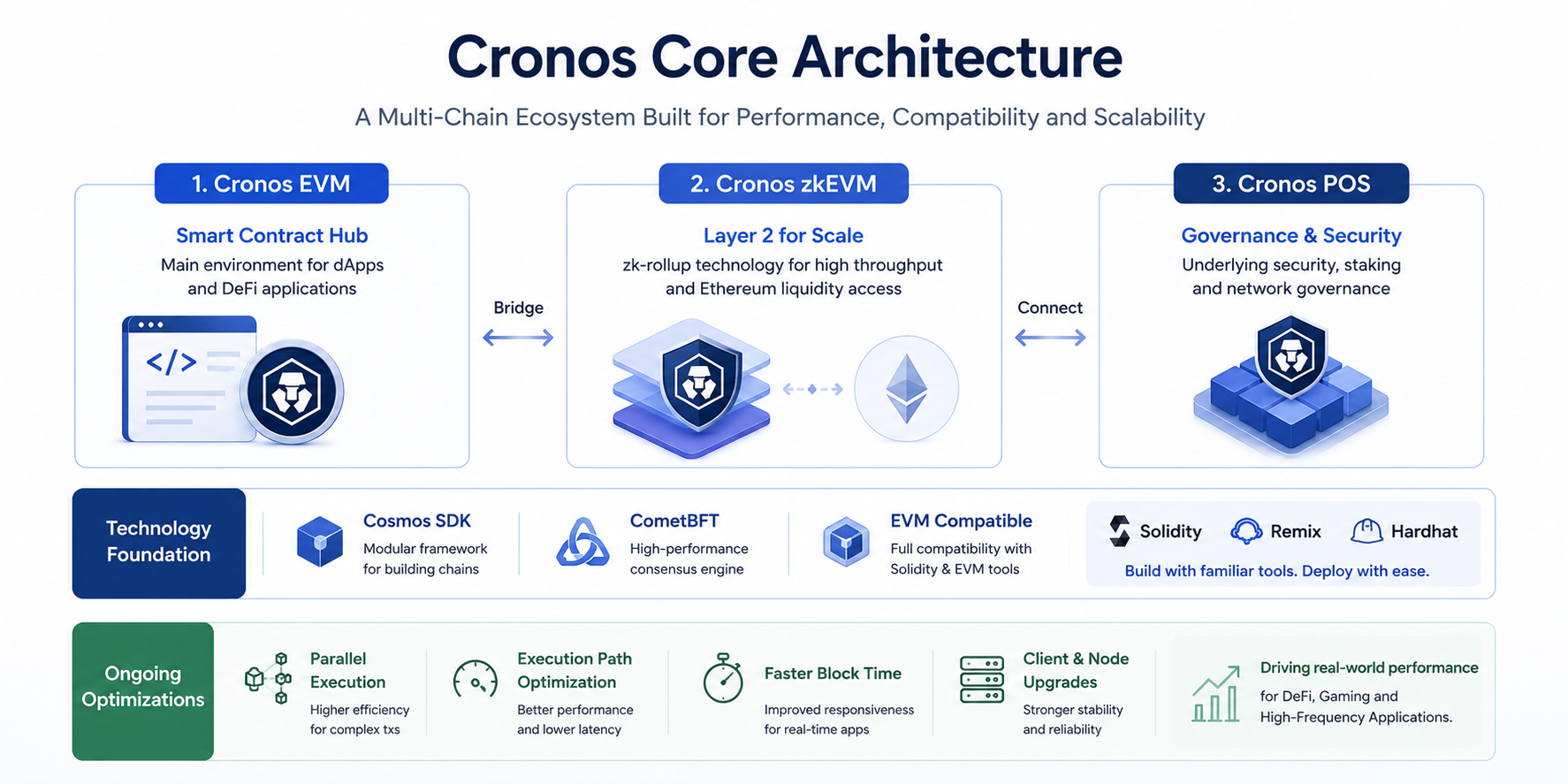
Cronos is not a single-chain solution. Instead, it is an integrated ecosystem consisting of Cronos EVM, Cronos zkEVM, and Cronos POS. Cronos EVM powers the primary Smart Contract layer, Cronos zkEVM provides Layer 2 scalability and access to Ethereum liquidity, and Cronos POS delivers an underlying governance and security support role.
Technically, Cronos leverages the Cosmos SDK and CometBFT to build its execution and consensus frameworks, while maintaining full compatibility with the EVM toolchain. This means developers can deploy using familiar stacks—Solidity, Remix, Hardhat—without incurring significant migration costs.
Cronos EVM's ongoing roadmap focuses on parallel execution, execution path optimization, shorter block times, and upgraded client capabilities. Effective implementation of these upgrades will directly enhance support for High Frequency Trading, blockchain gaming, and complex DeFi portfolio strategies. Unlike theoretical TPS marketing, consistent protocol- and Node-level improvements demonstrate real engineering maturity.
EVM Compatibility and Cross-Chain Interoperability
Cronos' first major competitive advantage is its EVM compatibility. For developers, this allows for seamless migration of existing Smart Contracts, Wallet integrations, audit workflows, and frontend components, significantly shortening the journey from concept to Mainnet. For the broader ecosystem, higher compatibility reduces friction for external applications and liquidity inflows.
Its second competitive edge is cross-chain interoperability. Leveraging IBC and third-party bridges, Cronos connects the EVM ecosystem with Cosmos-based assets and messaging. Recent updates show that LayerZero now supports both Cronos EVM and Cronos zkEVM, broadening connectivity and enabling new cross-chain liquidity aggregation and multi-network orchestration.
This interoperability delivers immediate capital efficiency gains:
- Users can move Assets flexibly across chains.
- Protocols can tap into broader liquidity pools.
- Developers can build products driven by cross-chain states, breaking free from single-chain limitations.
This marks Cronos' transformation from an "on-chain application market" to a "cross-chain infrastructure Node."
DeFi and NFT Application Ecosystem
Cronos is positioned in DeFi as "low-cost, composable, and scalable." Its foundation includes trading, lending, return strategies, and Stablecoin protocols. Recent collaborations with Morpho and Crypto.com have drawn attention to its efforts in lending and tokenized asset scenarios, bringing in more structured capital demand beyond just short-term liquidity.
On the institutional side, Cronos' public partnership with Fireblocks signals a move to meet higher standards for custody, trading, and asset issuance. Smooth toolchain integration on the institutional front will enable Cronos to support on-chain flows of tokenized stocks, commodities, prediction markets, and other novel Assets.
NFTs and gamified applications remain critical Zones within the Cronos ecosystem. For these use cases, low Trading Fee and fast confirmation times directly impact user retention and interaction frequency. Particularly in "high-frequency, micro-transaction, ongoing engagement" scenarios, on-chain cost structure often outweighs single-transaction performance peaks. Cronos’ continual optimizations ensure it remains attractive for community- and content-driven applications.
Cronos' security is anchored in protocol mechanisms, Validator standards, and infrastructure governance. Its BFT consensus, Node high availability requirements, network defense practices, and audit processes collectively establish a strong security baseline. For users, Mainnet stability is just the beginning; a comprehensive security evaluation must also include bridging layers, Smart Contract layer, oracles, and frontend integrations.
In its public documentation, Cronos consistently emphasizes "instant finality" and stable execution, which are critical for DeFi liquidations, High Frequency Trading, and cross-chain confirmations. Clearer finality reduces the risk of transaction rollbacks, enabling more sophisticated Risk Control models.
Recent performance upgrades have focused on real engineering gains rather than promotional claims:
- Improved Node execution and storage optimization
- Reduced block times and enhanced throughput
- Parallelized execution and virtual machine improvements
- Upgrades for cross-chain communication and protocol compatibility
Sustained delivery on these fronts will further establish Cronos as foundational application chain infrastructure.
Future Development and Optimization Directions for Cronos
Based on its roadmap and recent developments, Cronos’ future optimization focuses on five key areas:
- Accelerating the execution layer, including deeper parallelization, optimized block times, and improved state management to support higher concurrency.
- Standardizing cross-chain capabilities. As LayerZero, IBC, and more third-party bridges mature, Cronos must unify cross-chain experiences in terms of security, cost, and usability. Achieving "low-friction default" cross-chain functionality will be key to capturing the next multi-chain application wave.
- Building institutional and real-world asset interfaces. Fireblocks collaborations highlight Cronos’ focus on institutional capital flows. The true test is not press releases, but sustainable trading depth, auditable processes, and extensible asset types.
- Integrating AI with on-chain applications. Cronos has repeatedly emphasized AI Agent-friendly development. As AI Agents begin to handle on-chain payments, trades, and asset management, Cronos will evolve from a "user-driven chain" to a "programmatic participation chain," fundamentally altering application structure.
- Prioritizing ecosystem quality over scale. Long-term competitiveness depends on developer retention, protocol revenue, high-quality user activity, and net cross-chain inflows—not just TVL spikes during market cycles. If Cronos continues to improve on these metrics, its technical story will translate into verifiable ecosystem growth.
Conclusion
Cronos has evolved from a "high-performance EVM-compatible chain" into a multi-chain, cross-ecosystem infrastructure network designed for diverse application scenarios. EVM compatibility lowers development barriers, Cosmos interoperability expands liquidity, continuous protocol upgrades enhance performance, and institutional partnerships open new real-world use cases.
According to recent public updates, Cronos has consistently advanced in cross-chain integration, lending partnerships, institutional infrastructure onboarding, and protocol performance upgrades. This signals a shift from pure tech competition to a holistic "technology + ecosystem + capital" strategy. For developers, investors, and industry observers, rigorous assessment of Cronos requires tracking verifiable metrics: application activity, trading and Trading Fee data, cross-chain capital flows, and post-upgrade network stability.