LLY stock's valuation has long been a central topic in the market. While many initially react by calling it "expensive," the real question isn't about price—it's about why the market is willing to assign high expectations to LLY. Behind high valuations lie growth prospects, pipeline strength, and scaling potential, making LLY one of the most closely watched pharmaceutical stocks. Establishing the framework from the LLY Stock Overview before reviewing valuation criteria helps avoid being misled by multiples alone.
Why Does LLY Consistently Trade at a Premium?
LLY is consistently valued at a premium because the market views it as a pharmaceutical company with strong growth certainty. When a company operates in a high-growth sector with robust products and expectations, the market typically assigns a higher valuation. This approach prices in future growth, rather than relying solely on historical profitability for static comparisons.
High valuations are inherently sensitive to information: changes in sales, supply, competition, or regulation can shift the pricing anchor. Understanding this dynamic allows investors to move beyond debating "expensive or not" and focus on whether the underlying assumptions remain valid.
Think of high valuation as the market "paying in advance for confidence in growth." This upfront pricing leaves little room for error: a similar slowdown in growth impacts high-expectation stocks more than those with lower expectations. As a result, when analyzing LLY's valuation, the priority is always to verify the underlying assumptions—not to simply label the multiples.
How Should Growth Stock Valuations Be Evaluated?
Evaluating growth stocks goes beyond static price-to-earnings ratios. The critical questions are: Can growth be sustained? Will profits materialize? Are market expectations overly optimistic? If growth consistently exceeds expectations, high valuations can persist; if growth slows, they are likely to be repriced.
For pharmaceutical stocks, valuation must be tied to the business model. Factors such as R&D investment, patent windows, and commercialization scale determine whether profits can be realized over a sufficiently long period. For more details, see the business and financial sections in the LLY Stock Overview.
A reliable analytical approach is: first, identify the sources of growth; second, assess if profits can keep pace; and finally, evaluate the market's expectations. Reversing this order often turns valuation analysis into an emotional debate. In growth stock research, multiples are the outcome—not the starting point.
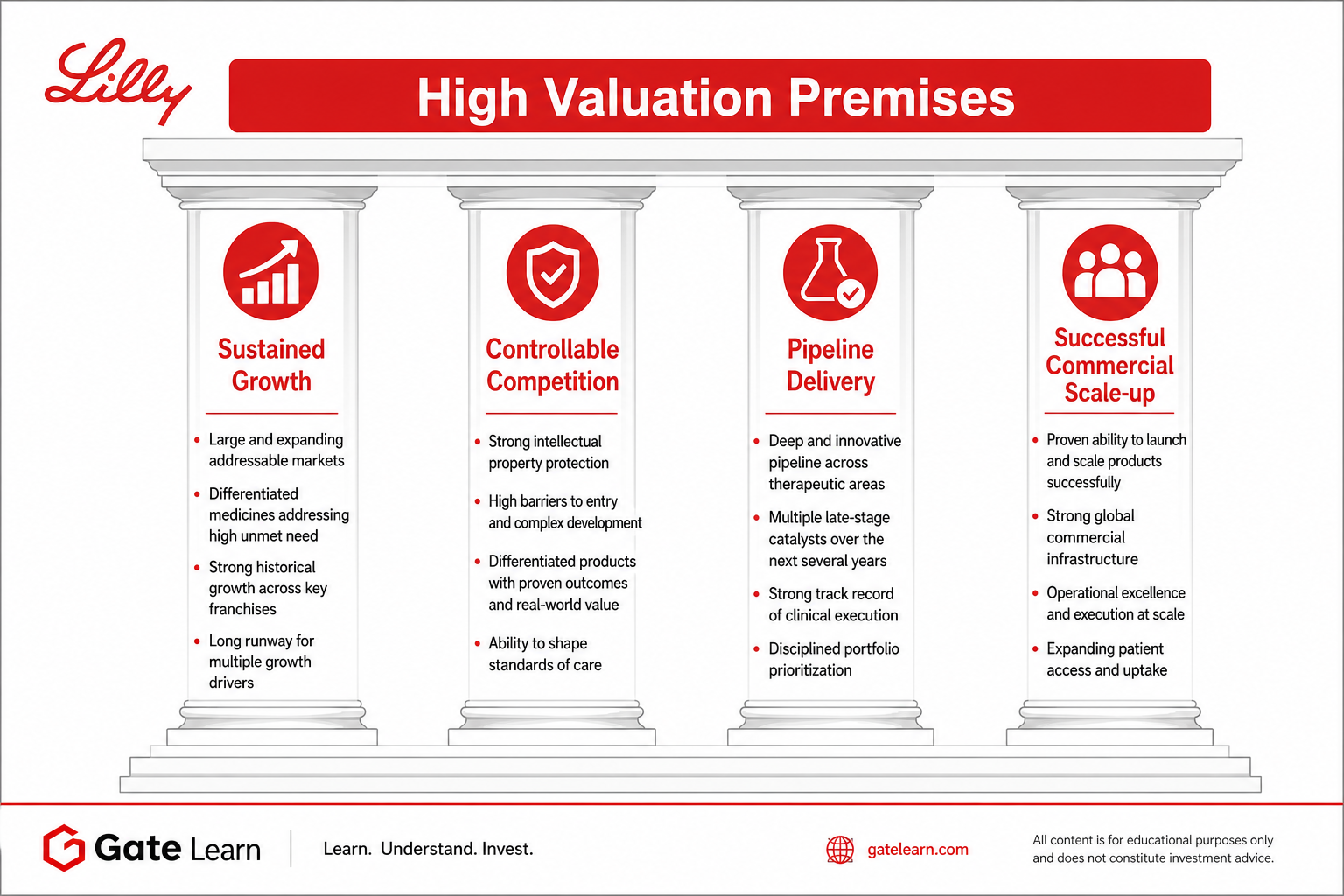 Figure 1. Key drivers of LLY's high valuation: growth, competition, pipeline realization, and commercialization scale collectively support pricing.
What Are the Core Assumptions Behind High Valuation?
Several key assumptions underpin high valuations: sustained growth, manageable competition, pipeline realization, and smooth scaling. If any of these falter, the market will reassess the company's future profit potential. The challenge with high valuation is not the premium itself, but the demanding pace of delivery it requires.
| Key Assumption |
If True |
If False |
| Sustained growth |
Revenue maintains strong momentum |
Market lowers expectations |
| Manageable competition |
Pricing and market share remain stable |
Market reassesses potential |
| Pipeline realization |
New growth drivers emerge |
Future growth gaps |
| Smooth scaling |
Faster commercialization |
Extended realization cycle |
Peer competition is the most frequently referenced assumption. The Pillar Overview's competition section provides insight into how market share and product rollout affect expectations.
This checklist has another important use: When market sentiment is overheated, it helps identify if only narratives remain without evidence; when sentiment is subdued, it helps determine if fundamentals have deteriorated or if expectations are simply normalizing. Identical valuation swings may have entirely different root causes.
How Do Competition, Patents, and Regulatory Risks Impact Valuation?
LLY faces valuation risks from multiple directions. Competition affects market share, patent expirations erode exclusivity, and regulatory or safety issues can alter growth trajectories. As these variables shift, the valuation anchor adjusts accordingly.
Risk does not equate to "inevitable correction," but signals that high-expectation pricing requires ongoing validation. When analyzing valuation, treat the risk checklist as an observation tool—not as a trading directive.
Risks can be categorized as those "altering revenue paths" and those "affecting expectation elasticity." The former—competition, patents, regulation—directly impact profit sources; the latter—valuation crowding, concentrated narratives—affect how the market prices identical profits. Both are important, but should be tracked separately to avoid attributing all volatility to a single cause.
How Should Long-Term Pricing Logic Be Understood?
Long-term pricing logic ultimately hinges on industry demand and the company's moat. If demand for obesity, diabetes, and related treatments continues to expand—and LLY maintains product and R&D leadership—market expectations will remain robust. If competition intensifies or growth slows, high expectations will weaken.
Long-term analysis should distinguish two points: First, is the sector large enough? Second, can the company consistently deliver within the sector? The former explains why the market assigns high multiples; the latter determines if those multiples are sustainable. For platform benchmarking and order field analysis, see Trading LLY Stocks on Gate.
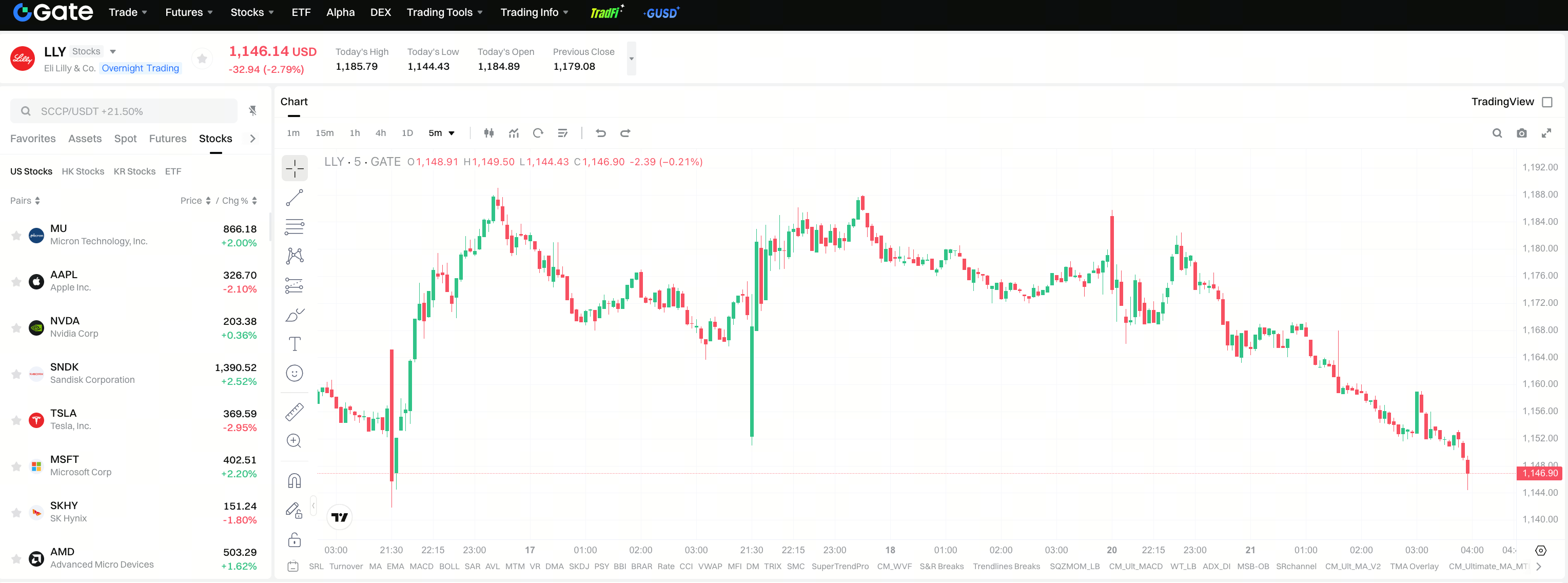
Note: Long-term pricing logic does not mean every stage's valuation is "reasonable." While sector demand may be structurally strong, periodic changes in supply, competition, or regulation can drive substantial expectation swings. Distinguishing "long-term sector trends" from "short-term pricing cycles" prevents a single narrative from masking all near-term variables.
Summary
LLY's valuation logic fundamentally reflects growth expectations, product scarcity, and R&D execution. Evaluating valuation in tandem with business model, financial quality, and competitive dynamics provides a clearer understanding of the conditions supporting high multiples.
If you remember one key takeaway: The core of high-valuation research is not scoring multiples, but continually verifying whether the four assumptions—growth, competition, pipeline, and scaling—remain intact.
FAQ
Why Is LLY Stock Consistently Valued at a Premium?
Because the market has high expectations for its growth and pipeline execution. As long as the growth trajectory is clear, the valuation anchor is likely to remain elevated.
How Should High-Valuation Stocks Be Analyzed?
Focus on whether growth is sustainable, profits are realized, and expectations are excessive. For LLY, these three questions matter more than simply reviewing multiples.
Does High Valuation Automatically Mean Greater Risk?
Not necessarily. The key is whether the company can continually deliver high growth. If growth matches valuation, the premium does not automatically imply unacceptable risk; if growth slows, high valuation becomes more sensitive.
What Risks Could Cause LLY's Valuation to Be Repriced?
Heightened competition, slower growth, underperforming pipeline, and regulatory risks can all trigger repricing. If market confidence in future profits weakens, valuation typically adjusts first. Repricing may result from bad news or simply from growth continuing but falling short of previously inflated expectations.