Token Issuance Moves On-Chain, Redefining Market Leadership
Traditionally, projects seeking market attention needed to pass centralized exchange reviews and complete listing processes. That standard path is loosening. Increasingly, teams are deploying tokens directly on public blockchains, enabling the market to independently discover prices and establish liquidity in a decentralized setting.
The core transformation here is that price discovery is no longer confined to a single platform but is distributed across all on-chain participants through their trading activity. Capital flows themselves serve as the most direct voting mechanism. For project teams, this allows for faster validation of whether their narrative resonates with the market. For investors, early opportunities increasingly arise on-chain—often before any exchange announcement.
Experience seamless on-chain trading now at Gate DEX: https://web3.gate.com/
Real Barriers to On-Chain Participation
In theory, anyone with a wallet can join on-chain trading, but in practice, the process is far more complex. Most users must constantly switch between different tools:
- Finding token contract addresses through community sources
- Verifying contract authenticity via blockchain explorers
- Checking liquidity and token distribution on analytics platforms
- Finally, executing swaps on a DEX
This fragmented process is not only time-consuming but also heightens the risk of operational errors and misinformation. While on-chain markets are open, the real challenge often lies in information integration, not technical barriers.
Gate DEX’s Integrated Approach
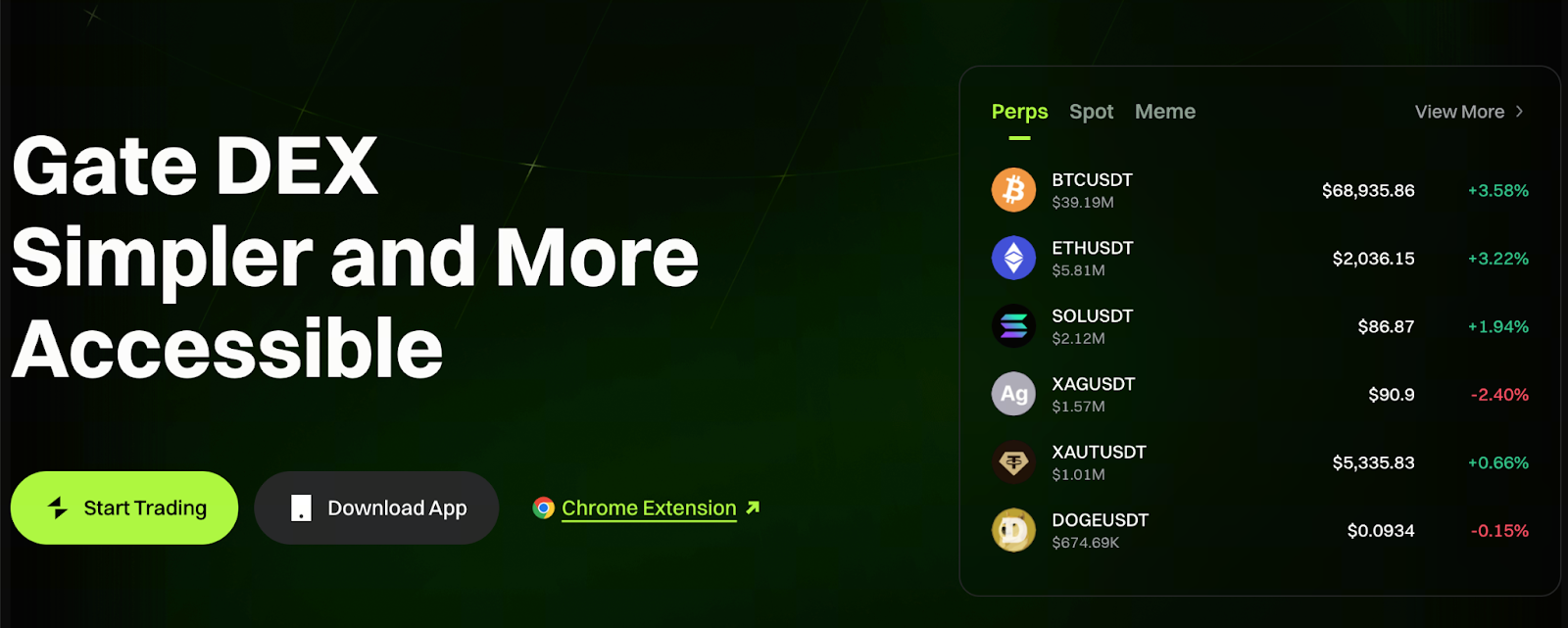
In response, Gate has launched Gate DEX, aiming to consolidate fragmented on-chain workflows into a single entry point.
The focus is not on piling up features, but on streamlining the user journey. Within a single interface, users can:
- Discover the latest on-chain assets
- Monitor market trends and liquidity in real time
- Execute trades directly
This integrated model eliminates the need to jump between multiple windows for on-chain trading, delivering an experience closer to traditional trading platforms. It lowers the learning curve and narrows information gaps.
Compressing the Gap Between Decision and Execution
In early-stage on-chain markets, speed is a competitive advantage. Many opportunities exist only within short market windows. Those able to confirm information and execute trades faster often secure more favorable entry points.
Gate DEX puts data monitoring and trading access on the same level, enabling users to act immediately after making a market decision. This shortens the path from spotting an opportunity to executing a trade—essentially accelerating decision-making.
On-Chain Transparency: Making Risk Traceable
On-chain trading is defined by transparent capital flows. Integrated on-chain data allows users to track various structural indicators, such as:
- Whether a token is seeing sustained capital inflows
- Sudden surges in trading volume
- High concentration of token holdings in a few addresses
While this information does not guarantee returns, it grounds decisions in verifiable data rather than relying solely on community sentiment or single viewpoints.
A Smoother Process Doesn’t Mean Lower Risk
Even with streamlined workflows, new assets remain highly uncertain. Low liquidity, opaque project information, and rapidly shifting market sentiment are the norm in on-chain markets. The platform’s value lies in lowering the barriers to entry and information costs, not in absorbing market volatility for users. Investors should still manage their position sizes and avoid chasing price spikes or excessive leverage driven by short-term gains.
On-Chain Trading Expands to Wider Participation
Previously, on-chain trading was the realm of technical users and early adopters. As interfaces improve and workflows become standardized, on-chain markets are opening up to a broader range of traders. Gate DEX marks the emergence of platform-level gateways for on-chain trading. It is no longer just a collection of fragmented tools, but a core component of a comprehensive trading system. As issuance models move to public blockchains, market entry points must evolve accordingly.
Summary
As token issuance transitions on-chain, market structures and price discovery mechanisms are undergoing deep transformation. On-chain is no longer merely a supplement but the starting point for new assets and liquidity. By integrating asset discovery, data monitoring, and trade execution, Gate DEX brings greater consistency and efficiency to previously fragmented on-chain processes. As the on-chain ecosystem expands, these one-stop entry platforms are becoming vital bridges connecting new projects with market capital—and opening the door for more participants to enter the on-chain world.







