Gate Offers 100% Trading Fee Rebates on Stock Tokens, Up to 1,450 USDT per User

Beginner
Quick Reads
Last Updated 2026-03-26 18:31:45
Reading Time: 1m
Gate is rolling out a limited-time cashback promotion for stock token trading, available across all stock token pairs. Both spot and futures markets are eligible. Participants can receive up to 100% of their trading fees back, with a maximum reward of 1,450 USDT per user. The promotion runs until December 23.

I. Why Stock Tokens Are a Trending Trading Category

Stock tokens bring traditional stock prices onto blockchain-based trading platforms, allowing users to engage in stock price movements directly through their digital asset accounts—no need for a traditional securities account. This model provides greater flexibility in trading hours, improves capital efficiency, and offers easier operations. As a result, stock tokens have become an increasingly important derivative trading product on crypto platforms.

II. Core Logic Behind This Stock Token Cashback Event
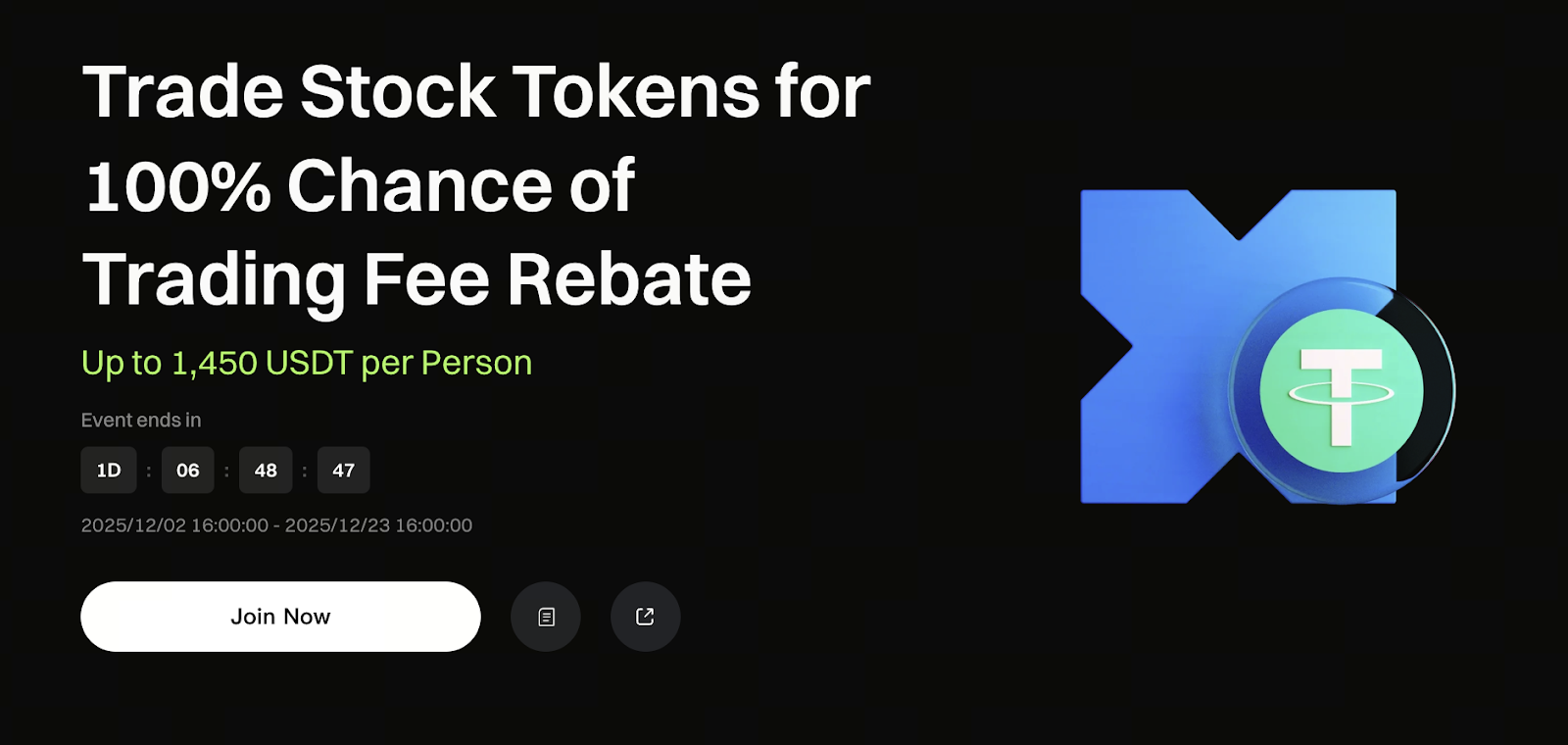

Figure: https://www.gate.com/campaigns/3422

This event is not a simple “giveaway.” Instead, it centers on trading fee cashback. Users generate trading fees through actual trades and receive cashback in return, which, within compliance guidelines, reduces or even eliminates trading costs. This approach incentivizes genuine trading and helps users become more familiar with the stock token trading process.

III. How Each of the Three User Types Can Participate Most Effectively

This event primarily targets three groups:

  • New users trying stock tokens for the first time
  • Regular users who trade at a steady frequency
  • Highly active users with large trading volumes

Each user type can select the participation option that best fits their trading habits. There’s no need to pursue every available reward.

IV. Participation Thresholds for Registration Rewards

The first event uses a registration lottery system. Among the first 2,000 users to sign up, 100 are randomly selected to receive 100 USDT each. Because this design involves virtually no trading costs, it primarily boosts event visibility. For those planning to participate, registering early is the logical choice.

V. What First Trade Cashback Means for New Users

The second promotion features a “zero-barrier first trade.” Users only need to complete their first spot or contract trade on eligible stock token pairs to receive 10–50 USDT in cashback. This lets new users experience the full stock token trading process with minimal capital outlay, while reducing the trial-and-error costs typically associated with trading fees.

VI. Trading Volume Cashback vs. Leaderboard Rewards

The third promotion is the event’s main incentive mechanism.

To qualify for the basic cashback, users must reach a cumulative trading volume of 500 USDT, which grants access to a 50,000 USDT prize pool—making this a broadly accessible reward.

Leaderboard rewards, however, are designed for high-volume traders. By setting clear trading volume thresholds, the event encourages frequent traders to compete for top spots. This tiered structure prevents regular users from competing directly with professional traders for the same rewards.

VII. Practical Value of Trading Fee Cashback Vouchers

All rewards are issued as trading fee cashback vouchers, which offset trading fees on future transactions. For users who trade regularly, these vouchers lower long-term trading costs rather than acting as one-off bonuses—making them ideal for medium- and long-term participants in the stock token market.

VIII. Compliance and Risk Reminders for Participation

Please note:

  • Users must complete identity verification and register for the event
  • Sub-accounts, institutional accounts, and market maker accounts are not eligible
  • Wash trading, self-trading, and other prohibited activities are strictly forbidden
  • Users from restricted regions may not be eligible for all offers

Stock token prices remain subject to market and regulatory influences. Cashback offers do not guarantee profits. Users should always trade based on their personal risk tolerance.

Author: Max
Disclaimer
* The information is not intended to be and does not constitute financial advice or any other recommendation of any sort offered or endorsed by Gate.
* This article may not be reproduced, transmitted or copied without referencing Gate. Contravention is an infringement of Copyright Act and may be subject to legal action.

Related Articles

AI-Native Settlement Layers: How United Stables Is Building the Next Financial Rail
Beginner

AI-Native Settlement Layers: How United Stables Is Building the Next Financial Rail

Stablecoins were originally designed as dollar substitutes within exchanges, primarily used for asset pricing and trade settlement. As on-chain financial ecosystems have matured, their role has expanded beyond simple payments to include collateral assets, cross-chain liquidity mediums, and unified settlement units. In particular, as AI systems and automated agents begin to participate directly in economic activity, demand has risen sharply for programmable value units capable of instant settlement. This shift is pushing stablecoins toward the role of foundational financial infrastructure.
2026-03-25 03:16:17
The ve(3,3) Flywheel Explained: How AERO Tokenomics Powers Aerodrome’s DeFi Economy
Beginner

The ve(3,3) Flywheel Explained: How AERO Tokenomics Powers Aerodrome’s DeFi Economy

In the competition for DeFi liquidity, high-inflation mining alone is no longer enough to build lasting advantages. Aerodrome applies the ve(3,3) economic model to redesign token emissions, voting mechanisms, and revenue distribution, creating a liquidity flywheel centered on governance and cash flow. This article examines AERO tokenomics, the veAERO locking mechanism, and protocol revenue models to explain how Aerodrome builds a sustainable DeFi economic system.
2026-03-25 06:41:58
Aerodrome Tokenomics: How ve(3,3) Powers Base's Most Profitable DEX
Beginner

Aerodrome Tokenomics: How ve(3,3) Powers Base's Most Profitable DEX

AERO is the native token of Aerodrome Finance, a core decentralized exchange and liquidity protocol in the Base ecosystem. It is primarily used for liquidity incentives and ecosystem operations. veAERO is a governance NFT that users receive by locking AERO, representing both voting power and the right to share protocol revenue. Through a dual track structure of AERO as a utility token and veAERO as a governance credential, Aerodrome separates liquidity usage value from long term governance power, allowing participants to act as liquidity providers, governance decision makers, and revenue sharers within the same system.
2026-03-25 06:40:31
How is the price of PAXG determined? Pegging mechanism, trading depth, and influencing factors
Beginner

How is the price of PAXG determined? Pegging mechanism, trading depth, and influencing factors

PAXG (Pax Gold) is a tokenized asset backed by physical gold reserves, launched by fintech firm Paxos and issued as an ERC-20 token on the Ethereum blockchain. The core concept is to digitally represent real-world gold assets, allowing investors to hold and trade gold via the blockchain network. Because each PAXG token corresponds to a specific quantity of physical gold, its price is theoretically expected to closely track the global gold market.
2026-03-24 19:11:40
How Does PAXG Work? In-Depth Overview of the Physical Gold Tokenization Mechanism
Beginner

How Does PAXG Work? In-Depth Overview of the Physical Gold Tokenization Mechanism

PAXG (Pax Gold) is a tokenized asset backed by physical gold, issued by the fintech company Paxos and traded on the Ethereum blockchain as an ERC-20 token. The core concept is to tokenize physical gold on-chain, with each PAXG token representing ownership of a certain amount of gold. This structure enables investors to hold and trade gold in the form of a digital asset.
2026-03-24 19:12:51
Hybrid Collateral Stablecoins: Inside United Stables' Stability and Yield Architecture
Beginner

Hybrid Collateral Stablecoins: Inside United Stables' Stability and Yield Architecture

In the early stages of the crypto market, traditional stablecoins mainly relied on single-reserve or single-collateral models. Their primary focus was price stability and payment convenience, which allowed them to become foundational tools for on-chain trading and capital flows. As the market has entered a more mature financial phase, however, this structure has begun to reveal limitations, including high concentration risk and the difficulty of balancing liquidity with yield. These constraints have driven the evolution toward multi-layer collateral and portfolio-based designs, such as the dual-layer hybrid collateral architecture proposed by United Stables, which seeks to redefine the underlying logic of stable assets.
2026-03-25 03:17:39





