Gate Stock Token Zone Explained: Understanding Stock Price Movements on a Crypto Platform

Beginner
Quick Reads
Last Updated 2026-03-26 08:45:16
Reading Time: 1m
The Gate Stock Token Zone offers users a way to trade tokenized stock prices, enabling them to engage with stock price movements in a cryptocurrency trading environment. This article outlines the Zone’s features, how it works, and important risk disclosures.

I. Background of the Gate Tokenized Stocks Section Launch
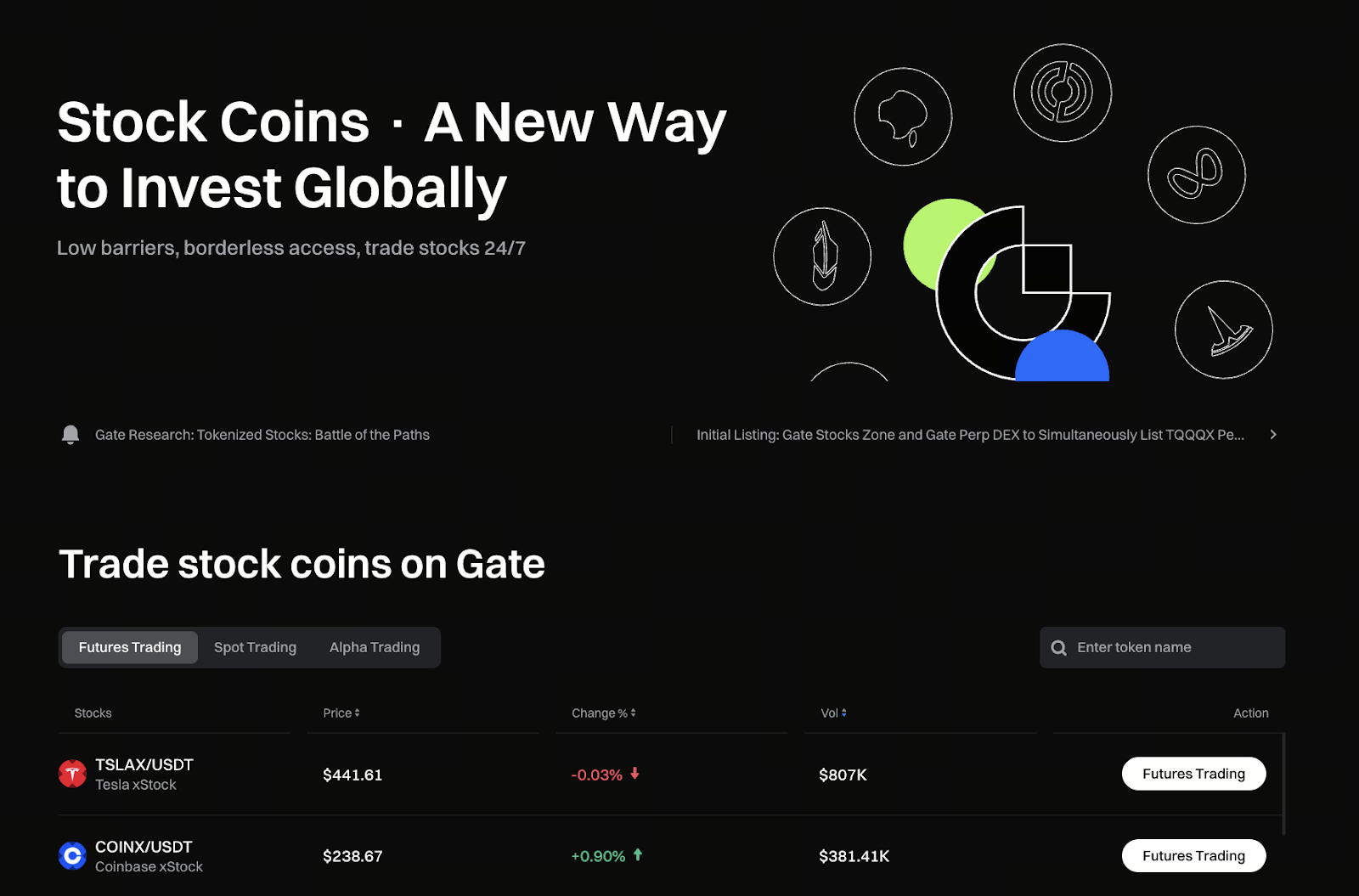

Image: https://www.gate.com/tokenized-stocks

As interest in diversified assets continues to rise among crypto market participants, Gate has introduced the Tokenized Stocks section to meet the growing demand for tokenized stock price display and trading. The primary objective is to integrate stock price elements from traditional markets into the platform, allowing users to monitor and engage with various asset price movements—all without changing their established crypto trading habits.

The Gate Tokenized Stocks section is not an extension of traditional securities services. Instead, it is a product that leverages price mapping. Users interact with the market performance of stock prices, not the underlying stocks themselves. This positioning makes the product more suitable for price speculation and market analysis, rather than for equity investment purposes.

II. Understanding Tokenized Stocks and Their Trading Logic

Tokenized stocks are digital assets pegged to the prices of specific equities, with their value tracking the performance of the corresponding stocks in traditional financial markets. When the price of a stock fluctuates, the price of its tokenized counterpart adjusts accordingly, mirroring stock market dynamics within a crypto trading environment.

Trading in the Gate Tokenized Stocks section follows the standard operational logic of digital assets. Users can buy and sell tokenized stocks to participate in price changes, without the need to open brokerage accounts or handle settlement cycles, as required in traditional stock trading. This structure lowers the participation threshold, but users must clearly understand the product’s features to avoid mistaking tokenized stocks for direct stock ownership.

III. Appropriate Use Scenarios for Tokenized Stocks

Practically speaking, tokenized stocks serve best as tools for price participation. They enable users to observe how different equities react to macroeconomic events, industry news, or market sentiment shifts, thereby deepening their understanding of stock market behavior.

Furthermore, the Gate Tokenized Stocks section offers a convenient way for users to track multiple asset classes on a single platform. This centralized display of market data helps users develop a cross-market pricing perspective. However, the section is not designed for long-term holding or value investing.

IV. Risk Awareness Before Participating in the Gate Tokenized Stocks Section

While tokenized stocks offer simplified trading operations, they still carry significant price volatility risks. Their prices are influenced not only by the underlying equities’ movements but also by changes in digital asset market liquidity and short-term sentiment, which can sometimes result in pronounced price swings.

Before trading in the Gate Tokenized Stocks section, users should fully recognize that tokenized stocks do not grant ownership rights, dividends, or governance privileges associated with actual stocks. Managing trade size prudently and conducting thorough risk assessments are essential for engaging with these price-based products. Gate also urges users to exercise sound judgment and caution in all transactions involving market volatility.

Author: Max
Disclaimer
* The information is not intended to be and does not constitute financial advice or any other recommendation of any sort offered or endorsed by Gate.
* This article may not be reproduced, transmitted or copied without referencing Gate. Contravention is an infringement of Copyright Act and may be subject to legal action.

Related Articles

The ve(3,3) Flywheel Explained: How AERO Tokenomics Powers Aerodrome’s DeFi Economy
Beginner

The ve(3,3) Flywheel Explained: How AERO Tokenomics Powers Aerodrome’s DeFi Economy

In the competition for DeFi liquidity, high-inflation mining alone is no longer enough to build lasting advantages. Aerodrome applies the ve(3,3) economic model to redesign token emissions, voting mechanisms, and revenue distribution, creating a liquidity flywheel centered on governance and cash flow. This article examines AERO tokenomics, the veAERO locking mechanism, and protocol revenue models to explain how Aerodrome builds a sustainable DeFi economic system.
2026-03-25 06:41:58
AI-Native Settlement Layers: How United Stables Is Building the Next Financial Rail
Beginner

AI-Native Settlement Layers: How United Stables Is Building the Next Financial Rail

Stablecoins were originally designed as dollar substitutes within exchanges, primarily used for asset pricing and trade settlement. As on-chain financial ecosystems have matured, their role has expanded beyond simple payments to include collateral assets, cross-chain liquidity mediums, and unified settlement units. In particular, as AI systems and automated agents begin to participate directly in economic activity, demand has risen sharply for programmable value units capable of instant settlement. This shift is pushing stablecoins toward the role of foundational financial infrastructure.
2026-03-25 03:16:17
Aerodrome Tokenomics: How ve(3,3) Powers Base's Most Profitable DEX
Beginner

Aerodrome Tokenomics: How ve(3,3) Powers Base's Most Profitable DEX

AERO is the native token of Aerodrome Finance, a core decentralized exchange and liquidity protocol in the Base ecosystem. It is primarily used for liquidity incentives and ecosystem operations. veAERO is a governance NFT that users receive by locking AERO, representing both voting power and the right to share protocol revenue. Through a dual track structure of AERO as a utility token and veAERO as a governance credential, Aerodrome separates liquidity usage value from long term governance power, allowing participants to act as liquidity providers, governance decision makers, and revenue sharers within the same system.
2026-03-25 06:40:31
How is the price of PAXG determined? Pegging mechanism, trading depth, and influencing factors
Beginner

How is the price of PAXG determined? Pegging mechanism, trading depth, and influencing factors

PAXG (Pax Gold) is a tokenized asset backed by physical gold reserves, launched by fintech firm Paxos and issued as an ERC-20 token on the Ethereum blockchain. The core concept is to digitally represent real-world gold assets, allowing investors to hold and trade gold via the blockchain network. Because each PAXG token corresponds to a specific quantity of physical gold, its price is theoretically expected to closely track the global gold market.
2026-03-24 19:11:40
How Does PAXG Work? In-Depth Overview of the Physical Gold Tokenization Mechanism
Beginner

How Does PAXG Work? In-Depth Overview of the Physical Gold Tokenization Mechanism

PAXG (Pax Gold) is a tokenized asset backed by physical gold, issued by the fintech company Paxos and traded on the Ethereum blockchain as an ERC-20 token. The core concept is to tokenize physical gold on-chain, with each PAXG token representing ownership of a certain amount of gold. This structure enables investors to hold and trade gold in the form of a digital asset.
2026-03-24 19:12:51
Aster vs Hyperliquid: Which Perp DEX Will Prevail?
Beginner

Aster vs Hyperliquid: Which Perp DEX Will Prevail?

Aster and Hyperliquid are the two representative protocols of the "purpose-built L1 path" within the current decentralized perpetual exchange (Perp DEX) sector. As a pioneer in the field, Hyperliquid has built a deep liquidity moat through its highly mature order book architecture and strong community consensus. Conversely, Aster, as a rising challenger, seeks to leapfrog the competition in high-performance trading through more aggressive multi-chain aggregation logic, private transaction modules, and an underlying execution environment optimized for 2026 market demands.
2026-03-24 11:58:33





