Gate US stock trading commission fee model matters because US stock access is no longer limited to fiat deposits, bank transfers, and broker-only account structures. Stablecoin-based access creates a bridge between digital asset balances and traditional equity exposure, while still requiring users to understand trading rules, eligibility, fees, and custody structure.
The digital asset value of this model comes from settlement flexibility. USDT can act as the account funding and settlement asset, which may reduce some fiat conversion steps for users who already hold stablecoins, but it does not remove stock market risk, execution risk, regulatory restrictions, or product-specific limitations.
What Is Gate US Stock Trading Commission?
Gate US stock trading commission refers to the trading cost charged when an eligible user buys or sells supported US stocks or ETFs through Gate’s stock spot product. Gate describes the product as US stock and ETF trading funded and settled in USDT, with market access supported through regulated brokerage infrastructure.
The core point is that the fee is connected to transaction activity, not to simply holding a stock position. This makes it different from products such as CFDs or leveraged derivatives, where funding costs, overnight fees, or margin-related costs may apply depending on the product rules. Understanding the difference between Gate Stocks trading and other traditional asset products can help users avoid mixing spot exposure with contract-based exposure.
Gate’s product page states that stock spot fees can be as low as 0.023%. The final applicable rate may depend on the user’s account level, transaction amount, and actual transaction record. For educational purposes, users should treat the public product page as a starting reference and confirm the final fee inside their order history or account fee page before relying on a cost estimate.
How Gate Charges Fees for Buying US Stocks with USDT
Gate charges stock trading fees as a percentage of the transaction amount. In simple terms, the fee is calculated from the value of the buy or sell order rather than as a fixed dollar amount per trade.
This percentage-based model can be easier for crypto-native users to understand because it resembles spot trading fee logic. A smaller order pays a smaller absolute fee, while a larger order pays more in absolute terms even if the percentage rate is unchanged. Gate’s help center also states that settlement is in USDT and that direct stock withdrawals are not currently supported.
| Fee Element |
How It Works on Gate US Stock Trading |
| Trading fee |
Charged as a percentage of transaction amount |
| Settlement asset |
USDT |
| Fee reference |
Based on applicable account or VIP-level rules |
| Holding fee |
Not presented as a standard stock spot holding fee |
| Stock withdrawal |
Direct stock withdrawals are not currently supported |
| Final confirmation |
Actual records should be checked in transaction history |
This table shows why users should not judge the cost from the headline fee alone. The visible trading fee is important, but settlement method, withdrawal limits, execution price, and user eligibility also affect the full experience.
How Traditional Brokers Charge for US Stock Trading
Traditional brokers can charge for US stock trading in several ways. Some brokers advertise zero-commission stock trading, while others may charge a fixed commission, percentage-based commission, custody fee, platform fee, foreign exchange spread, withdrawal fee, inactivity fee, or regulatory pass-through charge.
For international users, currency conversion is often a key cost. A user funding a brokerage account in local currency may need to convert into USD before buying US stocks. Even when the broker charges no explicit stock commission, the foreign exchange spread or conversion fee can become part of the total trading cost.
Broker pricing also varies by market, jurisdiction, account type, order type, and custody arrangement. This is why a simple “commission versus commission” comparison can be incomplete. A user comparing Gate with traditional brokers should review total transaction cost, not just the trading fee label.
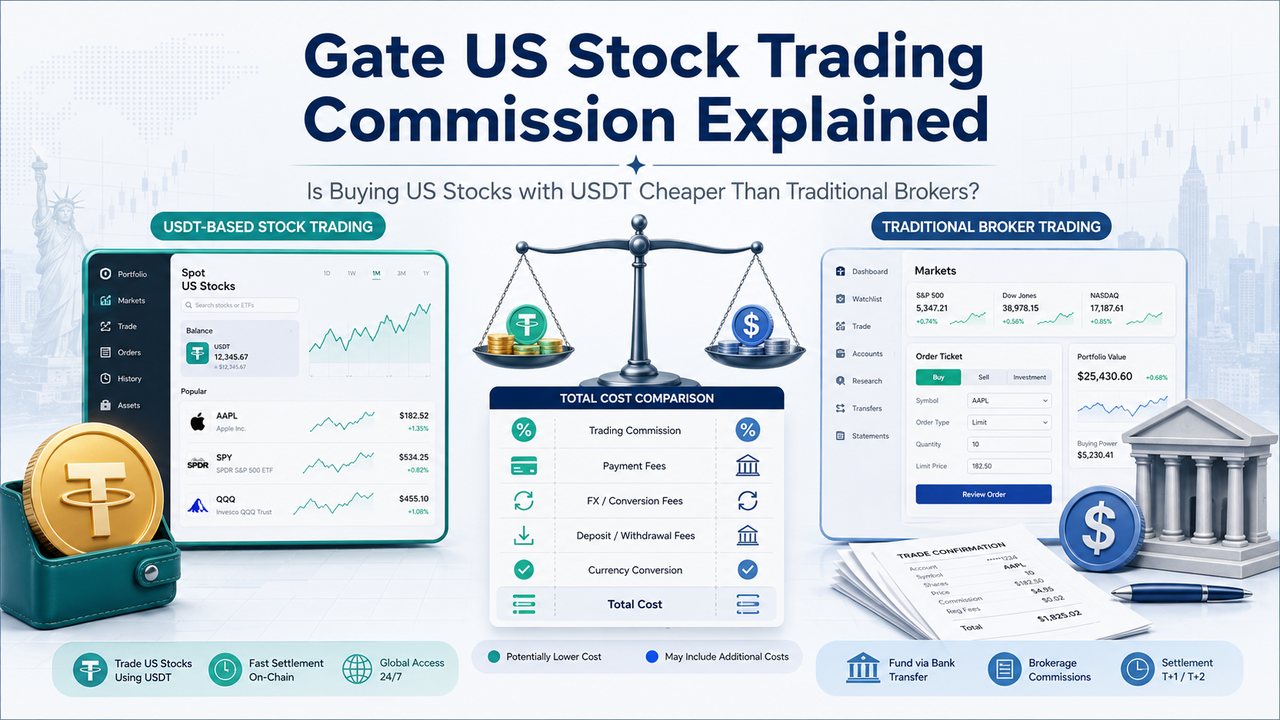
Gate vs Traditional Brokers: Which Fee Model Is Cheaper?
Gate may be cheaper for some users when the percentage-based stock trading fee and USDT settlement reduce steps that would otherwise involve fiat conversion, bank transfers, or broker-side charges. However, it is not accurate to say Gate is always cheaper than every traditional broker.
The comparison depends on the broker being used, the user’s country, the size of the order, currency conversion costs, account fees, and the bid-ask spread at execution. For example, a broker with zero stock commission and low currency conversion costs may be cost-effective for some users. In another case, a crypto user who already holds USDT may find a USDT-settled stock trading route operationally simpler.
| Cost Area |
Gate US Stock Trading |
Traditional Broker |
| Funding route |
USDT-based funding and settlement |
Usually fiat deposit and USD conversion |
| Stock commission |
Percentage-based trading fee |
May be zero, fixed, or percentage-based |
| Currency conversion |
May be reduced for users already holding USDT |
Often relevant for non-USD users |
| Holding cost |
Spot-style holding without standard derivative funding fees |
Usually no funding fee for cash stock positions |
| Product access |
Supported US stocks and ETFs on Gate |
Depends on broker and region |
| Withdrawal structure |
USDT withdrawal supported, direct stock withdrawal not currently supported |
Broker-specific stock transfer and cash withdrawal rules |
The cheaper model is the one with the lower total cost for a user’s actual situation. A fair comparison should include trade size, funding currency, conversion spread, order execution quality, account maintenance fees, and the cost of moving funds in or out.
Other Costs Users Should Compare Beyond Commission
Commission is only one part of trading cost. Users should also compare spreads, execution quality, currency conversion, deposit and withdrawal costs, tax handling, account fees, custody rules, and product availability.
Spreads matter because the execution price may differ from the visible mid-market price. A low commission can be offset if the buy-sell spread is wide or if execution occurs at a less favorable price. This is especially relevant during volatile market periods, when stock prices can move quickly.
Users should also understand product structure. Spot stock exposure differs from synthetic exposure, CFDs, and futures. The differences between Gate Stocks, brokers, and stock CFDs are especially important because each model has different ownership, settlement, leverage, and risk characteristics.
Benefits of Using USDT to Buy US Stocks on Gate
The main benefit of using USDT to buy US stocks on Gate is operational simplicity for users who already hold stablecoins. Instead of moving funds from a crypto account to a bank and then to a brokerage account, eligible users can access supported US stocks and ETFs through a USDT-settled stock trading environment.
This can also make the user journey more familiar for crypto participants. The funding asset, account balance, and transaction logic may feel closer to crypto spot trading than to a traditional brokerage interface. For users comparing asset classes, the ability to trade traditional assets with crypto balances sits near the broader idea of trading real-world assets with crypto assets.
Another practical benefit is fractional access where supported. Fractional trading can make high-priced stocks easier to access in smaller position sizes, although smaller position size does not reduce market risk. Users still need to consider stock volatility, company risk, sector risk, and broader macroeconomic conditions.
Risks and Limitations of Gate US Stock Trading
Gate US stock trading has risks and limitations that users should understand before comparing fee models. The product may be subject to regional availability, KYC requirements, market hours, supported asset lists, execution rules, corporate action handling, and platform-specific settlement conditions.
A key limitation is that settlement is in USDT and direct stock withdrawals are not currently supported. This means users should not assume the same transfer flexibility they may have with some traditional brokerage accounts. The distinction between economic exposure and shareholder-style rights also matters, especially when users compare stock access models. The relationship between economic rights and shareholder rights should be reviewed carefully in any cost comparison.
There are also market risks. US stocks and ETFs can decline in value, and stablecoin-funded access does not remove equity risk. USDT itself carries stablecoin, liquidity, issuer, and regulatory risks. A lower visible commission does not make a trade lower risk.
Summary
Gate US stock trading commission is a percentage-based fee model for buying and selling supported US stocks and ETFs with USDT. It may reduce operational steps for crypto users who already hold stablecoins, especially when compared with broker routes that require fiat deposits and currency conversion.
The question of whether Gate is cheaper than a traditional broker depends on total cost. Users should compare trading fees, spreads, currency conversion, deposit and withdrawal costs, execution quality, account charges, and product limitations. A careful comparison is more reliable than focusing only on the headline commission.
Gate’s stock spot model is most relevant for users who want USDT-settled access to supported US stocks and ETFs. It should be understood separately from CFDs, futures, and tokenized stock products because each structure has different costs and risks. The differences between US stock spot and futures on Gate are especially important for users comparing spot exposure with leveraged contract exposure.
FAQs
Is Gate US stock trading commission always cheaper than traditional brokers?
Gate US stock trading commission is not always cheaper than every traditional broker. The final comparison depends on the trading fee, broker commission, foreign exchange costs, spreads, deposit and withdrawal fees, and order execution. Users should compare total cost rather than relying only on the visible commission rate.
How is Gate US stock trading commission calculated?
Gate US stock trading commission is charged as a percentage of the transaction amount. The applicable rate may depend on account-level rules and should be confirmed through the user’s fee page or transaction history. This makes the cost scale with order size instead of being a fixed amount per order.
Does buying US stocks with USDT remove currency conversion costs?
Buying US stocks with USDT may reduce some fiat conversion steps for users who already hold USDT. It does not mean all conversion-related costs disappear in every situation. Users still need to consider how they acquired USDT, how they may withdraw funds, and whether any spread or transfer cost applies.
Is Gate US stock trading the same as stock CFDs?
Gate US stock trading is not the same as stock CFDs. Stock spot trading focuses on buying and selling supported stock or ETF exposure, while CFDs are contracts that track price movements without holding the underlying asset. Users comparing USDT stock trading without a brokerage account should separate spot-style access from leveraged derivatives.
What should users check before using Gate US stock trading?
Users should check regional eligibility, KYC requirements, supported stocks and ETFs, fee rates, execution rules, settlement method, corporate action handling, and withdrawal limitations. Gate US stock trading commission is only one part of the decision. Product structure and risk controls are equally important.