As demand for computing power in AI training continues to grow, traditional centralized computing models face challenges around cost and resource allocation. By introducing a token mechanism, Gensyn allows distributed nodes to participate in computation and receive incentives, helping build an open AI Compute Economy.
From a blockchain perspective, $AI is not only a payment tool. It also carries multiple functions, including verification, incentives, and value capture, enabling the AI computing process to form a closed loop within a decentralized network.
The Role of the Gensyn Token in the Ecosystem: The Core Economic Medium in an AI Compute Network
As the core economic medium in the Gensyn network, $AI runs through the entire AI computing process. First, at the payment layer, users need to pay computing fees in $AI when they conduct model training or use AI services. This turns all compute demand into on-chain economic input.
Second, at the incentive layer, nodes earn $AI rewards by executing AI tasks. This mechanism directly ties compute contribution to economic returns, creating a structure similar to “Compute Mining.”
In addition, at the security layer, nodes usually need to stake $AI to participate in network verification. If a node provides incorrect results or behaves dishonestly, it may face penalties, which helps constrain the behavior of network participants.
Source: docs.gensyn.network
Gensyn Token Supply: Supply Structure, Issuance Logic, and Release Path
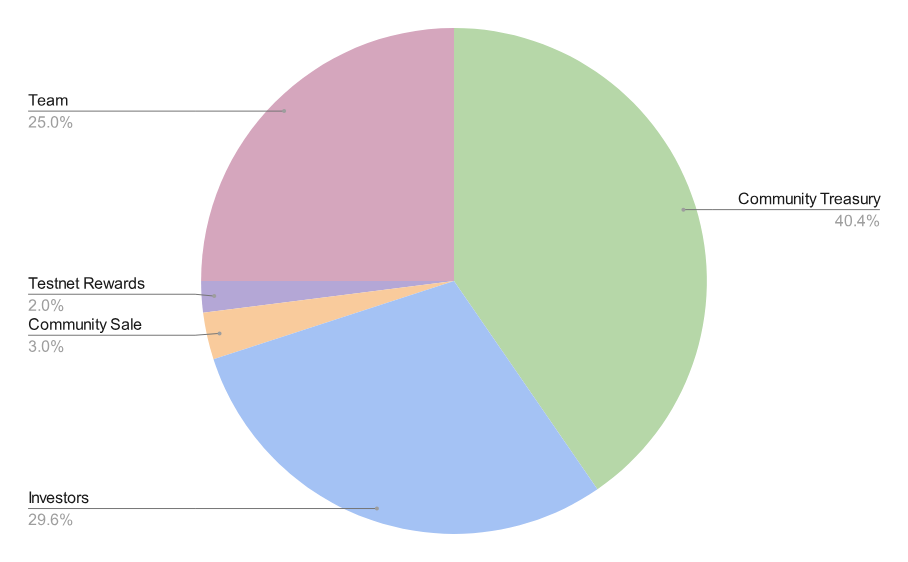
$AI has a total supply of 10 billion tokens. It follows a fixed supply model, although its circulating supply will change according to the release schedule.
In terms of allocation, the token is mainly divided into the following categories:
| Allocation Category |
Share |
Main Use |
| Community Treasury |
40.40% |
Ecosystem incentives, liquidity, research and development, and grants |
| Investors |
29.60% |
Supporting the protocol’s early development |
| Team |
25% |
Core contributors and long-term development |
| Community Sale |
3% |
Initial community participation |
| Testnet Rewards |
2% |
Incentives for early users |
Structurally, the large allocation to the Community Treasury shows that ecosystem expansion and incentives play an important role in the overall design.
At the same time, the team and investor allocations usually enter the market gradually through vesting. This mechanism helps ease short-term circulating supply pressure and extends the incentive cycle.
Compute Incentive Mechanism: Compute Mining and Node Reward Logic
Gensyn’s incentive mechanism is built on the logic that compute contribution creates value.
Nodes earn $AI rewards by executing AI training tasks. This process is similar to mining in traditional blockchains, but the core resource shifts from general computational hashing power to AI model training capability. For that reason, it is often called Compute Mining.
Reward distribution is usually related to factors such as:
-
The number of computing tasks completed by the node
-
The quality and accuracy of task execution
-
The node’s online stability
The key point of this mechanism is that incentives depend not only on the scale of computing power, but also on the reliability of computation results. This pushes the network toward higher quality computation.
In the Gensyn network, AI training demand is converted into economic input through the fee mechanism.
When users submit training tasks, they need to pay a certain amount of $AI. These fees can be calculated based on different dimensions, such as:
In actual operation, this fee structure may show market-based characteristics, meaning that fee levels are affected by the relationship between compute supply and demand.
When demand for computation increases, fees may rise, attracting more nodes to participate. The reverse may also occur. This mechanism allows the network to self-adjust to a certain extent.
Revenue Distribution Mechanism: The Value Allocation Structure Among Nodes, Validators, and the Protocol
Gensyn’s revenue mainly comes from computing fees paid by users. This revenue is distributed among network participants.
The distribution structure mainly includes:
-
Compute nodes: receive the main rewards for executing tasks
-
Validator nodes: verify the correctness of computation results and receive corresponding revenue
-
Protocol layer: sends a certain share of fees to the Community Treasury for ecosystem development
This distribution model ensures that different roles in the network all have economic incentives, helping maintain the operation of the system.
Gensyn’s Value Capture Logic: Buy-and-Burn Mechanism and the AI Compute Economy
One of Gensyn’s key designs is its value capture mechanism, which converts network revenue into token value through Buy-and-Burn.
The specific process is:
-
On-chain applications generate revenue, such as AI service fees
-
Revenue enters the protocol-controlled BuyBack Vault
-
The Vault buys $AI on the market
-
The purchased tokens are distributed proportionally
The distribution structure is as follows:
-
70% is burned, permanently reducing supply
-
29% goes to the Community Treasury
-
1% is used as execution rewards
The core of this mechanism is:
to directly connect network usage, meaning demand for AI training, with changes in token supply, thereby creating a value transmission path of “usage → buyback → burn.”
Compared with models that rely purely on inflationary incentives, this design places more emphasis on usage-driven value accumulation.
Tokenomics Risks and Sustainability: Key Challenges in the Compute Economy Model
Although Gensyn’s token model builds a relatively complete economic closed loop, it still faces several potential challenges.
First, the incentive mechanism may create dependence on token rewards. If network usage demand is insufficient, incentives alone may struggle to sustain long-term participation.
Second, imbalances between compute supply and demand may affect system efficiency. For example, when computing power is either excessive or insufficient, the fee and reward structure may fluctuate.
In addition, token releases, such as team and investor unlocks, may affect market circulation and, in turn, overall economic stability.
Finally, although the Buy-and-Burn mechanism can reduce supply, its effectiveness depends on real usage demand. If on-chain revenue is insufficient, its value capture capability will also be limited.
Summary
Through compute incentives, fee payments, and a buyback-and-burn mechanism, Gensyn’s $AI token connects AI training demand with its token economy. Its core logic is to turn distributed computing into measurable and incentivized economic activity.
This model not only reflects the integration of AI and blockchain, but also shows one possible economic design path for decentralized compute networks.
FAQ
- What is the main use of the $AI token?
It is used to pay AI computing fees, support node staking and verification, and participate in future governance.
- What is Compute Mining?
It refers to the mechanism in which nodes earn token rewards by executing AI computing tasks.
- How does the Buy-and-Burn mechanism affect the token?
It reduces supply by buying back and burning tokens, thereby linking network revenue to token value.
- Are Gensyn’s fees fixed?
Fees usually depend on computing demand and resource supply, so they may change dynamically.
- Does Gensyn’s token model depend on real usage?
Yes. Its value capture mechanism depends on on-chain revenue generated by demand for AI training.