As the global semiconductor industry's division of labor deepens, more companies are choosing to specialize in chip design and outsource manufacturing to dedicated foundries. This model positions GlobalFoundries as a critical platform connecting chip innovation with end applications, while building a revenue system centered on manufacturing services.
GFS Stock Basics
GlobalFoundries, headquartered in New York State, is one of the world's leading wafer foundries. The company operates manufacturing sites across the U.S., Germany, and Singapore, offering semiconductor manufacturing services to clients worldwide. GFS is the stock ticker for GlobalFoundries Inc., listed on the Nasdaq Stock Market.
Unlike many semiconductor firms, GlobalFoundries does not directly compete in consumer electronics branding. Instead, it sits in the midstream of the industry chain. Its clients include communications chip companies, automotive electronics suppliers, industrial control manufacturers, and IoT solution providers. With such a diverse client base, GlobalFoundries' performance often reflects demand trends across multiple end markets.
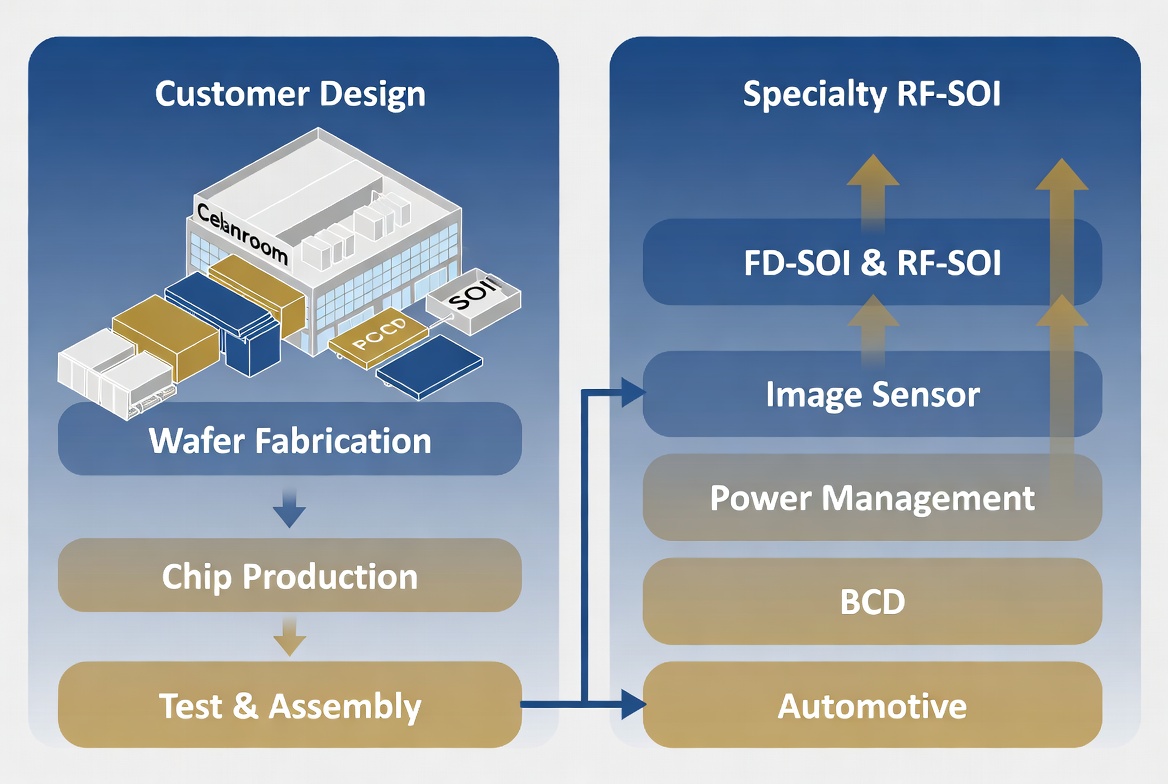
What Are GlobalFoundries' Revenue Sources?
GlobalFoundries generates revenue primarily from wafer manufacturing services.
Once clients complete chip design, they rely on foundries for mass production. GlobalFoundries leverages its process platforms, equipment, and manufacturing expertise to produce wafers, charging fees based on order size, process node, and product complexity.
Rather than depending on a single industry, GlobalFoundries serves multiple markets.
| Revenue Source |
Main Clients |
| Automotive Chips |
Automotive supply chain firms |
| Communications Chips |
Network equipment & telecom vendors |
| Industrial Control Chips |
Industrial automation companies |
| IoT Chips |
IoT device manufacturers |
| RF Chips |
Wireless communication supply chain |
This diversified client base helps buffer the impact of cyclical swings in any one sector.
How Does the Foundry Business Generate Revenue?
Wafer foundry is fundamentally a manufacturing service.
After clients submit chip designs, GlobalFoundries handles photolithography, deposition, etching, packaging coordination, and mass production support. As orders move into volume production, clients pay manufacturing fees per unit.
Like traditional manufacturing, foundries require ongoing capital investment in equipment, facilities, and process R&D, creating high entry barriers. However, once production lines stabilize, economies of scale take hold.
For GlobalFoundries, higher wafer shipments and higher capacity utilization typically lower unit costs. Maintaining steady order volume is therefore essential to the foundry business model.
Why Are Mature Process Nodes a Key Revenue Driver?
Mature process nodes are among GlobalFoundries' most important revenue pillars.
While the industry often focuses on advanced nodes, the vast majority of chips worldwide don't require cutting-edge technology. Automotive electronics, industrial controls, network equipment, and many consumer products still rely heavily on mature process chips.
The key advantages of mature processes are stability and cost efficiency.
For automakers, a chip with years of proven reliability is often more attractive than the latest node, because vehicles require product lifecycles exceeding a decade. For industrial equipment, long-term stable supply matters more than peak performance.
Thus, even as advanced processes evolve, demand for mature nodes remains substantial—a key reason GlobalFoundries has long maintained its mature process strategy.
Beyond mature nodes, specialty process platforms give GlobalFoundries a distinct edge over other foundries.
Specialty processes are manufacturing technologies tailored to specific applications, such as RF chips, power management chips, embedded memory, and automotive-grade processes.
These require extensive R&D and client qualification cycles, creating high entry barriers.
For example, smartphones, wireless networks, and 5G infrastructure all need numerous RF devices. GlobalFoundries has long invested in platforms like RF SOI, securing a major position in global RF chip manufacturing.
Since clients rarely switch suppliers after product qualification, specialty processes not only raise technical barriers but also strengthen customer loyalty.
How Do Long-Term Client Relationships Strengthen Business Stability?
Long-term relationships are a hallmark of the foundry industry.
Switching foundries forces chip designers to revalidate products, adapt processes, and reconfigure supply chains—time-consuming, costly, and risky.
Therefore, once a chip reaches mass production, clients typically stick with their foundry.
This is especially true in automotive electronics. Many vehicle platforms have lifecycles spanning years or even decades, requiring suppliers to guarantee long-term delivery. GlobalFoundries leverages its mature process platforms and long service record to build lasting partnerships.
This model provides high order predictability and reduces revenue volatility.
How to Buy GFS (GlobalFoundries) Stock
GFS trades on the Nasdaq in the U.S. and is one of the world's major foundries.
Traditionally, investors can buy GFS stock through a brokerage account that supports U.S. equities, gaining exposure to global semiconductor manufacturing. Given GlobalFoundries' reach across automotive, industrial, communications, and IoT, it is also a bellwether for the mature process market.
As digital assets and traditional finance converge, new instruments based on stock price movements have emerged. Some platforms offer CFDs linked to stock prices, allowing users to trade on price changes without owning the underlying shares.
For example, on Gate TradFi, users can access stocks, ETFs, indices, commodities, and digital assets in one ecosystem. Certain markets also offer Gate CFDs, adding flexibility for cross-asset management.
Whatever method you choose, make sure you understand the product structure, trading rules, and local regulations.
Summary
GlobalFoundries operates a semiconductor manufacturing service model. It generates revenue through wafer foundry, mature process nodes, and specialty technologies, while relying on long-term client partnerships for stability. Unlike companies chasing advanced nodes, GlobalFoundries focuses on automotive, industrial, and communications markets, carving out a differentiated position.
FAQ
What is GlobalFoundries' main source of income?
GlobalFoundries earns revenue by providing wafer manufacturing services to chip design companies, including mature process fabrication and specialty platform services.
Does GlobalFoundries design its own chips?
No. GlobalFoundries is a foundry—it manufactures chips, not designs them.
Why is there still demand for mature process nodes?
Automotive, industrial, and communications equipment prioritize stability and long-term supply, so many products continue using mature processes.
What areas do GlobalFoundries' specialty processes cover?
GlobalFoundries focuses on RF chips, automotive chips, power management chips, and embedded memory among its specialty platforms.
Why are long-term client relationships important?
Switching foundries requires product requalification, so clients prefer long-term partnerships, boosting order stability.
Is GlobalFoundries' business model the same as TSMC's?
Both are foundries, but TSMC emphasizes advanced nodes while GlobalFoundries specializes in mature processes and specialty technologies.