As global digitalization continues to accelerate, demand for semiconductor devices is rising across industries. Not every application requires chips made with the most advanced process nodes. Many critical devices place greater value on stability, reliability, and long term supply, which is exactly the market direction GlobalFoundries (GFS) has long focused on.
Why Chips Have Become Core Infrastructure for Modern Industry
Chips have become a vital part of the modern economy’s infrastructure. From smartphones to cars, from industrial robots to cloud computing servers, nearly every digital device relies on semiconductors to perform computing, control, communication, and data processing tasks.
Over the past few decades, industries around the world have gradually shifted toward digitalization and intelligent systems. Production equipment now relies on automated control systems, vehicles integrate a growing number of electronic functions, and communications networks continue to evolve toward 5G and future higher speed standards. These changes have all driven sustained growth in chip demand.
For many industries, chips are no longer just components. They have become a key foundation that determines product performance, functionality, and competitiveness. As a result, stable semiconductor supply capabilities have also become an important concern across global supply chains.
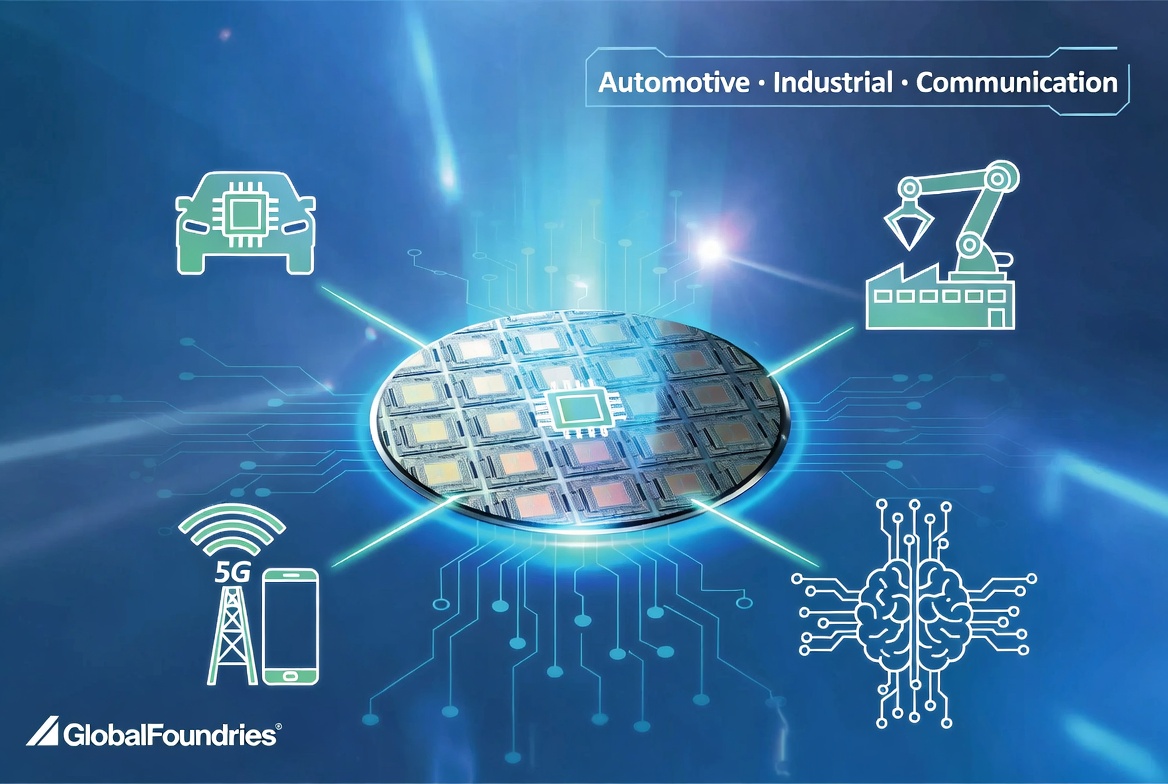
How GlobalFoundries Serves the Automotive Electronics Market
Automotive electronics have become one of GlobalFoundries’ most important application markets.
Modern vehicles often contain hundreds or even thousands of chips. These chips support engine control, battery management, body electronics, in vehicle infotainment systems, advanced driver assistance features, vehicle communications, and many other functions. As electric vehicles and smart cars develop rapidly, the semiconductor value per vehicle continues to rise.
Compared with consumer electronics, automotive chips face much higher reliability requirements. Vehicles often need to operate steadily for long periods in high temperatures, low temperatures, humidity, and complex road conditions. For this reason, automakers pay close attention to long term chip supply and quality certification systems.
GlobalFoundries has long been building automotive grade manufacturing platforms and maintains partnerships across the global automotive supply chain. Many automotive control chips, sensor chips, power management chips, and communications chips are produced using GlobalFoundries’ mature process technologies.
Why Industrial Equipment Relies on Mature Node Chips
Industrial automation is one of the most important application scenarios for mature node chips.
Factory robots, CNC machine tools, power control systems, industrial sensors, and smart manufacturing equipment often have product lifecycles of more than ten years. For these systems, long term stable operation matters far more than pursuing maximum computing performance.
As a result, many industrial chips do not use the most advanced process nodes. Instead, they rely on mature process platforms that have been validated over many years. Mature nodes not only offer higher yields, but also support longer supply cycles, helping industrial customers reduce operational risk.
GlobalFoundries has long been deeply involved in the industrial market, providing manufacturing services for industrial controllers, analog chips, power management chips, and sensor solutions. As the Industrial Internet of Things and smart manufacturing continue to develop, demand in this area remains on a growth path.
How Communications Networks Use Chips Manufactured by GlobalFoundries
Communications networks are one of the application areas where GlobalFoundries’ technical strengths are most visible.
Mobile base stations, fiber optic communications equipment, and wireless connectivity modules all require large numbers of RF chips and network processing chips. RF devices are responsible for transmitting and receiving signals, making them indispensable components of modern communications systems.
GlobalFoundries has long developed specialty technology platforms such as radio frequency silicon on insulator, RF SOI, and has become an important participant in global RF chip manufacturing. Many wireless connectivity modules in smartphones, as well as key RF devices in 5G infrastructure, may be produced using GlobalFoundries manufacturing technologies.
As global communications networks continue to upgrade, demand for RF chips and connectivity chips continues to expand, further strengthening GlobalFoundries’ importance in the communications market.
What Application Needs Do IoT and Edge Devices Have?
The development of the Internet of Things is driving strong growth in demand for low power chips.
Smart home devices, wearables, industrial sensors, logistics tracking systems, and smart city infrastructure all rely on connectivity chips and control chips to enable data collection and communication. These devices usually emphasize low power consumption, small size, and long term stable operation.
For IoT devices, advanced process nodes are not the only option. Many applications place more emphasis on cost control and energy efficiency, so mature process platforms still have broad practical value.
The low power process platforms offered by GlobalFoundries can meet the needs of large scale IoT terminal deployment. They also support edge computing devices in processing some data locally, reducing pressure on network transmission.
Why the AI Era Still Needs Mature Node Chips
The development of artificial intelligence has increased demand for advanced process chips, but mature node chips remain an important part of the AI ecosystem.
The market often focuses on high performance GPUs and AI accelerators used to train large models. Yet complete AI infrastructure also requires many supporting chips. Network switching chips, power management chips, RF devices, memory controllers, and sensor chips are all important parts of running AI systems.
Data center construction relies not only on advanced computing chips, but also on large numbers of mature node devices to support power supply, cooling, network connectivity, and system management. Meanwhile, many control chips used in AI edge devices, industrial robots, and smart vehicles are still mainly manufactured on mature nodes.
Therefore, even as artificial intelligence drives rapid growth in advanced process technologies, the mature node market still has a long term demand base. This is one of the key reasons GlobalFoundries can continue to maintain market competitiveness.
How to Buy GFS (GlobalFoundries) Stock
GFS is listed and traded on the U.S. Nasdaq market and is one of the world’s major wafer foundry companies.
Traditionally, investors can buy GFS shares through brokerage accounts that support U.S. stock trading, gaining exposure to opportunities in the global semiconductor manufacturing industry. Since GlobalFoundries serves multiple markets, including automotive electronics, industrial automation, and communications networks, its business performance is often closely tied to global semiconductor demand and manufacturing industry trends.
As digital assets and traditional financial markets gradually converge, more trading tools linked to stock price movements have also emerged. For example, some platforms offer CFD products tied to stock prices, allowing users to participate in market price movements without directly holding the underlying shares.
Taking Gate TradFi as an example, users can follow not only the digital asset market, but also traditional financial assets such as stocks, ETFs, indices, and commodities within the same ecosystem. Some markets also offer Gate CFD products, providing more options for cross market asset allocation.
Regardless of how investors participate in the market, they should fully understand the product structure, trading rules, and regulatory requirements in their region.
Conclusion
Although GlobalFoundries (GFS) does not directly design chips, its manufacturing capabilities are deeply integrated into the global digital economy. From automotive electronics and industrial automation to communications networks, IoT, and AI infrastructure, many critical chips rely on GlobalFoundries’ mature process nodes and specialty technology platforms for production. As industries worldwide continue to digitalize, stable and reliable semiconductor manufacturing capacity will remain an important pillar of modern supply chains.
FAQs
What types of chips does GlobalFoundries mainly produce?
GlobalFoundries mainly manufactures automotive chips, RF chips, industrial control chips, power management chips, communications chips, and IoT related semiconductor devices.
Does GlobalFoundries produce AI chips?
GlobalFoundries does not focus on manufacturing advanced AI GPUs, but it does produce networking, communications, and control chips needed to support AI infrastructure.
Why does the automotive industry need GlobalFoundries’ manufacturing capabilities?
Automotive electronics require long term supply and high reliability validation. GlobalFoundries’ mature process platforms can meet the automotive industry’s requirements for stability and safety.
How do communications networks use chips manufactured by GlobalFoundries?
RF chips, wireless connectivity modules, and some network equipment chips used in communications networks may be produced using GlobalFoundries technologies.
Why do IoT devices use so many mature node chips?
IoT devices usually care more about low power consumption, cost control, and long term stable operation, so mature process nodes still have broad application value.
What are GlobalFoundries’ core markets?
GlobalFoundries’ core markets include automotive electronics, industrial automation, communications networks, IoT, and parts of the data center infrastructure sector.