As global capital markets undergo digital transformation, embrace intelligent technologies, and shift toward structural realignment, investment banking is evolving from traditional relationship-driven models to a new paradigm that integrates data, technology, and specialized expertise. AI, big data analytics, and automation tools are revolutionizing trading research, risk management, and client service processes—significantly boosting financial institutions’ efficiency in handling complex transactions.
Against the backdrop of rising corporate financing demand, a revitalized M&A market, and ongoing global industry restructuring, Goldman Sachs maintaining its capital markets edge offers a critical lens for understanding the competitive dynamics of modern investment banking.
What Is Investment Banking
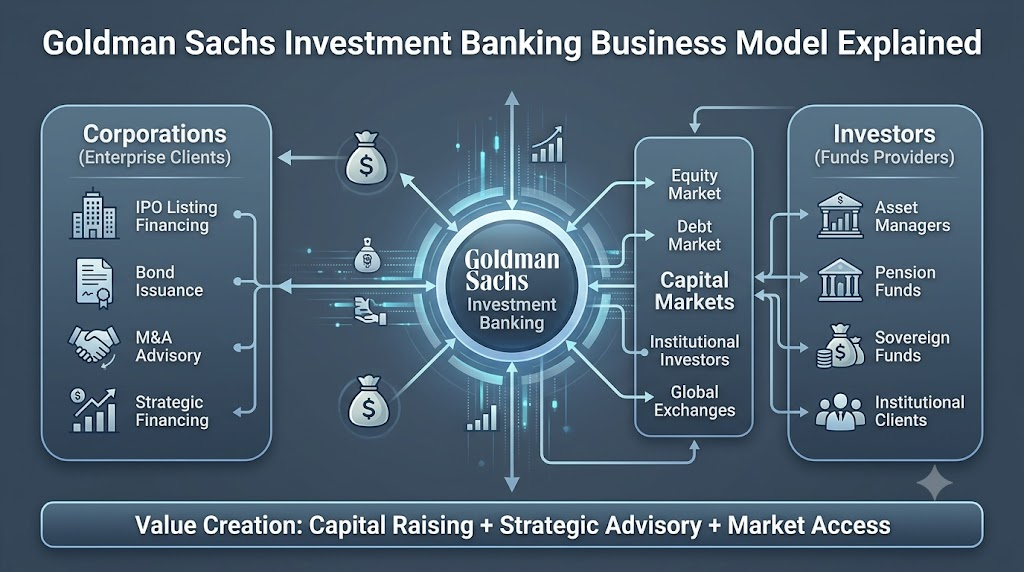
Goldman Sachs’ investment banking division delivers capital markets services to corporations, governments, and institutional clients. Its core functions include facilitating corporate financing, driving M&A transactions, structuring capital, and providing strategic advisory.
Unlike commercial banks, which primarily earn profits from deposit and loan activities, investment banks do not directly offer traditional loans. Instead, they generate value by connecting capital seekers with capital providers. For instance, when a company aims to go public and raise funds, an investment bank helps design the IPO plan, set the offering price, engage investors, and execute the stock issuance.
Investment banking typically centers around three main areas: equity financing, debt financing, and M&A advisory.
Equity financing helps companies raise capital by issuing shares, such as through initial public offerings (IPOs) and follow-on offerings. Debt financing involves issuing corporate bonds to secure long-term funding from the capital markets. M&A advisory supports companies in acquisitions, mergers, and strategic restructuring.
For major global enterprises, investment banks serve not only as financing channels but also as strategic partners. Complex transactions often require corporate valuation, market analysis, legal coordination, and risk management—necessitating the expertise of specialized financial institutions.
How Goldman Sachs Engages in IPOs, M&A, and Capital Financing
IPOs are a cornerstone of Goldman Sachs’ investment banking business. Companies transitioning from private to public status must undertake extensive preparations, including financial planning, market positioning, regulatory engagement, and investor relations management.
Goldman Sachs typically acts as an underwriter for IPOs, crafting issuance strategies and connecting clients with institutional investors. Leveraging its robust capital markets resources, the firm helps companies enhance market visibility and optimize their fundraising process.
In recent years, the rapid growth of AI, biotech, and energy transition sectors has fueled demand for tech company IPOs, positioning investment banks as increasingly vital players in new economy financing.
Beyond IPOs, corporate M&A is another core business for Goldman Sachs. When companies seek to expand market share, enter new sectors, or optimize asset structures, M&A transactions become essential strategic tools.
During M&A deals, Goldman Sachs provides target company valuation, transaction structuring, negotiation support, and financing solutions. Large cross-border M&A transactions often involve billions of dollars and require coordination across multiple markets and financial resources.
In capital financing, Goldman Sachs assists clients in issuing stocks and bonds, as well as designing structured financing solutions—enabling companies to select the most suitable capital instruments for their stage of development.
Why Global Enterprises Choose Goldman Sachs
Goldman Sachs’ sustained leadership in global investment banking is closely linked to its brand reputation, client network, and transaction capabilities.
-
Global enterprises highly value the market credibility of investment banks. Large-scale financing and M&A deals involve substantial capital; failed transactions can impact long-term corporate growth. As a result, companies prefer financial institutions with deep experience and proven track records.
-
Goldman Sachs maintains a client network spanning all major economies. Whether serving US tech firms, European industrial groups, or large Asian enterprises, the firm leverages global resources to support cross-border transactions.
-
Goldman Sachs excels in executing complex financial transactions. Modern corporate financing is no longer limited to issuing stocks or bonds—it involves capital structure optimization, risk management, and long-term strategic planning.
-
Goldman Sachs is influential in industry research. To advise clients effectively, investment banks must have a deep understanding of sector trends. Goldman Sachs covers technology, energy, healthcare, and consumer sectors, amassing extensive market data and expertise.
How the M&A Market Drives Investment Banking Growth
The M&A market is a major contributor to investment banking revenue.
When economic conditions are stable and corporate confidence is strong, companies are more inclined to acquire competitors, enter new markets, or integrate supply chains for growth. Increased M&A activity translates into higher advisory fees for investment banks.
Recently, global industry structures have been shifting. AI, semiconductors, energy transition, and digital infrastructure are emerging as key battlegrounds, with companies pursuing M&A to secure technology, market share, and strategic resources.
For example, the rise of AI drives companies to seek hashrate, chips, software, and data resources—fueling M&A demand in related sectors. Energy transition is prompting traditional energy firms and new energy companies to consolidate assets.
However, the M&A market is sensitive to interest rate environments and economic cycles. When financing costs rise and market uncertainty grows, companies may delay major deals, causing investment banking revenues to decline.
M&A activity is thus regarded as a critical indicator of investment banking sector health.
How Goldman Sachs Serves Institutional Clients
Goldman Sachs’ primary clients include large corporations, government agencies, pension funds, asset managers, insurance companies, and other financial institutions.
For corporate clients, Goldman Sachs provides capital market financing, strategic advisory, and risk management services. For example, a company planning overseas expansion can receive tailored financing solutions and market analysis.
For institutional investors, Goldman Sachs delivers market research, trade execution, and financial product services. Large funds require high-quality market intelligence and liquidity support, which the firm supplies through its professional trading capabilities.
Governments and public agencies are also key investment banking clients. Governments may need to issue bonds to finance infrastructure projects, and investment banks facilitate these capital market operations.
As financial markets grow more complex, institutional clients increasingly rely on comprehensive financial services—not just single transaction execution.
How Goldman Sachs Differs from JPMorgan and Morgan Stanley
Goldman Sachs, JPMorgan, and Morgan Stanley are all global financial leaders, but their business focuses differ.
Goldman Sachs specializes in investment banking and capital markets, with strengths in IPOs, M&A, trading, and institutional client services.
JPMorgan Chase operates a full-scale commercial banking platform, including retail banking, credit cards, corporate loans, and investment banking—resulting in a more diversified revenue mix.
Morgan Stanley’s business model is similar to Goldman Sachs, emphasizing investment banking and wealth management. In recent years, Morgan Stanley has expanded its wealth management business, stabilizing its income structure.
In essence, Goldman Sachs is a global capital markets specialist, while JPMorgan is a comprehensive financial conglomerate.
Challenges Facing the Investment Banking Sector
Despite high barriers to entry, investment banks face several challenges.
-
Macroeconomic conditions are highly impactful. Changes in interest rates, economic growth, and market volatility affect corporate financing and M&A appetite.
-
Regulatory pressures are intensifying. Post-financial crisis, regulators have strengthened capital requirements, risk controls, and business transparency for major financial institutions.
-
Technology is reshaping traditional investment banking. AI and automation tools enhance analytical efficiency but may reduce demand for some basic financial roles.
-
Industry competition remains fierce. Global banks vie for corporate clients and capital market share, while emerging fintech companies are entering select financial service segments.
Future Directions for Goldman Sachs Investment Banking
Goldman Sachs’ investment banking business is set to focus on global expansion, technological innovation, and servicing emerging industries.
AI will be a pivotal technology for investment banks. AI-driven research, automated data processing, and intelligent risk analysis will enhance transaction efficiency.
Emerging industry financing needs are expected to unlock new growth opportunities. AI, semiconductors, clean energy, and digital infrastructure are attracting substantial capital, fueling corporate financing and M&A demand.
Goldman Sachs is also strengthening asset management and wealth management to reduce reliance on cyclical capital markets.
Going forward, investment banking competition will be defined by financial expertise, data capabilities, and technological strength—not merely capital scale.
How to Invest in Goldman Sachs (GS) via Gate Stock Trading
As global investors increasingly seek US equity exposure, traditional financial markets are converging with digital asset ecosystems. Gate Stock Trading enables users to participate in global equity markets, supporting USDT trading for US stocks—including Goldman Sachs (GS).
Gate Stock Trading offers access to over 11,000 stocks and ETFs, including 10,000+ US stocks and ETFs and 1,000+ Hong Kong stocks, covering major markets such as NYSE, Nasdaq, NYSE Arca, NYSE American, and BATS. Investors interested in Goldman Sachs’ investment banking performance can directly tap into long-term growth opportunities in the financial sector.
The platform also supports fractional share trading, with a minimum purchase of 0.01 shares, allowing investors to flexibly allocate GS stock based on their capital. Gate Stock Trading provides a 24/7 trading experience—covering pre-market, after-hours, overnight, and weekend trading—to offer global investors greater flexibility in asset management.
However, stock investments remain subject to company performance, capital market cycles, macroeconomic conditions, and regulatory policies. Investors should assess Goldman Sachs’ long-term competitiveness and industry trends in line with their risk tolerance.
Summary
Goldman Sachs’ investment banking division is a cornerstone of global capital markets, connecting companies with global capital through IPOs, M&A advisory, capital financing, and institutional services.
Leveraging its enduring brand strength, global client network, and expertise in complex transactions, Goldman Sachs maintains its leadership in investment banking. As AI, big data, and fintech drive industry transformation, future competition will increasingly depend on technology and data capabilities.
With ongoing global corporate financing needs, emerging industry investments, and M&A market shifts, Goldman Sachs’ ability to sustain core competitiveness will hinge on balancing traditional financial strengths with technological innovation. For investors, understanding the investment banking business model is essential to analyzing the long-term value of GS stock.