gStocks Tokenized Stocks defines its role within the overall architecture from a product landscape perspective. To verify asset mapping, you need to break down how reserves correspond, how issuance and redemption are linked, how bidirectional conversion works, and which information channels allow cross-verification.
What Is 1:1 Backing for gStocks?
1:1 backing means that the circulating supply of gStocks matches the number of underlying real stock reserves on a one-to-one basis. The platform enforces a fully-backed 1:1 real stock reserve standard, ensuring token issuance cannot expand without constraint—any increase in circulation must be supported by corresponding real stock deposits or reserve transfers.

Backing answers the question, “What does each token unit represent?” gStocks held by users are not unsupported virtual certificates; they are tokenized securities units pegged to specific stocks and backed by real stock reserves. This mechanism is directly tied to the real stock reserve narrative highlighted in gStocks vs Traditional Stocks vs CFD, as CFDs typically lack equivalent reserve structures.
| Concept |
Meaning |
User Understanding |
| 1:1 Correspondence |
1 gStocks ≈ 1 share of underlying target (per product rules) |
Cantidad en tenencia can be mapped to real stock exposure |
| Fully Backed |
All circulating tokens are supported by real stocks |
No unconstrained issuance |
| Target Binding |
Each gStocks type is linked to a specific stock |
Code and name must be verified |
The table above summarizes the three core dimensions of backing. Each gStocks product corresponds to a different underlying stock; trading and verification must be based on specific codes and cannot be mixed.
How Does the Reserve Model Work? What Are the Issuance and Redemption Paths?
The reserve model operates on a simple logic: when users acquire gStocks through the platform, corresponding real stocks are added to the reserve pool; when users redeem or convert to native stocks, the reserve is released accordingly. Issuance and redemption are governed by the platform’s reserve management system, ensuring that changes in circulation are synchronized with changes in reserves.
Mechanically, the reserve pool functions as “asset custody + mapping bookkeeping”: real stocks are stored in the reserve system, gStocks circulate within platform accounts, and the two are matched via the 1:1 rule. Users don’t need to operate the reserve pool directly, but understanding this process helps clarify the asset support behind their holdings.
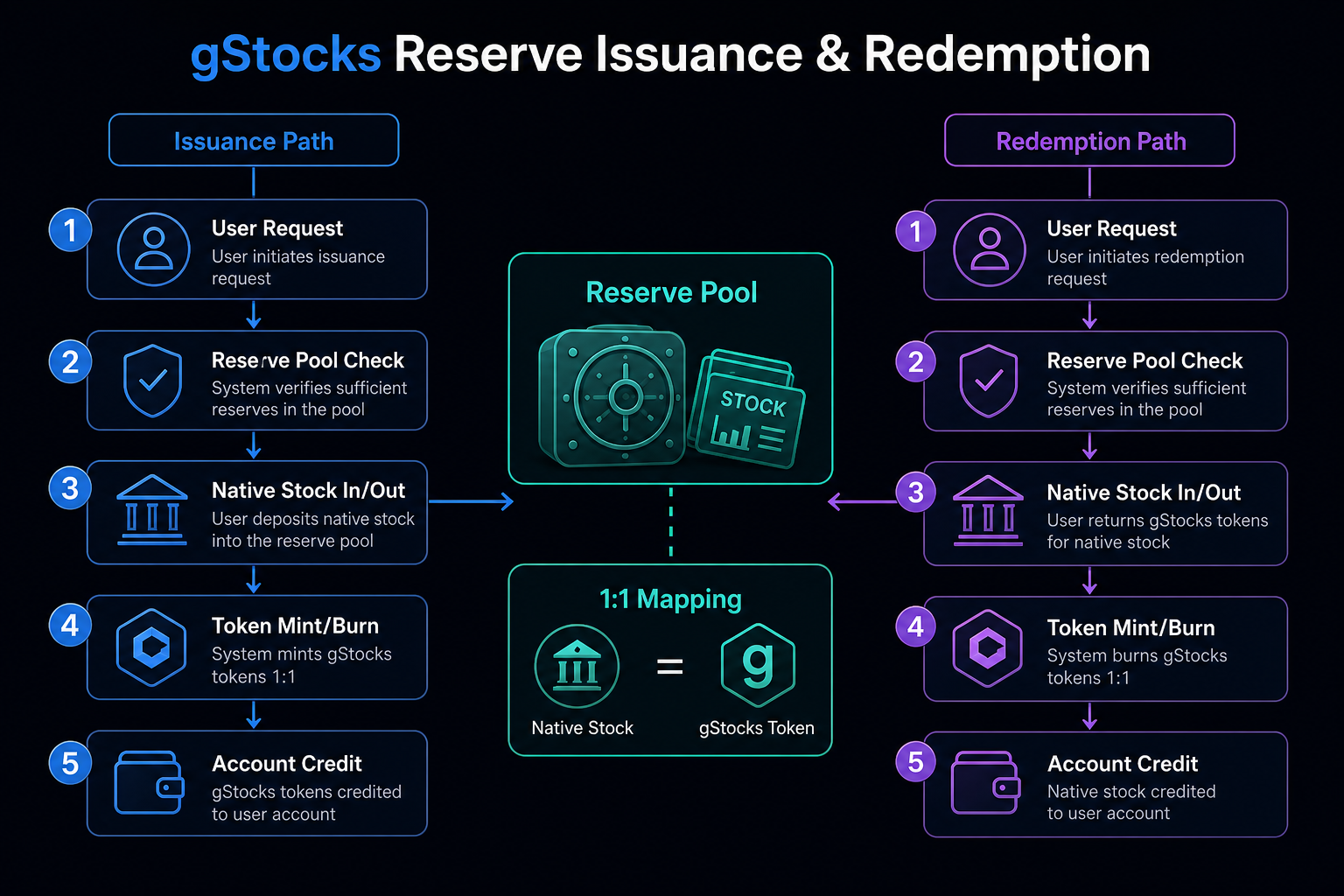
Figure 1. gStocks reserve pool, issuance/redemption, and 1:1 token mapping flow.
What Is Bidirectional Conversion? How Do Stocks and gStocks Switch?
The platform is designed to support free 1:1 bidirectional conversion between stocks and gStocks: users can switch between native stock holdings and tokenized units without liquidating and rebuilding positions in another form. Bidirectional conversion reduces the operational cost of changing forms, enabling gStocks to serve as both trading and allocation tools, and to revert to traditional stock holdings as needed.
The actual status of the conversion feature, trading fees, slippage, and processing time are subject to the Gate product page and official announcements. The planned “free and no slippage” description reflects product design intent; users should confirm whether the feature is available before use. The conversion process involves reserve transfers and account bookkeeping; after completion, users should verify that the quantities in both forms match in their holdings section.
How Can Users Verify the Relationship Between Reserves and Holdings?
To verify the backing relationship, users should check three aspects: reserve standards in the product documentation, the relationship between gStocks holdings in their account and the underlying target, and whether corporate actions (such as dividends) are consistent with rules for the underlying asset. Gate, as the issuing and trading platform, must disclose reserve management principles through public channels; user holding records should reflect the types and quantities of gStocks owned.
Transparency of the backing mechanism does not mean users can freely audit the physical reserve warehouse. Users typically rely on platform disclosures, account reconciliation, and product terms to understand the mapping relationship, rather than directly inspecting the custody warehouse. If there are questions about the reserve standards for a particular asset, confirmation should be based on Gate’s official statements and customer support channels.
After completing the Gate gStocks trading process, users can cross-check the types and quantities of their holdings with the backing standards disclosed on the product page, establishing a repeatable habit for verifying holdings.
What Are Common Misconceptions About 1:1 Backing?
Misconception 1: Backing means no risk. 1:1 reserves address asset correspondence and support, but price fluctuations of underlying stocks will still affect the market value of gStocks. Risks such as liquidity and rule changes remain.
Misconception 2: Backing means full shareholder rights. Whether governance rights like voting and shareholder meeting participation apply fully in tokenized form depends on product terms and cannot be assumed to be equivalent to direct shareholding.
Misconception 3: Conversion is always zero-cost and instant. The planned bidirectional conversion is intended to be free and without slippage, but feature availability, processing time, and exceptions are subject to actual online rules.
Misconception 4: All gStocks share a single reserve pool. Different gStocks products correspond to different underlying stocks; reserves are managed separately by asset and cannot be used interchangeably.
gStocks Risk and Compliance Boundaries provides further explanation on risk checklists. When evaluating the backing mechanism, “clear mapping” and “controllable risk” should be considered independently.
Summary
gStocks’ 1:1 backing establishes a bridge between underlying stocks and tokenized units through the correspondence of real stock reserves and circulating tokens. Issuance, redemption, and reserve linkage, as well as bidirectional conversion, support form switching. Users should pay attention to product disclosures, holding records, and conversion rules when verifying, and avoid equating backing with no risk or full shareholder rights.
FAQ
Is gStocks Truly 1:1 Backed by Real Stocks?
gStocks implements a fully-backed 1:1 real stock reserve standard, keeping circulating tokens aligned with underlying reserves. This ensures token units are supported by real stocks, but does not eliminate market risks from price fluctuations of the underlying asset.
Can Stocks and gStocks Be Converted to Each Other?
The platform is designed to support free 1:1 bidirectional conversion between stocks and gStocks, allowing users to switch between the two forms of holdings. Feature availability, trading fees, and processing rules are subject to the Gate product page and official announcements.
Does 1:1 Backing Mean Holding gStocks Is Risk-Free?
No. Backing addresses asset mapping and reserve support; market risk, liquidity risk, rule risk, and operational risk still objectively exist. Backing does not mean price stability, nor does it guarantee any capital outcomes.
How Can I Confirm Which Stock My gStocks Holdings Correspond To?
Check the gStocks type code and name in the holdings section of your Gate account, and cross-verify with the underlying stock code and company name. Different gStocks correspond to different underlying stocks and cannot be mixed.
Where Can I View Reserve Information?
Reserve management principles and product descriptions are typically disclosed in Gate announcements, product pages, and the Help Center. Account holding records show the types and quantities of gStocks held, which can be cross-verified with the backing standards in the product description.