Tires are one of the few key auto components that need to be replaced continuously throughout a vehicle’s life. Even when vehicle sales fluctuate, the vast number of vehicles already in use worldwide still requires regular maintenance and tire replacement. As a result, the tire industry can benefit from the development of automotive manufacturing while also relying on the aftermarket for long term revenue.
In recent years, with the development of connected cars, electric vehicles, and digital fleet management, tire companies have gradually expanded their business scope from product manufacturing to data services and mobility solutions. Goodyear is one of the representative companies in this industry transformation.
GT is the stock ticker of Goodyear Tire & Rubber Company. Headquartered in Akron, Ohio, the company is one of the oldest tire manufacturers in the world.
Since its founding in 1898, Goodyear has gradually grown into a tire brand with operations across many countries and regions. Its products cover passenger car tires, SUV tires, light truck tires, commercial vehicle tires, construction machinery tires, aviation tires, and other segments. Its long accumulated brand influence and manufacturing capabilities have made Goodyear an important supplier in the global automotive supply chain.
Compared with some competitors that focus on premium markets or regional markets, Goodyear follows a more comprehensive market strategy, serving automakers, transportation companies, and end consumers at the same time. As a result, the company’s revenue does not depend on a single customer group, but comes from contributions across multiple market segments.
What Are Goodyear’s Revenue Sources
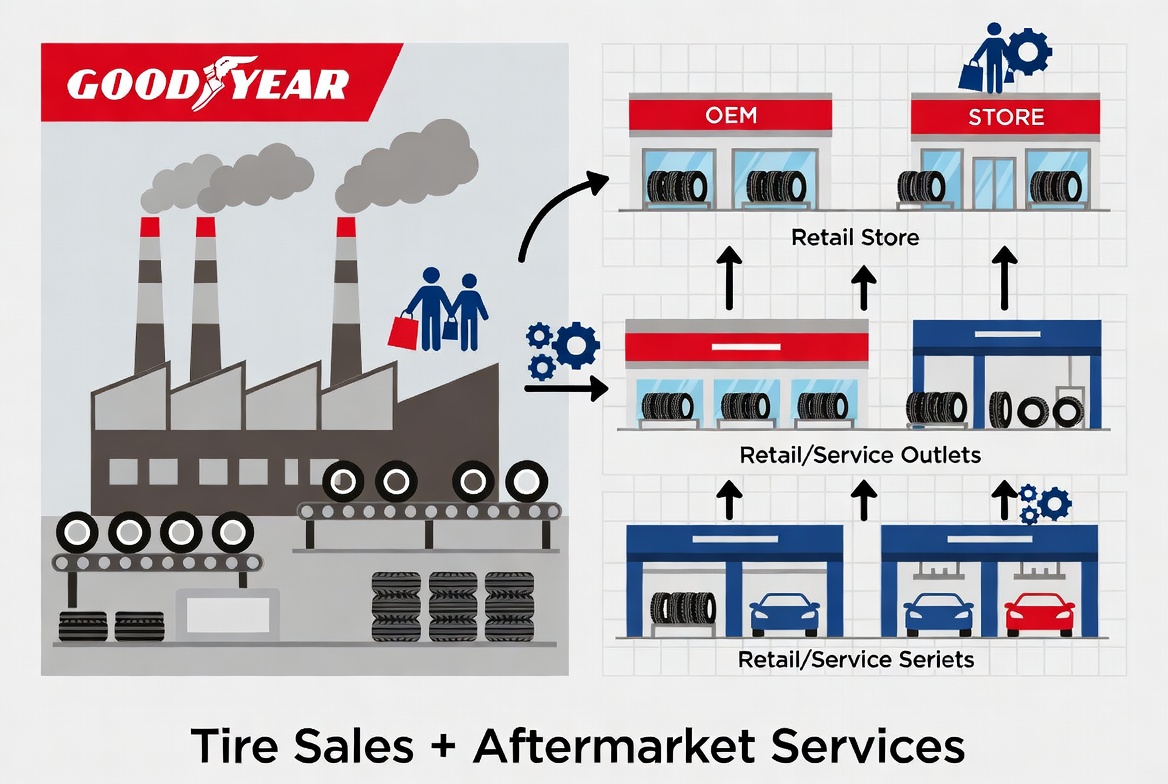
Goodyear’s revenue mainly comes from tire sales and related service businesses, with tire products remaining its core source of revenue. From a business model perspective, however, Goodyear actually participates in two important parts of the automotive supply chain: the original equipment manufacturer market, or OEM market, and the replacement tire market.
The OEM business mainly supplies tire products to automakers. When automakers produce new vehicles, they need to purchase tires that meet model specific requirements as original equipment, so major tire companies usually build long term partnerships with automotive brands.
The replacement tire market, on the other hand, directly serves vehicle users. Because tires wear down as mileage increases, consumers and fleet operators need to replace them regularly. Compared with the OEM business, the replacement market usually has higher margins and more stable demand.
In addition, commercial vehicle services, fleet management solutions, and digital services are becoming new supplementary revenue sources, gradually expanding Goodyear’s business model from product sales toward service based revenue.
| Revenue Segment |
Main Business |
| OEM business |
Original equipment tires for new vehicles |
| Replacement market |
Tire replacement and retail sales |
| Commercial vehicle business |
Logistics fleets and transportation services |
| Specialty tires |
Construction machinery and aviation tires |
| Digital services |
Fleet management and data solutions |
How the OEM Tire Business Generates Revenue
The original equipment market is an important entry point for tire companies into the automotive supply chain.
When automakers launch new vehicle models, they need to rigorously test tire performance, safety standards, durability, and energy efficiency. As a result, tire companies that enter automaker supply chains usually have strong technical capabilities. Goodyear has long supplied original equipment tires to many global automotive brands. This not only generates direct sales revenue, but also helps improve brand recognition.
For tire companies, the greatest value of the OEM business lies not only in sales volume, but also in brand exposure. The tire brand consumers first encounter when buying a new car often influences their choice when replacing tires later. In this sense, the original equipment market is also an important channel for acquiring long term customers.
However, the OEM business usually faces significant price competition, because automakers often have strong bargaining power. For this reason, tire companies usually need the follow on replacement market to improve overall profitability.
How the Replacement Tire Market Contributes to Long Term Growth
The replacement tire market is considered one of the most important profit sources in the tire industry.
Unlike new vehicle sales cycles, replacement tire demand is more closely tied to the number of vehicles in use worldwide. Even when auto sales growth slows, vehicles already on the road still need tire replacement based on actual use, so demand is relatively stable.
This business model gives the tire industry certain consumer goods characteristics. When consumers replace tires, they usually pay more attention to brand reputation, safety performance, and user experience, so well known brands often gain higher market share.
For Goodyear, its global sales network and aftermarket service system allow it to compete in the replacement market over the long term. As the global vehicle parc continues to grow, the replacement tire market remains an important foundation supporting the company’s revenue.
How Commercial Vehicle and Fleet Businesses Improve Profitability
Beyond the ordinary consumer market, commercial transportation is also an important business area for Goodyear.
Logistics companies, passenger transport operators, construction transport companies, and large fleets often operate many vehicles, so they have higher requirements for tire durability, operating cost, and maintenance efficiency. Compared with individual consumers, these customers usually purchase in bulk and build long term partnerships.
Commercial vehicle tires not only carry higher unit prices, but are also often accompanied by demand for tire maintenance, monitoring, and management services. As a result, tire companies can improve overall profitability through service revenue beyond product sales.
For large transportation fleets, tire wear has a direct impact on fuel costs and vehicle operating efficiency, so more companies are adopting digital tire management systems. This also creates new opportunities for Goodyear to expand its service based businesses.
How Tire Services and Digital Solutions Expand the Revenue Structure
With the development of smart mobility and connected vehicle technologies, tire companies are transforming from traditional manufacturers into integrated mobility service providers.
In recent years, Goodyear has continued to invest in digital solutions, including tire monitoring systems, fleet management platforms, and predictive maintenance services. These technologies help enterprise customers monitor tire conditions in real time, reduce failure risks, and improve operating efficiency.
Unlike one time tire sales, digital services usually use long term subscription or ongoing service models, allowing them to create more stable recurring revenue. For capital markets, recurring revenue often means stronger revenue predictability.
As autonomous driving, smart logistics, and connected vehicles continue to develop, data services may become even more important in the tire industry. For Goodyear, this means its business model is gradually expanding from manufacturing oriented to service oriented.
How to Buy GT (Goodyear Tire & Rubber) Stock
GT is listed and traded on the Nasdaq market, making it one of the important listed companies in the global tire industry and automotive supply chain.
Investors can usually buy GT stock through brokerage accounts that support U.S. stock trading, and participate in the potential returns and risks related to the tire industry, automotive supply chain, and global transportation market development.
As digital assets and traditional financial markets gradually converge, more trading tools linked to stock price movements have also appeared in the market. For example, some platforms offer CFD products linked to related stock prices, allowing users to participate in market movements through price changes without directly holding the underlying shares.
Taking Gate TradFi as an example, users can follow not only the digital asset market, but also traditional financial assets such as stocks, ETFs, indices, and commodities within the same ecosystem. Some markets also offer Gate CFD products, allowing users to participate in price movement trading for related assets through a digital asset account.
No matter how investors choose to participate in the market, they should fully understand the product structure, trading rules, liquidity conditions, and regulatory requirements in their region.
Conclusion
Goodyear’s business model is built on tire manufacturing, aftermarket services, and long term customer relationships. The OEM business helps the company enter the automotive supply chain, the replacement tire market provides stable cash flow, and commercial vehicle services and digital solutions create new room for future growth. As the automotive industry moves toward electrification and intelligence, the role of tire companies is gradually expanding from traditional component suppliers into integrated mobility service providers.
FAQs
What Businesses Does Goodyear Mainly Make Money From?
Goodyear mainly earns revenue from original equipment tire sales, the replacement tire market, commercial vehicle businesses, and tire related services.
Why Is the Replacement Tire Market Important to Goodyear?
The replacement tire market depends on the number of vehicles in use worldwide rather than relying only on new vehicle sales, so it usually provides a more stable and continuous revenue source.
What Does OEM Business Mean?
OEM, or Original Equipment Manufacturer, business refers to providing original equipment tires to automakers. It is an important channel for tire companies to enter the automotive supply chain.
How Does the Commercial Vehicle Business Improve Profitability?
Commercial vehicle customers usually purchase at larger scale and require long term maintenance and management services, which can create higher value added revenue for tire companies.
Is Goodyear Expanding into Digital Businesses?
Yes. Goodyear has begun offering digital solutions such as tire monitoring, fleet management, and predictive maintenance to expand revenue sources beyond traditional tire sales.
Will Electric Vehicles Affect Goodyear’s Business Model?
Yes. Electric vehicles place higher demands on tire wear resistance, rolling resistance, and noise reduction, while also driving growth in demand for smart tires and data services.