Unlike traditional Layer-1 blockchains that primarily position tokens as Gas fee vehicles, HANA embodies the tokenomics of an "experience-driven public chain": user value originates from social interaction, gamified tasks, and P2P fiat on/off ramps, while the token converts these behaviors into measurable, allocable, and governable on-chain equity. Without incentives and unlock schedules tied to real engagement, SocialFi projects often suffer from "idle points and token sell pressure." Hana's model aims to mitigate this structural tension through a high community allocation, phased ecosystem releases, and a protocol revenue feedback mechanism currently under exploration by the foundation.
From a blockchain and digital asset industry perspective, HANA's tokenomics reflects a "growth-is-governance" approach in the Web4 context: by linking user acquisition, retention, and governance participation via a 51% community share alongside the layered design of Hana Points and HANA, while team and investor allocations follow a 12–24 month linear unlock to balance early capital returns with long-term sell pressure. The sections below sequentially examine HANA's functional role, distribution and incentives, social rewards, user growth mechanics, value drivers, governance framework, investment risks, and long-term potential.
Core Functions and Uses of the HANA Token
HANA is not merely a gas token; within the Hana Network multi-product matrix, it serves the following roles (as per official and foundation public statements):
| Function Category |
Specific Use Case |
Ecosystem Role |
| Governance |
Proposal voting, parameter adjustments, treasury allocation |
Community-driven protocol evolution |
| Incentives |
Ecosystem growth, task rewards, contributor recognition |
Cold start and user retention |
| Utility |
Future advanced features (e.g., real-time redemptions) |
Product monetization and access thresholds |
| Staking |
Planned for network security and rewards |
Aligning long-term holders |
| Value Capture |
Protocol revenue feedback (under exploration) |
Tying activity to token demand |
Division of labor with Hana Points:
Hana Points are primarily earned through actions like Hanafuda deposits and task completion; they are application-layer points with lower barriers and faster feedback. HANA is the native on-chain asset, anchoring governance, trading, and cross-product value. Together they form a common Web3 growth funnel: "Points attract users → Tokens retain them." Whether a conversion or airdrop mechanism will be implemented depends on official announcements.
Network layer role:
As the native token of the Cosmos SDK chain, HANA will also function as a staking asset for validators and settle transaction fees, rolling out gradually as the mainnet governance module matures.
HANA Token Distribution and Incentive Mechanism
Total Supply and Allocation Structure
The total fixed supply of HANA is 1 billion tokens, allocated as follows (detailed breakdown per DropsTab / official sources):
| Category |
Percentage |
Amount (Approx.) |
Description |
| Ecosystem Growth |
30% |
300 million |
Partnerships, grants, long-term ecosystem building |
| Treasury |
20% |
200 million |
Strategic reserves, operations, emergencies |
| Team |
19% |
190 million |
Core contributors |
| Incentives |
16% |
160 million |
User and community activities |
| Community Total |
51% |
510 million |
Includes Ecosystem Growth + Incentives |
| Pre-seed |
8% |
80 million |
Early institutional investors |
| Pre Sale |
5% |
50 million |
Public sale before TGE |
| Strategic Round |
2% |
20 million |
Strategic investors |
| Investor Total |
~15% |
— |
Includes the three rounds above |
The community share exceeds half, aligning with the "growth-first" allocation typical of SocialFi and consumer-grade public chains. Team and Treasury together account for 39%, reserving resources for product iteration and market expansion.
Unlock and Vesting Schedule (Key Milestones)
After TGE on September 26, 2025, the unlock rules vary significantly by round:
| Round |
TGE Unlock |
Subsequent Vesting |
| Pre Sale (50 million) |
100% |
Fully circulating at TGE |
| Incentives (160 million) |
100% |
Fully released at TGE |
| Strategic Round |
Partial |
20-month linear |
| Pre-seed |
0% |
12-month linear |
| Team |
0% |
24-month linear |
| Treasury |
Partially released |
24-month linear |
| Ecosystem Growth |
0% |
Linear release after 12-month cliff |
As of the first half of 2026, approximately 29% of total tokens have been unlocked globally, with roughly 71% still in lockup or linear release. The circulating supply is around 240 million tokens (about 24% of total supply). Over the coming months to years, Ecosystem Growth (300 million) and Team (190 million) will be key sources of sell pressure to monitor.
Funding and Pricing Anchors
- Cumulative funding across rounds is approximately $6–$9 million (including incubation from Binance Labs / YZi Labs).
- The "No More CEX" round and pre-TGE sale had a unit price of about $0.04, corresponding to an FDV of roughly $40 million.
- The Early Access Sale in June 2025 raised approximately $2 million, with tokens fully unlocked at TGE.
The incentive mechanism is designed to use Incentives and Pre Sale liquidity for short-term exchange listings and market attention, while phased unlocks bind the team and ecosystem builders' interests over the medium to long term.
HANA's Role in Social Interaction and Ecosystem Rewards
Hana Network's Hypercasual Finance relies on social virality and low-barrier engagement. HANA and its supporting reward system function as follows:
-
Hanafuda (Card Lego)
Users deposit assets like ETH and USDC to earn Hana Points and Hanafuda cards, then form teams to compete for Tickets. On-chain data once showed over 400,000 unique addresses and tens of millions of deposit interactions, forming the demand foundation for HANA's economic model. The points system lowers the barrier for Newbies and may be linked to HANA in the future via airdrops, conversions, or access thresholds.
-
Hana Gateway (P2P Fiat On/Off Ramp)
Gateway serves as the fiat-to-crypto entry point. After completing P2P transactions, users enter the ecosystem's points and gaming environments. Gateway itself does not necessarily consume HANA, but it provides a "real user funnel" for the token economy.
-
Reunion (DeFi Quest)
Provides tasks and bounties for partnership agreements; HANA can be used as task settlement or incentive pool assets, strengthening the B2B growth flywheel.
-
Hana Play / Hana Rewards (Wallet Side)
In 2025–2026, the ecosystem expanded the XP reward system: Daily Check-Ins, multi-chain swaps, friend referrals, etc., accumulate XP. Top users on the Leaderboard earn weekly prizes in USDC (e.g., the Top 100 share a prize pool of over $500 each week). This approach uses stablecoin rewards to reduce volatility concerns while keeping trading behavior within the Hana Wallet ecosystem, building an active user base for HANA's long-term utility.
-
Social Platform Integration
The official team emphasizes integration with Twitter, Telegram, Discord, TikTok, etc. Social sharing, invites, and team mechanics amplify the viral coefficient of incentives—this is the key to whether the SocialFi token model succeeds, rather than simply boosting staking APY.
How HANA Drives User Growth and Community Engagement
HANA's growth model can be distilled into a "three-layer cycle":
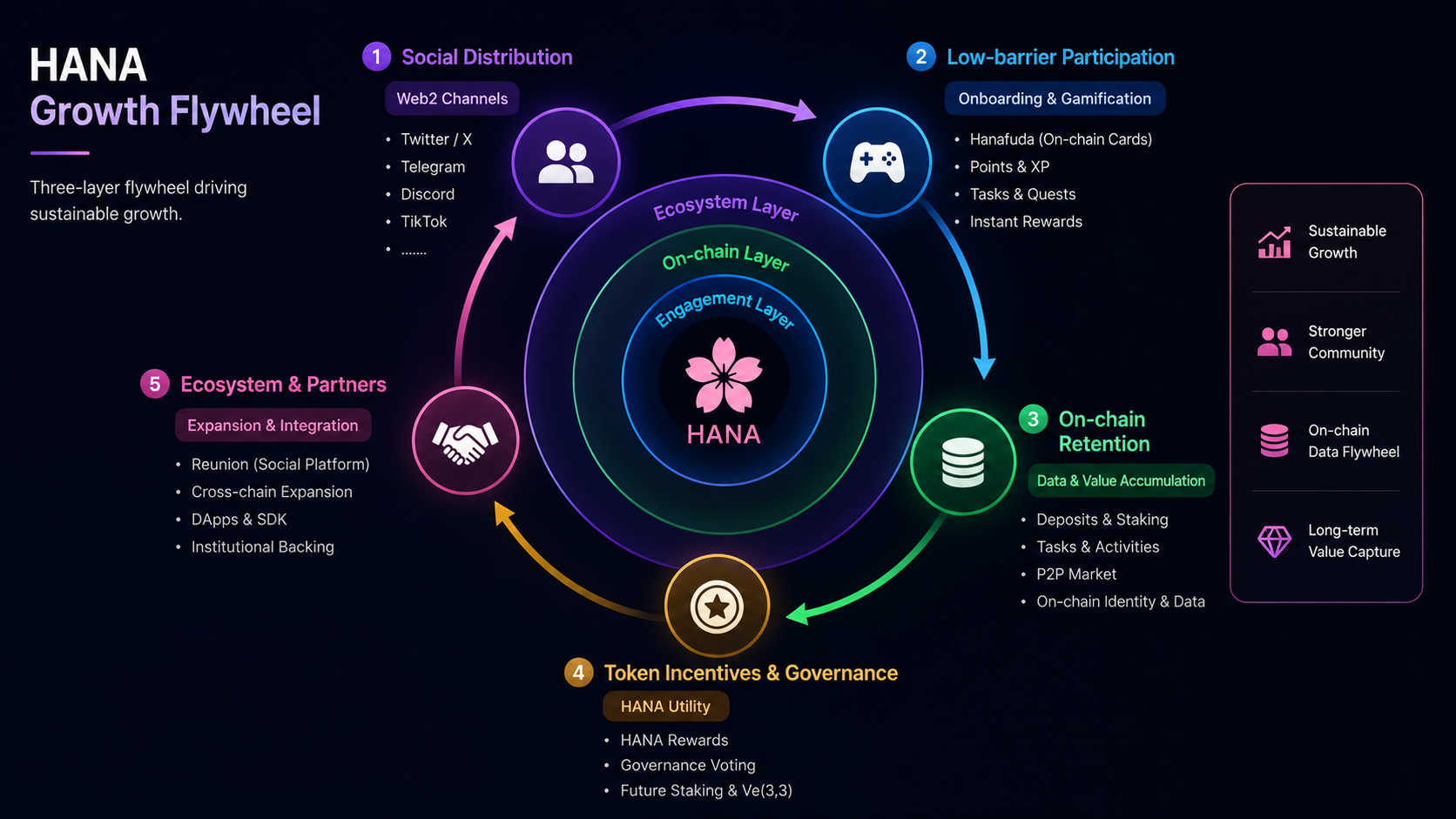
Specific mechanisms:
- Viral User Acquisition: Card collection, team competitions, and referral rebates align with hypercasual product logic, with marginal acquisition costs lower than traditional CEX paid campaigns.
- Behavior as Equity: Continuous check-ins, deposits, and task completion increase points and potential HANA rights, boosting retention.
- Institutional Backing: Incubation by Binance Labs and partnerships with Babylon, Osmosis, etc., build trust and aid exchange listings and liquidity (e.g., Binance Futures DCA robot supporting HANA in March 2026 lowered the barrier for Auto Invest).
- Phased Product Releases: After Capsule Shop (NFT Gacha) and Dipsy (Live) go live, tipping, clubs, and real-time interaction will create new HANA use cases (consumption, tipping, memberships, etc., based on actual launched features).
Track these key community engagement metrics: weekly active unique addresses on Hanafuda, Gateway transaction volume, Hana Play XP participation, HANA on-chain holder count changes, and governance proposal participation rates.
Key Factors Influencing HANA Token Value
HANA price is affected by multiple intertwined factors. The following is an objective analysis framework (based on market data from the first half of 2026; prices are highly volatile):
| Factor |
Side |
Description |
| Unlock sell pressure |
Bearish |
~71% still locked; Ecosystem Growth's 300 million will be released in batches |
| Ecosystem activity |
Bullish |
Hanafuda addresses, deposit volume, XP participation |
| Liquidity & exchange listings |
Bullish/Volatile |
CEX listings and derivative tools (e.g., Binance DCA) expand the trading community |
| Market sentiment |
Volatile |
Rose ~157% in a single week on HTX in January 2026; followed by significant pullbacks |
| Macro & BTC |
Correlated |
Small-cap tokens have high beta |
| Value capture implementation |
Long-term bullish |
Protocol revenue buybacks/staking dividends could improve supply-demand dynamics |
| Competition |
Uncertain |
Other SocialFi/GameFi L1s may divert users |
How the Hana Network Governance Mechanism Works
HANA governance is still in its early stages. The publicly available information outlines the following framework:
Participants
- HANA holders: Vote on proposals concerning protocol upgrades, economic parameters, treasury expenditures, etc.
- Hana Foundation: Responsible for ecosystem grants, partnerships, and strategic execution, with a stated aim for transparent treasury disclosure (official vision).
Typical Governance Matters (Expected Scope)
- Incentive pool allocation ratios and activity rules
- Ecosystem grants and partner onboarding
- Product priorities during mainnet phases (Capsule Shop, Dipsy, etc.)
- Staking parameters, Trading Fee structure, and protocol revenue distribution
Operating Principles (Official Tendency)
- Public proposal → voting → execution flow, with quorum and passing thresholds
- Auditable treasury spending to reduce "black box" allocations
Compared to mature DeFi protocols, the maturity of Hana's on-chain governance remains to be seen. Monitor the first governance proposal, voting participation rates, treasury multisig addresses, and whether governance fully integrates with the Cosmos SDK module. Governance effectiveness directly impacts the efficiency of the 20% Treasury and 30% Ecosystem Growth allocations, which in turn affects long-term trust in HANA.
Key Risks When Investing in HANA
- Unlock and Supply Shock: Incentives and Pre Sale were largely released at TGE; Ecosystem Growth, Team, and Pre-seed will continue linear unlocking over the next 12–24 months.
- High Price Volatility: Small-cap assets can swing by double-digit percentages daily; leverage and DCA tools amplify both gains and losses.
- Point-to-Token Transmission Uncertainty: If Swap rules for Hana Points to HANA underperform expectations, users may earn points while token price remains under pressure.
- Product Concentration: Growth is highly dependent on Hanafuda and Gateway; delays in Phase 2/3 products could weaken the narrative.
- Regulation: P2P fiat on/off ramps involve various countries' payment and KYC requirements, potentially affecting the user funnel.
- Competition and Narrative Fatigue: The SocialFi, blockchain gaming, and wallet reward spaces are crowded; user attention is scarce.
- Information Quality: Rely on hana.network and official Medium; beware of unofficial airdrop scams.
Disclaimer: The above content is for research reference only and does not constitute investment advice. Crypto assets may result in total loss of principal.
Long-Term Potential of the HANA Ecosystem
Favorable Conditions
- Clear track positioning: Web4 + Hypercasual Finance, targeting "the next billion users," differentiates from pure trading platforms.
- Product validated: Hanafuda once reached hundreds of thousands of addresses, proving casual finance can attract users.
- Community-focused token allocation: The 51% community share is relatively high among similar projects, supporting long-term incentives.
- Infrastructure attention: Binance Futures DCA integration, multi-chain wallet rewards, etc., enhance accessibility in 2026.
- Roadmap expansion: NFT gacha, live tipping, and real-world payments could expand HANA demand scenarios if implemented.
Key Deliverables to Watch
- Value capture loop: The foundation's "protocol revenue feedback to holders" is still in exploration; look for hard mechanisms like buybacks, staking dividends, or fee burns.
- Substantive governance: Can the 510 million HANA in Treasury and Ecosystem Growth be converted into sustainable development rather than short-term marketing?
- FDV and activity alignment: With only ~24% circulating, if active user growth lags behind unlock speed, valuation may face long-term pressure.
In the medium to long term, HANA's potential depends on whether Hana Network can convert social traffic into a verifiable on-chain economy and protocol revenue, rather than relying solely on exchange listings and short-term sentiment. If Phase 2 Capsule Shop and Phase 3 Dipsy replicate Hanafuda's growth curve, the token model could transition from "incentive-driven" to "utility-driven."
Summary
The core of the HANA tokenomics model is to drive Hana Network's social finance ecosystem using a fixed supply of 1 billion tokens, 51% community allocation, and layered incentives (Points / XP / HANA): short-term user acquisition via Incentives and product experience, medium-term builder alignment through phased unlocks, and long-term value capture via governance and protocol revenue mechanisms. As of the first half of 2026, roughly 70% of tokens have not yet fully entered circulation, the ecosystem is in early multi-phase mainnet expansion, and there is a clear divergence between price and fundamentals.
For researchers and investors, it is essential to track the unlock calendar, Hanafuda activity data, Gateway transaction volume, governance proposal progress, foundation revenue disclosures, and HANA adoption in derivatives and wallets. The tokenomics design provides a growth framework, but sustained ecosystem expansion ultimately depends on product-market fit and real user demand, not allocation ratios alone.