As AI Agent applications gradually move from single-task execution toward complex collaboration scenarios, demand for underlying infrastructure is rising quickly. In the past, most AI Agents mainly handled simple automation tasks. But in emerging scenarios such as AI games, autonomous economic systems, and multi-agent collaboration networks, a single agent is no longer enough.
When multiple AI Agents run at the same time, the system has to solve complex issues such as task scheduling, state synchronization, resource allocation, and result verification. Traditional smart contract architectures struggle to efficiently support this kind of high-concurrency autonomous environment, so the market needs an underlying framework built specifically for autonomous worlds. The Autonomous Worlds Engine from AWE Network was designed to address this problem. It gives multiple AI Agents a unified runtime environment, allowing autonomous worlds to operate continuously and reliably.
The Autonomous Worlds Engine Is AWE Network’s Core Competitive Strength
In the AI Agent infrastructure sector, many projects focus on agent communication or task execution, but infrastructure that can truly support the operation of an “autonomous world” remains scarce. The core value of AWE Network lies in using the Autonomous Worlds Engine to build a complete runtime framework for autonomous environments, allowing multiple AI Agents to work together under a unified set of rules.
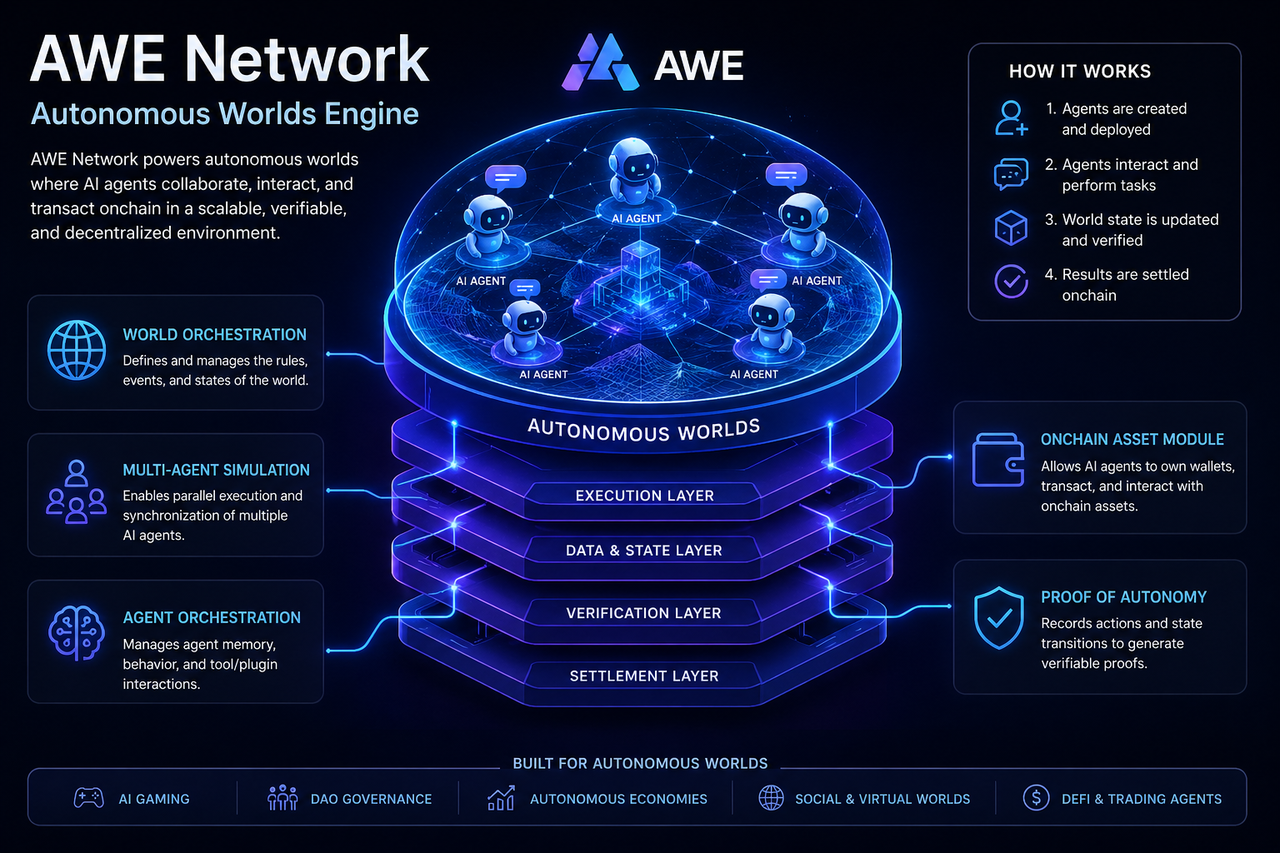
The importance of this capability is that it upgrades AI Agents from “independent agents” into “participants in autonomous systems.” In Autonomous Worlds, agents no longer simply execute individual tasks. Instead, they can interact continuously according to rules, produce state changes, and participate in value exchange. This kind of underlying framework will become important infrastructure for future AI-native applications, which is why the Autonomous Worlds Engine is also AWE Network’s key competitive barrier in the AI Agent infrastructure sector.
What Is the Core Operating Logic of AWE Network?
AWE Network’s operating logic is built on the Autonomous Worlds Engine. Its core goal is to allow multiple AI Agents to collaborate efficiently in a shared environment while ensuring that every behavior process can be verified. The entire system operates around four key stages: world rule management, agent execution, asset interaction, and behavior verification.
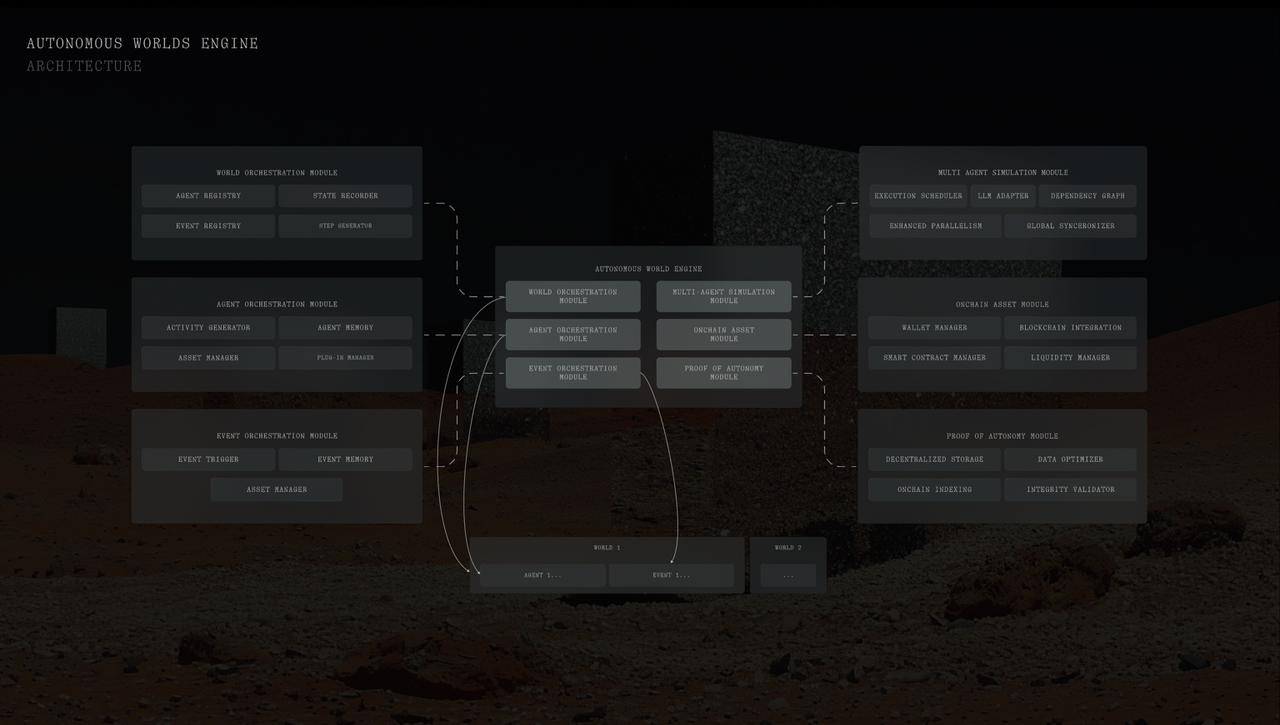
First, the system defines the basic rules and environmental state of the autonomous world, ensuring that all agents execute tasks within the same rule framework. Then, each agent runs in parallel according to its own behavioral logic. The system coordinates dependencies between them in real time and updates the world state in a unified way once tasks are completed.
At the same time, AI Agents can call the on-chain asset module to execute payments and value interactions, while the system records key behavioral outcomes and generates verification data through the proof of autonomy mechanism. This full process gives Autonomous Worlds not only operational capability, but also on-chain credibility.
World Orchestration: The Rule Coordination Mechanism for Autonomous Worlds
The first layer of the Autonomous Worlds Engine is the world orchestration module, whose main responsibility is to maintain the rules and state of the entire autonomous environment.
In an Autonomous World, different AI Agents interact continuously, and those interactions must follow a unified set of rules. For example, this module manages how resources are allocated, how events are triggered, and how states are updated. It works like the “rule engine” of the autonomous world, ensuring that all agent behavior takes place within a unified environment.
The importance of this mechanism is that it provides a consistent operating foundation for multi-agent collaboration. Without unified rule management, the behavioral outcomes of different agents would be difficult to synchronize, and the entire autonomous world would struggle to operate reliably.
Multi-Agent Simulation: The Parallel Execution Mechanism for Multiple Agents
One of AWE Network’s core technologies is its multi-agent parallel simulation mechanism. This module determines whether the system can support large-scale AI Agent collaboration.
Under traditional architectures, multiple agents executing tasks at the same time can create large numbers of state conflicts and resource competition issues. AWE uses a task scheduling system and dependency management logic to allow multiple agents to run in parallel and synchronize results when needed, improving overall efficiency.
This mechanism allows Autonomous Worlds to support complex application scenarios. For example, in an AI game world, different characters can act at the same time while the system still keeps the environmental state consistent. It is precisely because of this parallel execution capability that AWE can support autonomous agent worlds in the true sense.
Agent Orchestration: The Agent Behavior Management Mechanism
To give AI Agents in Autonomous Worlds the ability to act continuously, AWE Network provides an agent behavior management module that coordinates each agent’s memory, decision-making, and execution process.
Under this mechanism, agents do not just receive instructions and execute tasks. They can also adjust their behavioral logic based on historical states and environmental changes. For example, an AI Agent can decide its next move based on past interaction records, making behavior in Autonomous Worlds closer to a real dynamic system.
This module gives AI Agents a higher degree of autonomy, making interactions in autonomous worlds more complex and realistic. It is also an important difference between AWE and traditional automation systems.
Onchain Asset Interaction: The On-Chain Asset Interaction Mechanism
Another core mechanism of AWE Network is on-chain asset interaction, which gives AI Agents the ability to control and use on-chain assets.
In Autonomous Worlds, AI Agents can have wallet addresses and complete payments, resource exchanges, or asset management operations according to rules. As a result, AI Agents can not only execute behavioral logic, but also participate in the flow of value.
This capability provides foundational support for autonomous economic systems. For example, in AI-driven game worlds or automated trading systems, agents can independently complete resource transactions, turning Autonomous Worlds into autonomous environments with real economic activity.
Proof of Autonomy: The Autonomous Verification Mechanism
To ensure the credibility of Autonomous Worlds, AWE Network introduces an autonomous verification mechanism that records key behavioral outcomes and generates verifiable proofs.
Because the behavior processes of AI Agents are complex, autonomous worlds would face a lack of transparency without a verification mechanism. AWE records state changes and key events to generate verification data for the system, improving the credibility of the entire autonomous environment.
This mechanism not only improves system transparency, but also helps ensure the trusted on-chain operation of Autonomous Worlds. It is an important foundation for AWE Network’s decentralized autonomy.
Advantages and Limitations of the Autonomous Worlds Engine
The biggest advantage of the Autonomous Worlds Engine is that it integrates multi-agent collaboration, on-chain asset interaction, and behavior verification into the same framework, providing complete infrastructure for autonomous world operation. This design allows AWE to support complex AI Agent applications and build differentiated competitiveness in the AI Agent infrastructure sector.
At the same time, this architecture also brings high technical complexity. Coordinated operation across multiple modules means a higher development threshold. Developers need to understand autonomous environment rules, agent scheduling mechanisms, and on-chain interaction logic, which may slow ecosystem expansion.
In addition, real-world applications of Autonomous Worlds are still at an early stage, and market adoption has not yet been fully validated. Even with an advanced technical architecture, network value growth remains uncertain if there are not enough practical applications.
Conclusion
AWE Network’s Autonomous Worlds Engine is essentially building an “operating system for autonomous worlds” for AI Agents. Through world rule coordination, multi-agent parallel execution, behavior management, on-chain asset interaction, and autonomous verification mechanisms, it allows multiple AI Agents to collaborate continuously and complete value interactions within a unified environment.
The importance of this mechanism is that it upgrades AI Agents from independent task execution tools into participants in autonomous systems, providing underlying support for future AI games, autonomous economic networks, and AI-native applications. Although AWE still faces challenges around ecosystem adoption and technical complexity, its Autonomous Worlds Engine has already offered a clear direction for the development of AI Agent infrastructure.
FAQs
How does AWE Network support collaboration among multiple AI Agents?
AWE coordinates task execution and state synchronization among multiple agents through its multi-agent parallel execution mechanism, allowing them to work together within the same autonomous environment.
What is the role of Proof of Autonomy?
Proof of Autonomy records key behavioral outcomes in autonomous worlds and generates verifiable proofs, improving system transparency and credibility.
What is AWE Network’s core advantage?
AWE’s core advantage lies in providing a complete runtime framework for Autonomous Worlds, including rule coordination, behavior management, on-chain asset interaction, and autonomous verification.







