As the Bitcoin Layer2 ecosystem grows, market demand for Bitcoin smart contracts and on-chain applications continues to rise. Compared to traditional scaling solutions, ZK Rollup strikes an effective balance between security, scalability, and developer compatibility, making it a key technical path in the Bitcoin Rollup space. B² Rollup is the core infrastructure BSquared Network created to bring this vision to life.
What Is B² Rollup
B² Rollup is the zero-knowledge Rollup execution network powering BSquared Network.
The core idea behind Rollup is simple: process a high volume of transactions and computations off-chain, then submit only the compressed results and verification proofs to the main chain. This cuts main-chain resource usage while boosting transaction throughput.
For BSquared Network, B² Rollup handles smart contract execution, account state maintenance, and application logic, while the Bitcoin network takes care of final verification and settlement.
This setup lets the Bitcoin ecosystem support far more complex applications without touching Bitcoin's underlying protocol.
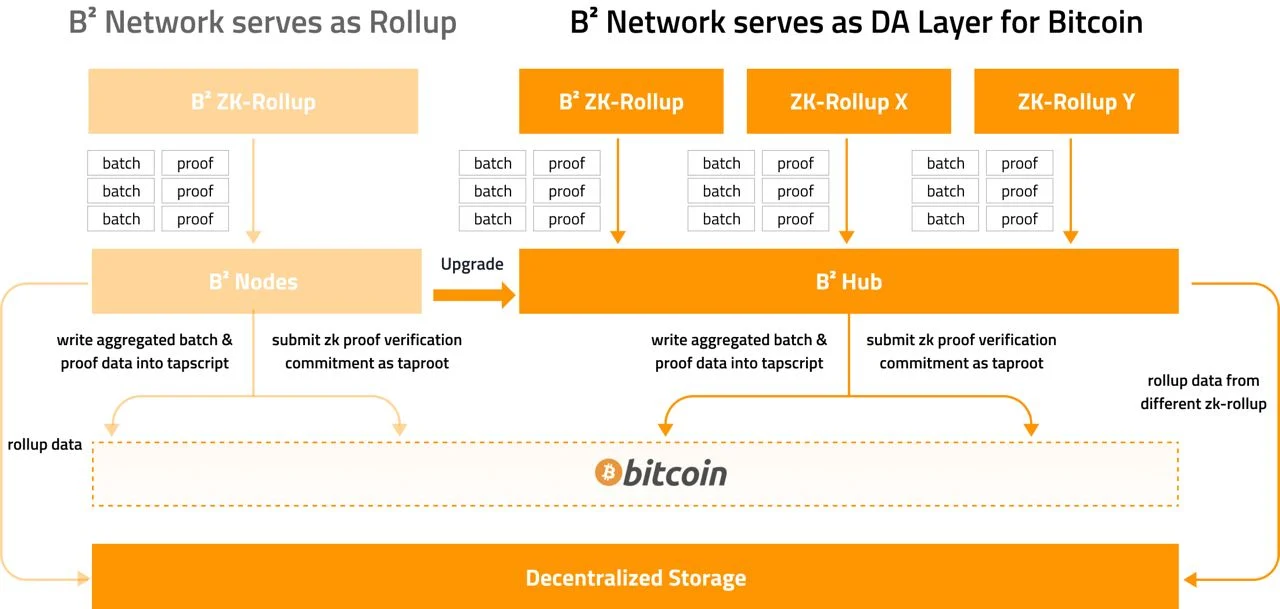
How User Transactions Enter the B² Rollup Network
It all starts when a user initiates a transaction.
Once a user submits a transaction request via a wallet or decentralized application, the transaction goes to a receiving node in the B² Rollup network.
These transactions can be token transfers, DeFi operations, NFT interactions, or smart contract calls.
The network runs initial checks on the transaction format, signature, and account state to confirm validity.
After validation, the transaction moves to a pending queue, waiting for the Sequencer to order and package it.
How the Sequencer Orders and Packages Transactions
The Sequencer is the Rollup network's transaction ordering node.
When a flood of transactions hits the system at once, the Sequencer orders them by predefined rules and groups multiple transactions into a batch. This centralized approach boosts network throughput and cuts the number of on-chain data submissions.
Once ordering is done, the Sequencer creates a new state update record and sends it to the execution environment.
In BSquared Network's long-term roadmap, the Sequencer mechanism will gradually become more decentralized.
How zkEVM Executes Smart Contracts
B² Rollup uses zkEVM as its execution environment.
zkEVM is an Ethereum Virtual Machine (EVM)-compatible execution system that can run Solidity smart contracts and produce computation results ready for zero-knowledge proofs. Developers can use existing EVM toolchains, frameworks, and smart contract standards to deploy apps.
When the Sequencer submits a transaction batch, zkEVM executes the computation and updates account balances, contract states, and on-chain data. After execution, the system generates a new state root for proof verification.
How the Prover Generates Zero-Knowledge Proofs
The Prover is a core piece of the ZK Rollup architecture.
After zkEVM finishes state computation, the Prover generates a zero-knowledge proof from the execution results. This proof confirms all transactions were executed correctly under the protocol rules without revealing the full computation details. Verification nodes only need to check the proof itself to verify the whole transaction batch.
This mechanism slashes verification costs while boosting network security and scalability.
How Data Is Stored in B² Hub
Beyond the proof itself, Rollup also needs to keep transaction data accessible and verifiable.
BSquared Network provides data availability support through B² Hub. After a transaction batch is executed, the relevant data is submitted to B² Hub for storage and management. The data availability layer ensures network participants can access transaction records and state changes, enabling open verification.
This modular design eases the load on the Bitcoin main chain while improving system scalability.
How the Bitcoin Network Completes Final Settlement
Final settlement is one of the biggest ways B² Rollup differs from ordinary sidechains.
After the zero-knowledge proof is generated, BSquared Network anchors the key state data and proof to the Bitcoin network. The Bitcoin blockchain acts as the ultimate trusted settlement layer, recording and confirming the Rollup state. Once the data is written to the Bitcoin blockchain, the state achieves finality.
This design lets B² Rollup tap into Bitcoin's security model to protect the entire network.
How B² Rollup Differs From Traditional Bitcoin Layer2 Solutions
Many Bitcoin Layer2 projects take different scaling approaches.
The Lightning Network focuses on payment scaling, using state channels to boost transaction speed.
Sidechain solutions typically have their own independent validator set and consensus mechanism. B² Rollup, on the other hand, uses zero-knowledge proofs and Bitcoin settlement to separate execution from verification.
| Dimension |
B² Rollup |
Bitcoin Sidechain |
Lightning Network |
| Core Use Case |
Smart Contract Scaling |
Independent Ecosystem |
Payment Scaling |
| Execution Environment |
zkEVM |
Independent Chain |
Channel Network |
| Proof Mechanism |
ZK Proof |
Sidechain Consensus |
Channel Signatures |
| Final Settlement |
Bitcoin |
Sidechain Itself |
Bitcoin |
| Application Support |
DeFi, AI, NFT |
Diverse |
Payments |
This architecture makes B² Rollup a better fit for complex application development and large-scale on-chain ecosystem building.
Summary
As the core execution layer of BSquared Network, B² Rollup delivers a Bitcoin Layer2 architecture that balances security and scalability across multiple stages: transaction ordering, zkEVM execution, zero-knowledge proof generation, data availability storage, and Bitcoin final settlement.
Compared to traditional sidechains and payment channel solutions, B² Rollup is built for smart contracts, DeFi, AI Agents, and other complex on-chain apps. By moving computation off-chain and using the Bitcoin network for final verification, BSquared Network opens up a new path for scaling and application development in the Bitcoin ecosystem.
FAQs
What is the core function of B² Rollup?
B² Rollup is the execution layer of BSquared Network. It handles transactions, runs smart contracts, and generates zero-knowledge proofs, giving the whole ecosystem a scalable runtime environment.
What does the Sequencer do in B² Rollup?
The Sequencer receives user transactions, orders them, and packages them into batches. It's the core coordination component in the Rollup network.
What's the difference between zkEVM and a regular EVM?
zkEVM stays compatible with the EVM while also supporting zero-knowledge proof generation. That means smart contract execution results can be verified efficiently.
Why is the Prover needed?
The Prover creates zero-knowledge proofs to show that all transactions were executed according to the protocol rules. This boosts verification efficiency and cuts on-chain computation costs.
What role does B² Hub play in the execution process?
B² Hub manages data availability and ecosystem coordination, making sure transaction data can be publicly accessed and verified.
Does B² Rollup depend on the Bitcoin network?
Yes. B² Rollup's final state is anchored to the Bitcoin network, where the Bitcoin blockchain handles final confirmation and security.