Bitcoin has long been regarded as the most secure and decentralized blockchain network, but its native scripting capabilities are limited, making it difficult to directly support complex smart contracts and on-chain financial applications. As Ethereum Rollups and Layer2 technologies have gradually matured, the market has begun exploring how to give BTC greater scalability and programmability while still inheriting Bitcoin’s security.
Against this backdrop, the concepts of Bitcoin Rollups and BTCFi have started to gain traction. As one of the important projects in the Bitcoin ZK Rollup space, Citrea aims to use zkEVM, BitVM, and zero knowledge proof technology to enable BTC to support use cases such as DeFi, stablecoins, lending, and on-chain financial markets, while minimizing reliance on external trust mechanisms as much as possible.
What Is Citrea’s ZK Rollup?
Citrea’s ZK Rollup is an off chain execution architecture built on Bitcoin. Its core goal is to increase network throughput and provide smart contract capabilities for BTC without changing Bitcoin’s consensus rules.
In the traditional Bitcoin network, every transaction must be written directly to the main chain, which limits scalability. In a Rollup model, a large number of transactions are executed on Layer2 first, and the compressed state proof is then submitted to the main chain.
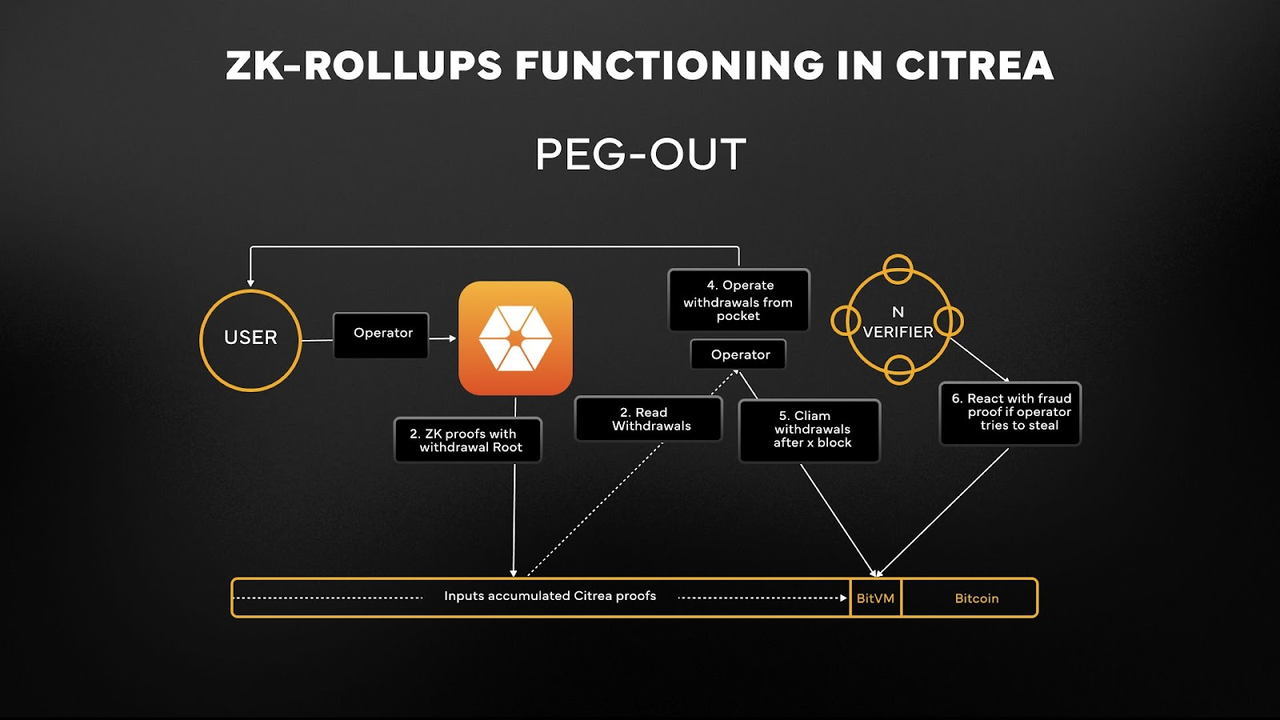
Citrea uses a Type 2 zkEVM as its execution environment, allowing Ethereum developers to migrate Solidity contracts and existing DeFi applications. At the same time, Citrea uses Bitcoin as both the data availability layer, or DA, and the final settlement layer, and verifies state correctness through BitVM.
This design makes Citrea not only a scaling network, but also a foundational infrastructure for BTCFi.
How Do User Transactions Enter the Citrea Network?
When users make transactions on Citrea, such as transfers, DEX trades, or lending operations, those transactions do not go directly to the Bitcoin mainnet. Instead, they are first sent to Citrea’s Layer2 network.
The sequencer is responsible for receiving and ordering these transactions, then batching them into the zkEVM execution environment. All smart contract logic, state updates, and DeFi operations are completed on Layer2.
Compared with executing directly on Bitcoin, this approach can significantly improve throughput and reduce on-chain costs.
The whole process is similar to how Ethereum Rollups operate, but Citrea places greater emphasis on bringing the final state back to Bitcoin for security verification.
What Does zkEVM Do in Citrea?
zkEVM is Citrea’s core execution layer.
Its main role is to support the Ethereum smart contract ecosystem, allowing Solidity developers to deploy applications on Bitcoin Layer2 without completely rewriting their code logic.
Citrea uses a Type 2 zkEVM, which means most Ethereum tools can be supported, Solidity contracts can be migrated, DeFi applications can connect more easily, and the learning curve for developers is also reduced.
zkEVM is also responsible for recording changes in transaction states and providing the underlying data needed for later ZK Proof generation.
This structure allows Citrea to quickly absorb the existing Ethereum DeFi ecosystem and support the expansion of the BTCFi market.
How Are ZK Proofs Generated?
After transactions have been executed, Citrea compresses a large number of state updates into a zero knowledge proof, or ZK Proof.
The core function of a ZK Proof is to prove to Bitcoin that these transactions were executed correctly according to the rules, without requiring Bitcoin to recompute the entire transaction process.
In this process, Prover nodes are responsible for aggregating transactions, calculating state changes, generating the final proof data, and then submitting it to Bitcoin.
| Module |
Function |
| Transaction Batch |
Aggregates transactions |
| State Transition |
Calculates state changes |
| Prover |
Generates ZK Proofs |
| Compression |
Compresses proof data |
| Submission |
Submits to Bitcoin |
Because ZK Proofs can directly prove that “the computation is correct,” Rollups can greatly increase transaction throughput while maintaining security.
How Does Citrea Submit Data to Bitcoin?
After generating a ZK Proof, Citrea submits the state data and proof to Bitcoin.
Here, Bitcoin does not execute transactions. Instead, it mainly serves functions such as data availability storage, final state confirmation, and security settlement.
Citrea chooses Bitcoin as its Data Availability, or DA, layer, meaning that transaction related data ultimately returns to the Bitcoin mainnet.
Compared with relying on an external DA network, this approach can reduce additional trust assumptions as much as possible. However, because Bitcoin block space is limited, controlling data costs and improving compression efficiency have also become important challenges for Bitcoin Rollups today.
How Does BitVM Verify Rollup States?
BitVM is a key component of Citrea’s architecture. Its goal is to enable verification of complex off chain computation without modifying Bitcoin’s consensus rules.
In Citrea, BitVM’s role is to verify whether the state proofs submitted by the Rollup are correct.
Put simply, Layer2 executes the transactions first, the Prover then generates a ZK Proof, and BitVM is responsible for verifying the proof. Bitcoin ultimately completes state confirmation.
Compared with the multisig bridges and federated verification mechanisms commonly seen in traditional sidechains, BitVM places greater emphasis on allowing Bitcoin itself to participate in verification logic.
This means Citrea aims to reduce custodial bridge risks, reliance on centralized validators, and the influence of external security committees as much as possible.
However, BitVM is still a relatively new technical approach. Its long term verification efficiency and ability to operate at large scale in practice remain under market observation.
How Is Citrea Different From an Optimistic Rollup?
Citrea uses a ZK Rollup, not an Optimistic Rollup.
The biggest difference between the two lies in how states are verified.
Optimistic Rollups assume transactions are valid by default and only conduct Fraud Proof verification when disputes arise during the challenge period. ZK Rollups, by contrast, submit validity proofs directly to prove that transactions have been executed correctly.
| Comparison Dimension |
ZK Rollup |
Optimistic Rollup |
| Verification method |
Validity Proof |
Fraud Proof |
| Withdrawal waiting period |
Shorter |
Usually longer |
| Data compression efficiency |
Higher |
Medium |
| Computational complexity |
Higher |
Relatively lower |
| Final confirmation speed |
Faster |
Slower |
Citrea chooses ZK Rollup mainly because it better fits an architectural path that emphasizes “Bitcoin final security.”
Why Is Bitcoin DA Important?
Data Availability determines whether users can verify network states and recover transaction data.
Citrea uses Bitcoin as its DA layer, essentially to ensure that Rollup data is ultimately stored on the Bitcoin network.
This design means state data does not fully depend on external systems. Bitcoin can participate in final security confirmation, while the Rollup also moves closer to a “Bitcoin native” structure.
For Bitcoin Rollups, the security of the DA layer is an important factor in long term trustworthiness. Therefore, Citrea places greater emphasis on Bitcoin DA instead of relying entirely on an independent data network.
Summary
Citrea’s ZK Rollup architecture is essentially designed to provide BTC with smart contract and BTCFi capabilities while inheriting Bitcoin’s security.
Through zkEVM, ZK Proofs, BitVM, and Bitcoin Settlement, Citrea moves transaction execution to Layer2 and ultimately brings state security back to the Bitcoin mainnet.
This structure allows Bitcoin to become more than just a store of value network. Over time, it can expand into infrastructure for on-chain finance.
However, the Bitcoin Rollup ecosystem is still in its early stages. BitVM verification efficiency, DA costs, ZK infrastructure maturity, and the scale of BTCFi liquidity remain important issues that the market continues to watch.
FAQs
What role does zkEVM play in Citrea?
zkEVM is Citrea’s execution layer, used to run Solidity smart contracts and DeFi applications.
Why is BitVM important?
BitVM enables Rollup state verification without modifying Bitcoin’s consensus rules.
Why does Citrea use Bitcoin as its DA layer?
Citrea aims to bring final security and data availability back to the Bitcoin mainnet, reducing external trust assumptions.
Is Citrea a ZK Rollup or an Optimistic Rollup?
Citrea is a ZK Rollup. It verifies state correctness through Validity Proofs.
How is Citrea different from traditional Bitcoin sidechains?
Citrea places greater emphasis on a Bitcoin native Rollup architecture, while traditional sidechains usually rely on federated validators or custodial bridges.
What is the core value of a Bitcoin Rollup?
The core goal of a Bitcoin Rollup is to improve scalability and BTC’s on-chain capital efficiency while inheriting Bitcoin’s security.