As global cryptocurrency regulation matures, Europe is emerging as one of the most closely watched compliant digital asset markets. The official rollout of the MiCA framework marks the EU's first unified regulatory regime for crypto assets across all 27 member states. For cryptocurrency exchanges, securing MiCA authorization means not only legal operation but also entry into one of the world's most mature digital asset markets.
At the core of the MiCA framework lies the CASP (Crypto-Asset Service Provider) license, widely regarded as the fundamental gatekeeping mechanism for the European crypto industry. Whether you run a centralized exchange, a digital asset custodian, a brokerage, or any other digital asset service provider, if you aim to serve EU users, meeting CASP requirements is generally mandatory.
Which Businesses Need a MiCA License?
MiCA applies to most digital asset service providers operating in the European market.
Cryptocurrency exchanges are the most typical CASP applicants. Whether a platform offers spot trading, brokerage services, or digital asset swaps, it may fall under regulatory oversight.
Digital asset custodians also need authorization, as they manage client private keys and safeguard digital assets.
In addition, platforms facilitating digital asset transfers, order execution, investment advice, or asset management may also require CASP status.
What to Prepare Before Applying for a MiCA License
Regulators typically will not approve companies that lack a fully built compliance framework.
Therefore, before submitting a formal application, firms must complete foundational infrastructure: company incorporation, governance structure, and a compliance team.
Management team members generally need experience in finance, law, risk management, or the digital asset sector. Regulators evaluate whether the core team can sustain operations and control risks.
Additionally, companies must establish client asset protection policies, information security systems, anti-money laundering (AML) mechanisms, and internal audit procedures.
These preparatory steps are often the most time-consuming part of the process.
Step 1: Choose Your Licensing Country
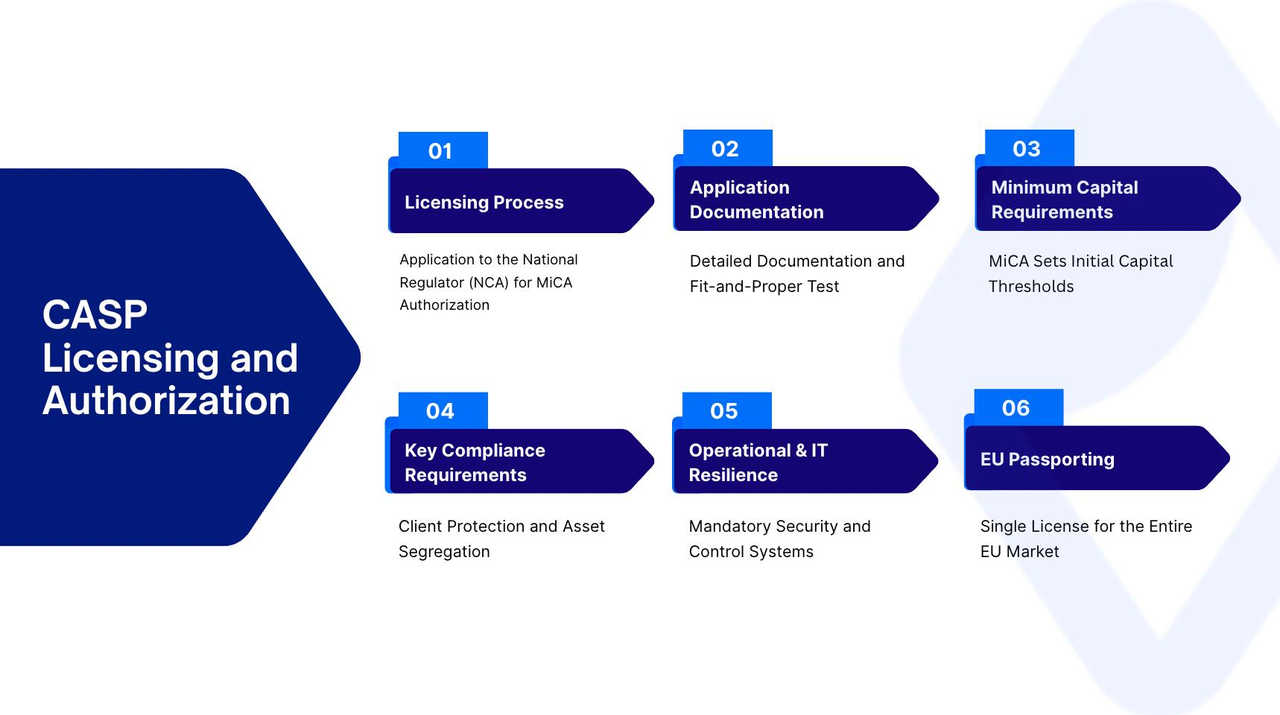
Although MiCA applies across the entire EU, each company must select one member state as its primary regulatory home.
Countries differ in regulatory experience, review speed, and industry ecosystem, making jurisdiction selection a strategic decision.
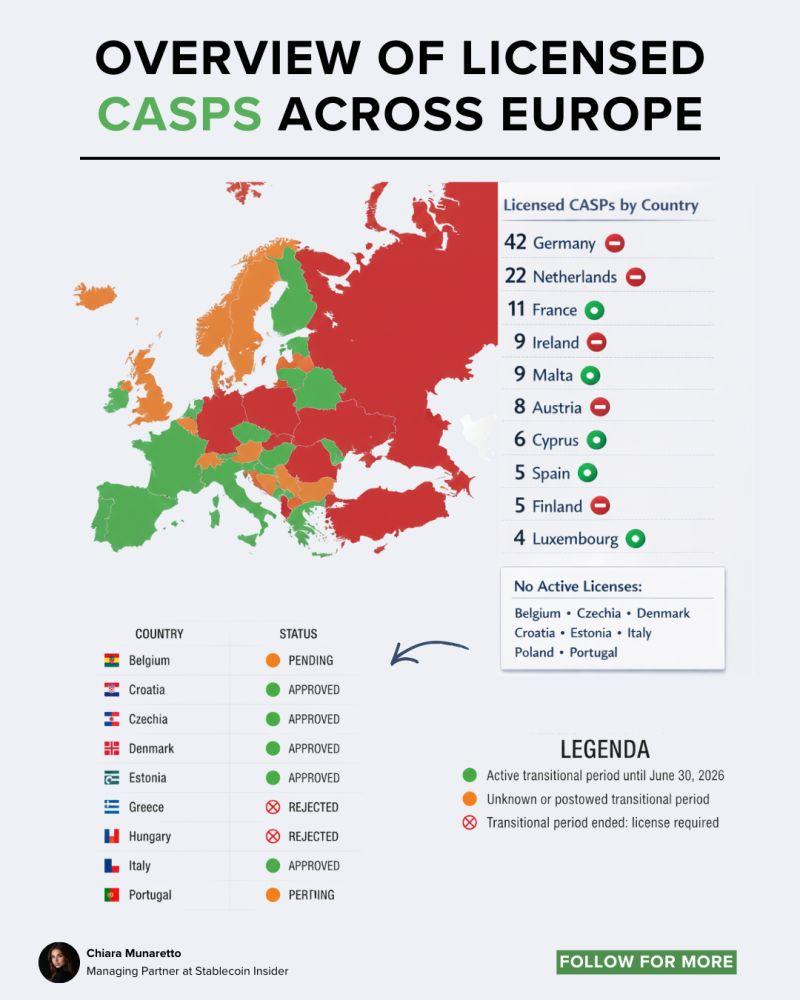
In recent years, Malta, France, Luxembourg, the Netherlands, and Ireland have become popular choices among international crypto firms.
Companies typically weigh regulatory climate, tax policies, operating costs, and talent availability before deciding.
Once approved by the local authority, the company can leverage the MiCA passporting mechanism to serve the entire EU market.
Step 2: Establish Corporate Governance
Corporate governance is a key pillar of MiCA review.
Regulators require applicants to have a clear organizational structure with well-defined, auditable responsibilities for key roles.
The board, senior management, and risk control officers must demonstrate sufficient expertise while avoiding conflicts of interest.
Regulators also scrutinize decision-making processes, internal controls, and long-term viability.
A solid governance structure not only influences license approval but also affects ongoing compliance obligations.
Step 3: Build a Risk Management Framework
Risk management capability is a critical focus of MiCA review.
Companies must identify market, liquidity, technical, and cybersecurity risks inherent in their operations, and develop corresponding mitigation strategies.
For cryptocurrency exchanges, client asset security is paramount. Platforms need cold/hot wallet management protocols, private key governance, and emergency recovery plans.
Regulators also assess readiness to handle system failures, cyberattacks, and extreme market volatility.
A robust risk management system significantly boosts the chances of a successful application.
Step 4: Implement AML and KYC Policies
Anti-money laundering (AML) and Know Your Customer (KYC) are foundational to European crypto regulation.
Companies must establish user identity verification processes and the ability to flag high-risk clients and suspicious transactions.
Additionally, transaction record-keeping, source-of-funds checks, and suspicious activity reporting are key review points.
As the EU tightens AML rules for digital assets, strong AML/KYC capabilities have become a prerequisite for CASP authorization.
For international exchanges, this often requires substantial investment in technology and compliance resources.
Step 5: Submit the CASP Application
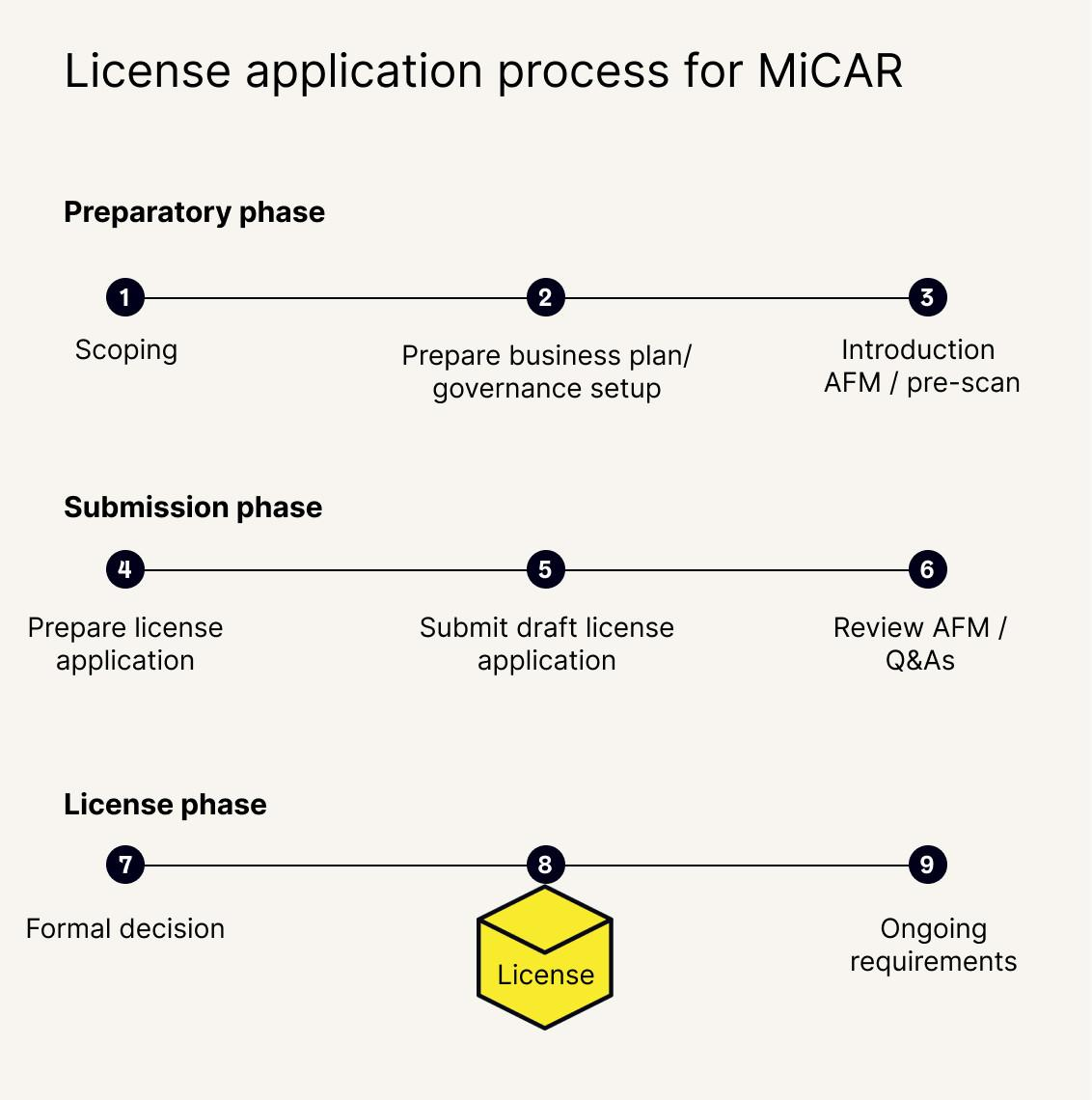
After internal preparation, companies formally submit their application to the chosen regulator.
Required materials typically include the company’s articles of incorporation, business plan, organizational documents, risk management policies, technical security plans, and AML policies.
Regulators may also ask for details on target markets, revenue models, client protection measures, and future growth plans.
The completeness and professionalism of the submission directly affect review speed, so most major exchanges engage specialized legal counsel to prepare the dossier.
Step 6: Undergo Regulatory Review
Once the application is received, the regulator conducts a comprehensive assessment.
Key evaluation areas include governance reasonableness, management qualifications, technical system security, and risk control adequacy.
Regulators may request additional documents or require amendments to certain policies.
For large international exchanges, the review process often involves multiple rounds of communication and iterative feedback.
Only after meeting all MiCA requirements can a company receive final authorization.
Advantages of a MiCA License
The primary benefit of CASP authorization is access to the entire EU market.
Through the passporting mechanism, companies can serve European users without needing separate licenses in each of the 27 member states.
Furthermore, a MiCA license significantly enhances market credibility and institutional partnerships.
Banks, payment providers, and traditional financial institutions view licensed operators as more trustworthy and lower-risk partners.
As global regulatory frameworks continue to improve, the MiCA license is becoming a key competitive differentiator for international crypto firms.
Challenges in Applying for a MiCA License
While MiCA provides clear rules, obtaining authorization is no simple task.
Companies must invest heavily in compliance infrastructure and continuously meet regulatory standards. For smaller platforms, technology upgrades, legal fees, and compliance team costs can be substantial.
Moreover, regulators impose high requirements for client asset protection and risk management. Some early-stage crypto companies may need to redesign operations to comply.
Thus, MiCA is more than a license—it represents a firm's transition toward institutional-grade operations.
Summary
The MiCA license (CASP authorization) has become a critical gateway to the European cryptocurrency market. The application journey spans company incorporation, governance setup, risk management development, AML/KYC implementation, regulatory submission, and review.
For cryptocurrency exchanges, MiCA authorization means not only legal operation but also access to the entire EU market via the passporting mechanism. As regulatory compliance increasingly drives industry competition, the MiCA license is emerging as a vital strategic asset for global crypto firms targeting Europe.
FAQs
Which businesses need to apply for a MiCA license?
Companies offering crypto asset trading, custody, transfer, brokerage, or investment advisory services to EU users generally require CASP authorization.
Does a MiCA license cover all of Europe?
Yes. Once approved by an EU member state regulator, companies can use the passporting mechanism to operate across the entire EU.
How long does the MiCA license application take?
The timeline varies by regulator and application complexity. Large international exchanges often face several months or more of preparation and review.
What are the most critical review criteria?
Regulators focus on corporate governance, risk management, client asset protection, technical security, and AML/KYC compliance.
What value does a MiCA license offer to crypto exchanges?
Beyond legal operation, a MiCA license boosts credibility, opens institutional partnerships, and provides access to a unified EU market of hundreds of millions of users.