The digital asset market, after years of development, has expanded significantly from pure cryptocurrency trading to a much broader asset allocation landscape. As more investors enter the space, simply holding crypto assets no longer satisfies the risk management and long-term allocation needs of some users.
Meanwhile, the convergence of Traditional Finance (TradFi) and Crypto Finance is accelerating. Advancements in stablecoins, real-world assets (RWA), and digital asset infrastructure are enabling capital to flow more seamlessly across different markets. Innovative stock trading services like Gate Stocks now allow users to invest in U.S. stocks and ETFs using USDT, managing both digital and securities assets within a unified account. This represents a key practical milestone in the integration of digital finance and traditional capital markets.

How Does Trading U.S. Stocks with USDT Work?
In the past, international investors had to open overseas brokerage accounts and rely on the banking system for cross-border wire transfers and USD conversions to access U.S. securities markets.
With the growth of digital asset infrastructure, a new market entry model has emerged. Users can now open stock trading accounts through digital asset platforms and use USDT as a funding gateway to invest in U.S. stocks and ETFs.
This approach reduces the operational complexity of cross-market investing and allows both digital and traditional financial assets to be managed in one place.
Step-by-Step Guide to Trading Stocks with USDT
Open a Stock Trading Account
The first step is to complete the stock account opening process.
Users must undergo identity verification and pass all required compliance checks. Once approved, they gain access to stock trading privileges.
Fund Your Account with USDT
USDT has become one of the most widely used stablecoins in the digital asset market.
For many investors, USDT serves not only as a medium of exchange but also as a crucial bridge linking digital asset markets with traditional financial systems.
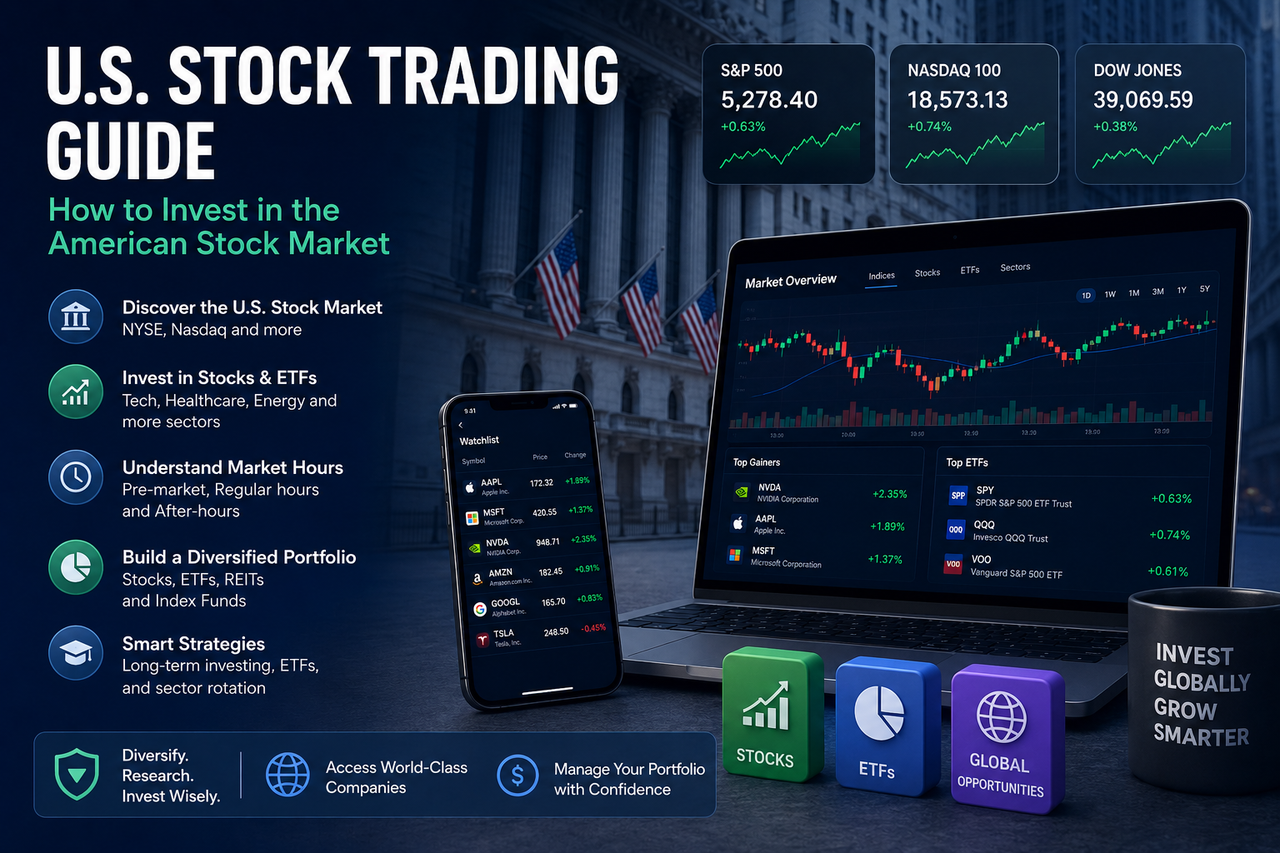
Choose Your Stocks or ETFs
Once your account is open and funded, you can browse the available assets.
Popular choices include:
Each asset carries different risk-return characteristics, so your investment objectives should be aligned with your asset selection.
Place Your Trade Order
After selecting your target asset, you can place a buy or sell order.
Orders are executed according to market rules. The transaction price is determined by supply and demand, influenced by liquidity and overall market conditions.
Manage Your Holdings and Portfolio
After completing trades, you can continuously monitor asset performance.
Unlike pure price speculation, stock investing places greater emphasis on a company's fundamentals, industry trends, and long-term growth potential. Position management is therefore a critical part of the investment process.
What Stock Assets Can Crypto Investors Trade?
The U.S. capital market offers a wide range of asset classes, each suited to different investment strategies.
U.S. Tech Stocks
Tech stocks are one of the most followed categories among crypto investors.
Companies involved in artificial intelligence, semiconductors, cloud computing, data centers, and digital infrastructure are often closely tied to the growth trajectory of the digital economy.
ETFs
ETFs are among the most popular investment vehicles in the U.S. market.
By holding a basket of assets, ETFs provide instant diversification, making them a preferred starting point for many investors entering the stock market.
Sector-Themed Assets
Beyond technology, the U.S. market offers abundant sector-themed investment opportunities, including:
-
Financials
-
Energy
-
Healthcare
-
Industrials
-
Consumer Services
-
Communication Services
These sectors are often influenced by different economic cycles and macroeconomic factors, offering investors additional diversification options.
How Does Trading U.S. Stocks with USDT Differ from Using a Traditional Broker?
While both approaches ultimately provide access to U.S. stocks, the entry points differ significantly.
Differences in Fund Management
Traditional brokers rely on bank accounts and the USD payment system.
Digital asset platforms, by contrast, allow you to use USDT as a funding gateway for stock trading.
Differences in Account Structure
The traditional model typically separates bank accounts from securities accounts.
Digital asset platforms emphasize unified account management, enabling you to view both stock and digital asset holdings in a single interface.
Differences in Cross-Market Allocation Efficiency
For users who already hold digital assets, using USDT to invest in stocks reduces the friction of moving funds between multiple platforms.
This is a key reason why more crypto investors are now exploring the stock market.
Does Buying U.S. Stocks with USDT Mean You're Buying Tokenized Stocks?
No, these are not the same.
Tokenized stocks represent stock rights mapped to digital tokens on a blockchain, enabling on-chain circulation and trading.
Stock market access services, on the other hand, facilitate real stock transactions through traditional securities market infrastructure. The two models differ fundamentally in underlying asset structure, trading mechanisms, and liquidity sources.
Summary
A growing number of crypto investors are turning their attention to traditional financial assets like U.S. stocks and ETFs. By using USDT as a funding gateway, investors can access the U.S. securities market more easily and manage both digital assets and stock holdings within a unified account.
From tech stocks and ETFs to sector-themed investments, the U.S. stock market offers crypto users a broader range of asset allocation options. At the same time, the ongoing convergence between TradFi and Crypto is pushing global capital markets toward greater openness, efficiency, and interconnectedness, making USDT-powered stock trading a vital bridge between digital assets and traditional finance.
FAQs
Can crypto investors buy U.S. stocks with USDT?
Yes. Some platforms allow users to use USDT as a funding gateway to invest in U.S. stocks and ETFs, eliminating the need for traditional cross-border remittance.
Do I need to convert USDT to USD to invest in U.S. stocks?
Depending on the service model, some platforms let you manage your stock trading funds directly in USDT, without the need for manual USD conversion.
Which U.S. stock assets are most commonly traded by crypto investors?
Tech stocks, AI-related stocks, semiconductor companies, and index ETFs are among the most popular asset categories among crypto investors.
Why are ETFs popular among crypto investors?
ETFs provide built-in diversification through a basket of assets, offering better risk distribution compared to individual stocks — a key reason they attract long-term investors.
Does buying U.S. stocks with USDT mean you're buying tokenized stocks?
Not necessarily. Real stock trading access and tokenized stocks are two different models, with clear differences in asset structure and trading mechanisms.
Why are more crypto investors starting to allocate to stocks?
The stock market offers risk-return profiles and investment logic that differ from digital assets. By allocating to both, investors can build a more diversified portfolio.







