Daewon Electric Wire's profit model is not simply driven by product price increases; it is shaped by order volume, raw material costs, product mix, and downstream demand. For those analyzing Korean wire and cable stocks, shifts in revenue structure and profit margins provide a more accurate picture of company fundamentals than short-term price movements.
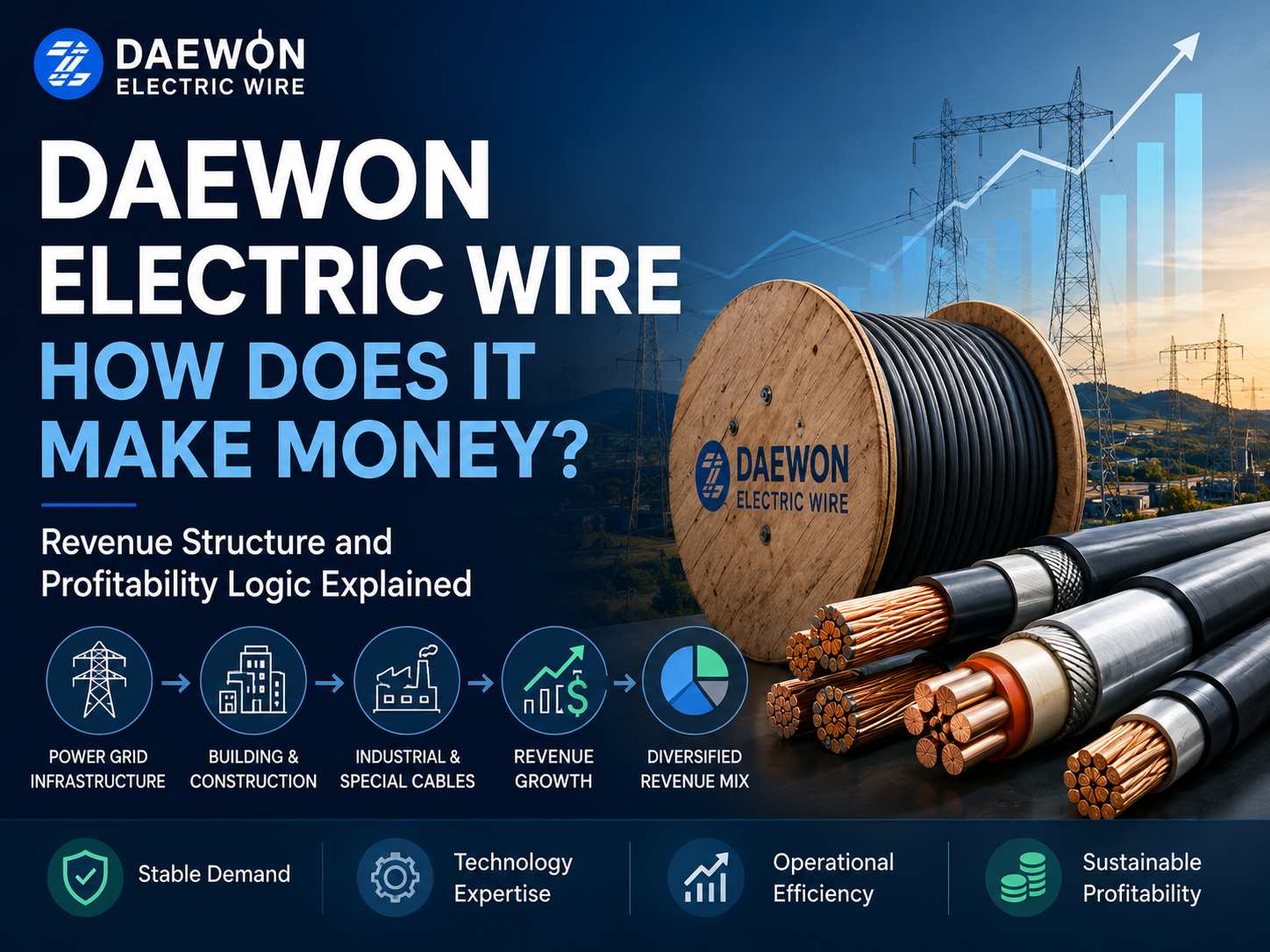
Where Does Daewon Electric Wire Generate Its Revenue?
Daewon Electric Wire primarily generates revenue from sales of wire and cable products, including power cables, communication cables, automotive cables, control cables, flame-retardant cables, and cross-linked polyethylene insulated cables. According to Investing.com, Daewon Cable's portfolio spans insulated cables, communication cables, aluminum cables, automotive cables, and power and control cables.
The company's revenue sources are distinctly industrial, as wire and cable products are rarely sold directly to consumers. Instead, they are integrated into the supply chains of construction, power grids, communications, automotive, and industrial equipment. Revenue growth is typically tied to engineering projects, enterprise procurement, infrastructure investment, and demand from downstream manufacturers.
| Revenue Source |
Main Products |
Application Scenario |
Impact on Profit |
| Power cables |
Power lines, control cables, XLPE cables |
Power grids, construction, industrial power |
Influences order volume and revenue stability |
| Communication cables |
Communication lines, optical communication cables |
Communication networks, information infrastructure |
Affected by communication build cycles |
| Automotive cables |
Automotive wires, automotive conductors |
Automotive manufacturing and parts supply chain |
Driven by auto production and model mix |
| Industrial and safety cables |
Flame-retardant cables, UL-certified cables |
Factories, equipment, building safety |
Impacts product mix and added value |
| Aluminum cables and related products |
Aluminum cables, conductor materials |
Industrial and power applications |
Influenced by material prices and procurement needs |
Why Is the Wire and Cable Business Order-Driven?
Wire and cable businesses are order-driven because demand originates from power grid development, construction projects, communication networks, automotive manufacturing, and industrial equipment. Daewon Cable's offerings—spanning residential and industrial power cables, communication lines, and automotive wires—generate revenue through project-based procurement and enterprise orders.
Sales cycles are closely linked to downstream project timelines, rather than daily retail demand. When Korea sees increased investment in power infrastructure, industrial expansion, residential construction, or automotive production, Daewon Electric Wire is positioned to capture more orders and attract greater market attention.
Order-driven business hinges not only on order quantity but also on quality, delivery timelines, and pricing terms. For Daewon Electric Wire, order growth from low-margin products may not translate into higher profits; whereas orders from higher value-added segments can improve profit quality and attract market focus.
How Do Copper Prices and Raw Material Costs Affect Profitability?
Copper prices and raw material costs directly impact Daewon Electric Wire's profitability, as wire and cable manufacturing is heavily reliant on copper, aluminum, and insulation materials. Revenue may fluctuate with material prices, but profit margins depend on the company’s ability to pass cost changes through to product pricing.
Profitability is determined by both revenue growth and cost transfer capability. When copper prices rise, cable prices may increase in tandem, boosting sales. However, if procurement costs outpace price adjustments, gross margins may shrink, and profit growth may lag behind revenue growth.
Material cycles also affect inventory and contract execution. Cable companies must procure materials and plan production ahead of time. Rapid price changes between procurement, production, and delivery can lead to cost mismatches, making profit margins in the cable industry highly volatile.
How Does Product Mix Affect Daewon Electric Wire's Gross Margin?
Daewon Electric Wire's gross margin is shaped by product mix, as different cable types have varying technical requirements, certification standards, customer applications, and bargaining power. Public data shows Daewon Cable’s offerings span power, communication, automotive, control, and flame-retardant cables, each contributing differently to margin.
Standard power cables are more vulnerable to raw material price fluctuations and market competition, while automotive, control, flame-retardant, and certified cables rely more on customer standards, quality consistency, and supply capability. Increasing the share of higher value-added products typically boosts profit quality.
Gross margin analysis should consider both product and customer composition. Even with revenue growth, if expansion is driven by highly competitive or material-intensive products, margin improvement may be limited. Growth from technically advanced or stable-demand products, however, can yield greater profit elasticity.
How Do Infrastructure, Industrial, and Communication Demands Drive Order Growth?
Infrastructure, industrial, and communication demands drive order growth for Daewon Electric Wire, since cables are essential for power transmission, equipment connectivity, communication networks, and construction projects. Industry sources describe Daewon Cable as a key solutions provider for power infrastructure, automotive, and information communications.
Korean power grid investment, industrial facility construction, and communication network upgrades can spur new cable procurement. For Daewon Electric Wire, stable downstream demand increases order visibility; conversely, slowing industrial investment or construction demand can constrain order growth.
Communication and automotive trends also shape revenue structure. Network construction may boost demand for communication cables, while automotive production and electrification trends affect automotive cable demand. Growth rates across business lines are not uniform, so overall performance reflects a blend of multiple demand cycles.
What Are the Cyclical Features of Daewon Electric Wire's Profit Model?
Daewon Electric Wire's profit model exhibits order, material, and industrial demand cycles. Wire and cable companies rely on project orders for revenue, while copper, aluminum, and insulation material prices affect both income and profit, often causing asynchronous changes.
Performance cycles are further influenced by domestic and international market dynamics. Yahoo Finance reports Daewon Cable manufactures and sells wire and cable products in Korea and abroad, so revenue is affected by both local engineering demand and export market fluctuations.
Financial data shows Daewon Cable’s net sales increased 25.1% year-over-year in Q1 2026, but manufacturing revenue growth must be evaluated alongside margin, cost, and cash flow. EMIS data indicates asset growth during the same period, highlighting the need to understand the profit model within the context of expansion and operational efficiency.
| Cycle Type |
Impact Path |
Significance for Daewon Electric Wire |
| Order cycle |
Engineering, industrial, and communication projects drive procurement |
Determines revenue scale and visibility |
| Material cycle |
Copper, aluminum, and insulation price fluctuations |
Impacts costs, pricing, and gross margin |
| Industrial cycle |
Changes in manufacturing investment and construction demand |
Drives downstream procurement intensity |
| Communication cycle |
Network construction and information infrastructure investment |
Shapes communication cable demand |
| Automotive cycle |
Automotive production and component demand shifts |
Affects automotive cable orders |
| Export cycle |
Overseas market demand and currency fluctuations |
Determines international sales resilience |
Summary
Daewon Electric Wire’s revenue is primarily derived from wire and cable sales, serving power, communication, industrial, residential, and automotive sectors. The company’s profit logic is shaped by order volume, material costs, product mix, and downstream demand.
Revenue growth does not guarantee profit growth, as copper, aluminum, material costs, and product composition affect margins. Understanding the wire and cable business model requires assessing sustained order demand, cost transfer ability, product mix improvements, and whether industry cycles support stable revenue growth.
FAQ
How does Daewon Electric Wire make money?
Daewon Electric Wire earns revenue by selling wire and cable products for power, communication, automotive, industrial, and construction applications. Profitability depends on order volume, product pricing, material costs, and gross margin dynamics.
What are Daewon Electric Wire's main revenue sources?
The main revenue sources are sales of power cables, communication cables, automotive cables, control cables, and flame-retardant cables, which serve power grids, communication networks, automotive manufacturing, and industrial engineering.
Why are wire and cable companies so sensitive to orders?
Wire and cable companies are highly sensitive to orders because demand stems from engineering projects, industrial procurement, communication infrastructure, and automotive supply chains. Order release timing directly affects production schedules, revenue recognition, and market performance expectations.
Does a rise in copper prices always benefit Daewon Electric Wire?
A rise in copper prices does not always benefit Daewon Electric Wire. While higher copper prices may increase sales, they can also compress margins. The key is whether the company can promptly transfer increased material costs to product pricing.
What mainly affects Daewon Electric Wire’s gross margin?
Gross margin is mainly affected by material prices, product mix, order pricing, and cost control. When higher value-added products represent a larger share, profit quality tends to attract greater market attention.
What cyclical features shape Daewon Electric Wire’s profit model?
The profit model is characterized by order, material, and industrial demand cycles. Revenue is driven by downstream project demand, while margins are influenced by copper and aluminum prices, product composition, and cost transfer capability.