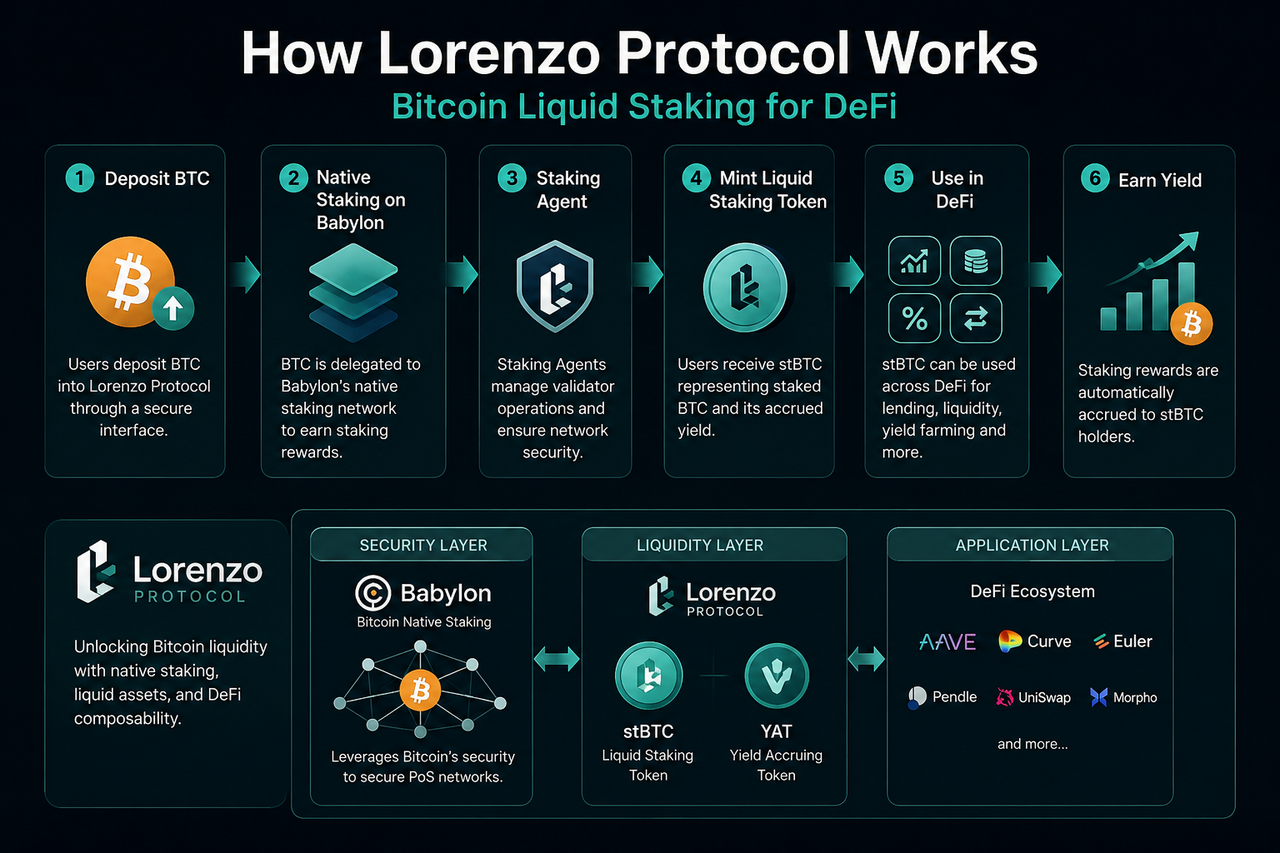
Lorenzo Protocol enables BTC to earn staking yield while retaining on-chain liquidity by integrating Babylon’s native Bitcoin staking network, liquid staking assets (LSTs), and yield tokenization. After users deposit BTC, the protocol connects the assets to the underlying staking system and issues corresponding liquid staking assets, allowing users to continue participating in DeFi activities such as lending, liquidity mining, and yield management.
As Bitcoin gradually evolves from a pure store of value into an on-chain financial asset, unlocking BTC liquidity has become an important issue for the industry. For a long time, large amounts of BTC have remained passively held. While Bitcoin has strong store of value properties, it has lacked the ability to participate in decentralized financial activities.
Lorenzo Protocol is a Bitcoin liquidity finance protocol created in this context. As an important infrastructure project in the Bitcoin Liquidity Finance (BLF) sector, Lorenzo integrates Babylon’s native staking network with a liquid staking model, allowing BTC to earn yield, remain liquid, and enter the DeFi ecosystem at the same time. In doing so, it improves the capital efficiency of Bitcoin.
What Is Lorenzo Protocol’s BTC Liquid Staking Mechanism?
The core mechanism of Lorenzo Protocol is Bitcoin Liquid Staking. This model allows users to participate in Bitcoin staking and earn yield while continuing to use the corresponding assets in other on-chain activities.
Traditional staking models usually require assets to be locked, which results in a loss of liquidity. Liquid staking solves this problem by issuing derivative assets that represent rights to the underlying assets.
In the Lorenzo ecosystem, after users deposit BTC, the underlying assets participate in staking, while the protocol issues corresponding liquid staking assets to users. These assets represent both ownership of BTC and the ability to continuously accrue underlying yield.
This design allows yield rights and liquidity to exist at the same time.
What Happens After Users Deposit BTC?
The entire Lorenzo Protocol process begins with a BTC deposit.
After users deposit BTC into the protocol, the system verifies the source of the assets and brings them into the protocol’s management framework. At this point, users do not directly lose their asset rights. Instead, they receive corresponding on-chain credentials.
Next, this portion of BTC enters the native staking system supported by Babylon, where it participates in the underlying process of network security protection and yield generation.
From the user’s perspective, although BTC has entered a staked state, its value and yield rights can still be used through the liquid staking assets generated later.
The whole process is similar to converting a long term savings certificate into a freely transferable financial asset.
How Does Babylon Provide Underlying Security?
Babylon is an important infrastructure project in the current Bitcoin native staking ecosystem.
Unlike traditional cross chain bridges or custody models, Babylon allows BTC to participate directly in a shared security system without converting the asset into the native token of another chain.
In Lorenzo’s architecture, Babylon is mainly responsible for:
Bitcoin native staking;
Verifying staking status;
Providing security layer support;
Generating underlying staking yield.
Babylon functions as the security engine of the entire system, while Lorenzo is responsible for building financial products around these yields and liquidity.
Therefore, the two have a collaborative relationship rather than a competitive one.
What Role Does the Staking Agent Play in the System?
The Staking Agent is an important component that connects user assets with the underlying staking network in Lorenzo Protocol.
Its main responsibilities include:
Managing staking operations;
Tracking asset status;
Collecting underlying yield;
Synchronizing on-chain data;
Coordinating yield distribution.
From an architectural perspective, the Staking Agent serves as an asset routing layer.
Users do not need to interact directly with the complex underlying staking process. Instead, the protocol automatically completes the relevant operations through the Agent system.
This design lowers the barrier to user participation while improving the operational efficiency of the overall system.
After BTC is deposited and enters the staking process, the protocol generates stBTC according to the corresponding rules.
stBTC represents the user’s ownership of the following rights:
The underlying BTC asset;
Accruing staking yield;
Rights to future yield distribution;
Related redemption rights.
As time passes, the underlying staking rewards continue to accumulate, and the value represented by stBTC also continues to grow.
For this reason, stBTC is not only a liquidity credential but also a yield bearing asset.
Users can hold, transfer, or use stBTC in supported DeFi protocols without exiting the underlying staking position.
How Is Yield Generated and Distributed?
The yield generated by Lorenzo Protocol comes from underlying Bitcoin native staking activity.
After BTC participates in the staking network supported by Babylon, the system continuously generates staking rewards.
These rewards are calculated by the protocol, then enter the yield pool and are distributed according to the relevant assets held by users.
The yield distribution process usually includes:
The underlying network generates rewards;
The protocol records yield data;
Yield is synchronized into the asset model;
The value of the user’s corresponding asset increases;
Holders accrue yield.
This mechanism allows yield to be automatically reflected in liquid staking assets without requiring users to claim rewards frequently.
How Does the Yield Tokenization Mechanism Work?
In addition to stBTC, Lorenzo also introduces a yield tokenization design.
In traditional staking systems, principal and yield are usually bundled together.
Through a yield splitting mechanism, Lorenzo separates future yield rights from the principal and turns them into independent yield certificate assets.
This design allows the market to trade the following separately:
BTC principal rights;
BTC future yield rights.
The separation of yield rights and principal rights makes the Bitcoin yield market more flexible. It also creates new infrastructure for fixed income products, structured financial products, and yield trading markets.
How Is Lorenzo Different From Traditional Wrapped BTC?
Both Lorenzo Protocol and Wrapped BTC allow BTC to participate in on-chain activities, but their goals are different.
The core function of Wrapped BTC is asset mapping.
After users custody BTC with a centralized or semi centralized institution, they receive an equivalent amount of cross chain assets that can be used on other blockchains.
Lorenzo, by contrast, places greater emphasis on yield generation and capital efficiency improvement.
Beyond cross chain liquidity, it also integrates native staking and yield accrual capabilities.
Comparison Dimension
Lorenzo Protocol
Wrapped BTC
Core Goal
BTC yield and liquidity
BTC cross chain mapping
Yield Source
Native staking rewards
Usually no yield
Liquid Staking
Supported
Not supported
Yield Tokenization
Supported
Not supported
DeFi Composability
High
Moderate
Therefore, Wrapped BTC solves the problem of usability, while Lorenzo addresses the problem of capital efficiency.
How Does Lorenzo Build the Bitcoin Liquidity Finance Ecosystem?
Bitcoin Liquidity Finance (BLF) aims to establish a complete Bitcoin financial system.
Lorenzo builds this architecture by connecting the security layer, yield layer, and application layer.
In this system:
Babylon provides the security layer;
Lorenzo provides the liquidity layer;
DeFi protocols provide the application layer.
Under this structure, BTC can not only participate in staking to earn yield, but also enter lending markets, liquidity pools, yield aggregators, and on-chain asset management products.
This structure gradually gives Bitcoin a function similar to an interest bearing asset in traditional financial markets.
Conclusion
By combining Babylon’s native staking network, liquid staking assets, and yield tokenization mechanisms, Lorenzo Protocol builds a complete liquidity finance infrastructure for Bitcoin. After users deposit BTC, their assets enter the underlying staking system while they receive liquid assets such as stBTC, allowing them to continue participating in DeFi activities while earning yield.
This model breaks through the limitation that BTC can only be held passively. It transforms Bitcoin from a simple store of value into a productive asset that can generate yield and participate in on-chain financial activities.
FAQs
Where Does Lorenzo Protocol’s Yield Come From?
Lorenzo Protocol’s yield mainly comes from staking rewards generated by the Babylon supported Bitcoin native staking network and is distributed to asset holders through the protocol mechanism.
What Is the Difference Between stBTC and BTC?
BTC is the original Bitcoin asset, while stBTC is a liquid staking asset issued by Lorenzo. It represents the underlying BTC and its yield rights, and it can continue to participate in DeFi applications.
Does Lorenzo Protocol Depend on Babylon?
Lorenzo Protocol’s underlying staking capability is built on the native Bitcoin staking infrastructure provided by Babylon, making Babylon an important security layer foundation for the protocol.
How Can Users Redeem the Underlying BTC?
Users can submit redemption requests according to the protocol rules, exchange their liquid staking assets back into the corresponding underlying BTC, and complete settlement based on the staking status.
How Is Lorenzo Protocol Different From Traditional Staking Platforms?
Traditional staking platforms usually require assets to be locked, while Lorenzo Protocol preserves user liquidity through a liquid staking mechanism, allowing BTC to earn yield and remain usable on-chain at the same time.
Author: Jayne
Translator: Jared
Disclaimer
* The information is not intended to be and does not constitute financial advice or any other recommendation of any sort offered or endorsed by Gate.
* This article may not be reproduced, transmitted or copied without referencing Gate. Contravention is an infringement of Copyright Act and may be subject to legal action.
Yala inherits the security and decentralization of Bitcoin while using a modular protocol framework with the $YU stablecoin as a medium of exchange and store of value. It seamlessly connects Bitcoin with major ecosystems, allowing Bitcoin holders to earn yield from various DeFi protocols.
Sui is a PoS L1 blockchain with a novel architecture whose object-centric model enables parallelization of transactions through verifier level scaling. In this research paper the unique features of the Sui blockchain will be introduced, the economic prospects of SUI tokens will be presented, and it will be explained how investors can learn about which dApps are driving the use of the chain through the Sui application campaign.
Hyperliquid's vision is to develop an on-chain open financial system. At the core of this ecosystem is Hyperliquid L1, where every interaction, whether an order, cancellation, or settlement, is executed on-chain. Hyperliquid excels in product and marketing and has no external investors. With the launch of its second season points program, more and more people are becoming enthusiastic about on-chain trading. Hyperliquid has expanded from a trading product to building its own ecosystem.