Why Does Ethereum Need Scaling Solutions?
Ethereum is one of the most important smart contract platforms in the world today and serves as the foundational infrastructure for DeFi, NFTs, DAOs, and a wide range of Web3 applications. However, as its user base continues to grow, the Ethereum mainnet is gradually facing performance constraints.
When a large number of users conduct transactions simultaneously, the network tends to become congested, transaction confirmation times lengthen, and Gas fees spike rapidly. During periods of high market activity, a simple transfer may incur fees of tens of dollars. While this situation helps ensure network security, it also hinders the large-scale adoption of blockchain technology. Therefore, improving transaction efficiency without compromising security has become a critical challenge for the long-term development of the Ethereum ecosystem.
What Is the Core Concept of Polygon?
 (Source: 0xPolygon)
Polygon was initially launched under the name Matic Network. Its core objective is to provide a faster and cheaper transaction environment without altering Ethereum’s underlying architecture. Polygon acts as an additional processing layer.
Users do not have to complete all transactions directly on the Ethereum mainnet. Instead, they can first process them on the Polygon network and then synchronize with Ethereum through specific mechanisms. This approach allows a large number of transactions to be offloaded to the Polygon network for execution, significantly reducing the load on the Ethereum mainnet. This is precisely why Polygon is considered a key scaling solution for Ethereum.
How Does Polygon PoS Work?
The most widely used Polygon network today is Polygon PoS. PoS stands for Proof of Stake, and its mechanism is similar to Ethereum’s current consensus model. On the Polygon network, validators must stake tokens to participate in network operations and are responsible for verifying transactions and generating blocks. When a user submits a transaction, it first enters the Polygon network, where validators confirm and order it.
After verification, the block data is packaged and synchronized to Ethereum, ensuring that the data ultimately receives mainnet-level security guarantees. Since most transaction processing takes place on the Polygon network, the overall speed is significantly faster than executing directly on the Ethereum mainnet. This is the key reason why Polygon can maintain low costs and high throughput.
Why Is EVM Compatibility So Important?
For developers, one of Polygon’s most attractive features is its EVM compatibility. The EVM (Ethereum Virtual Machine) is the core environment for running Ethereum smart contracts. When Polygon supports the EVM, it means that most applications already deployed on Ethereum can be directly migrated to Polygon without the need to rewrite the entire codebase.
This dramatically lowers development costs.
Many DeFi protocols, NFT platforms, and blockchain games can quickly expand into the Polygon ecosystem while retaining interoperability with Ethereum. From an industry perspective, EVM compatibility is also one of the key reasons Polygon has been able to rapidly build its ecosystem.
Why Is Polygon More Than Just a Single Blockchain?
Many people view Polygon as an independent blockchain, but in reality, Polygon is more of a scaling technology platform. In addition to the Polygon PoS network, its ecosystem includes a variety of other scaling solutions. In recent years, Polygon has been actively investing in zero-knowledge proof (ZK) technology and has launched multiple ZK Rollup solutions to further improve scaling efficiency and security. Moreover, Polygon offers a modular architecture that allows developers to create their own dedicated blockchains or application chains based on their specific needs. This diversified strategy has transformed Polygon from a simple Layer 2 into a comprehensive blockchain infrastructure platform.
What Does a Shorter Block Time Mean?
 (Source: 0xPolygon)
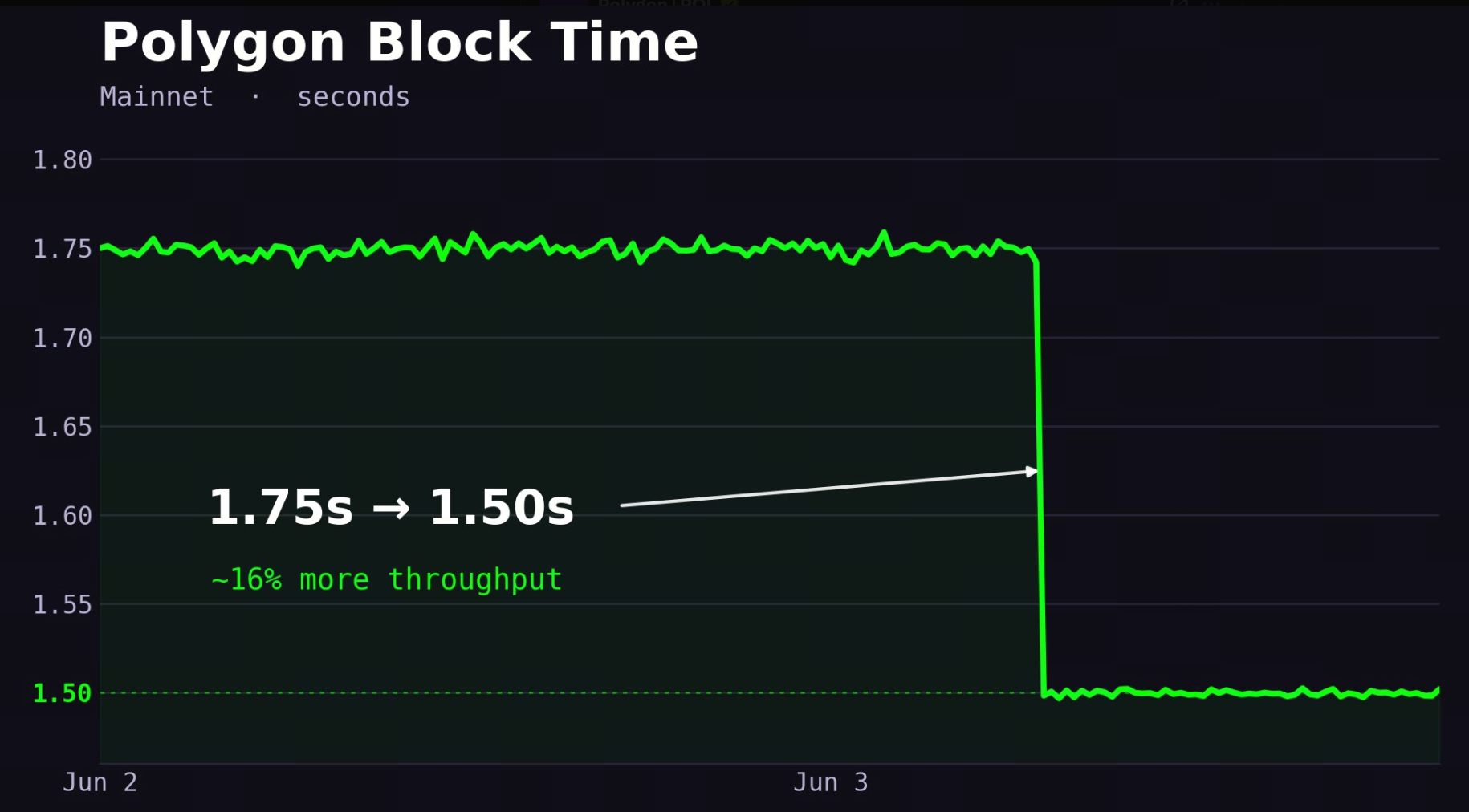
Recently, Polygon once again pushed a mainnet performance upgrade, further reducing the average block time from 1.75 seconds to 1.5 seconds. This marks the second time the network has lowered block generation time since its launch. Although the reduction is only 0.25 seconds, such optimizations in a high-frequency blockchain system often yield significant overall benefits.
Faster block generation means transactions can be packaged and confirmed more quickly, reducing user wait times and improving the network’s overall throughput. According to the Polygon team, this upgrade can increase the number of payment transactions processed per second by approximately 16%, providing tangible benefits for on-chain payments, gaming asset transactions, DeFi applications, and other scenarios requiring real-time responses. As blockchain applications move toward mass adoption, continuously improving performance while maintaining security and stability has become a key battleground among major public chains and Layer 2 networks.
What Are the Advantages of Polygon’s Scaling Model?
Polygon’s success isn’t just about cheap transactions. More importantly, it strikes a balance between performance, developer convenience, and ecosystem compatibility. Users enjoy near-instant transaction speeds and extremely low fees, while developers can continue leveraging Ethereum’s tools and technical architecture. At the same time, thanks to high interoperability with Ethereum, assets and applications can move across chains more easily. This model, which balances user experience with ecosystem integration, is the key reason Polygon has remained a market favorite.
Polygon’s Future Technological Direction
Looking at recent development strategies, Polygon has gradually evolved from a pure PoS network operator into a scaling platform centered on ZK technology. Zero-knowledge proofs are widely regarded as one of the key technologies for the next phase of blockchain. By enabling more efficient data verification, ZK Rollups can significantly increase network throughput while maintaining security. Polygon continues to invest in related research and development, aiming to build a more comprehensive multi-chain scaling architecture. In the future, Polygon’s role may go beyond being just a scaling tool for Ethereum—it could become a critical underlying infrastructure for the entire Web3 ecosystem.
Summary
Polygon’s core value lies in enhancing Ethereum’s scalability, allowing more applications to operate at lower cost and higher efficiency. Through Polygon PoS, EVM-compatible architecture, multi-chain scaling tools, and ZK technology development, Polygon has successfully built a solution that balances performance and ecosystem compatibility. As Web3 applications continue to grow, the demand for high-performance infrastructure will only increase, and Polygon is likely to remain one of the most important scaling platforms in the Ethereum ecosystem.







